
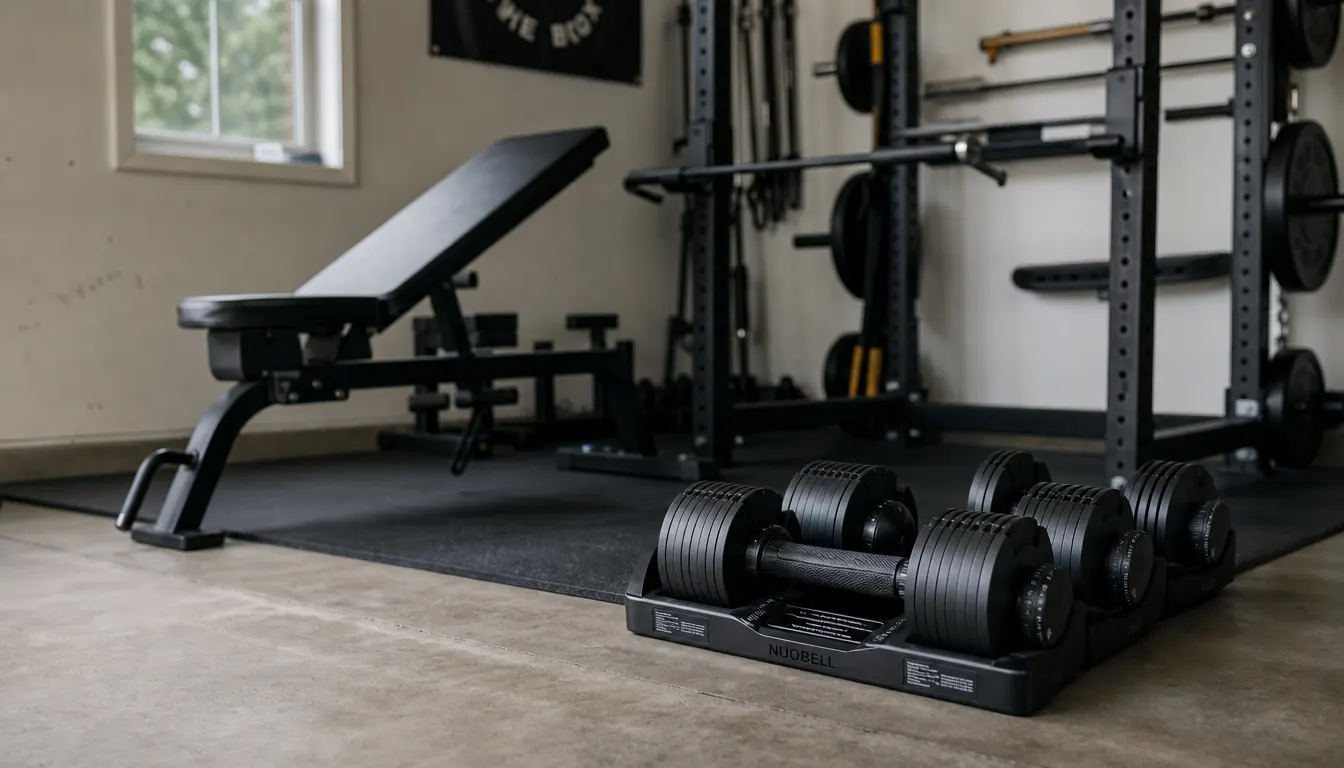
The first thing that goes wrong in a garage gym is not the barbell. It is the dumbbells. For two years I kept a plastic tier stand loaded with eight pairs of hex dumbbells, and every one of those pairs took up permanent floor space I did not have. My bay is 11 feet wide and 20 feet deep, a truck parks in the other half of the garage, and that stand ate a strip of concrete I needed for step-ups and one-arm rows. In November 2024 I sold the hex set on Marketplace and bought one pair of Lifepro adjustable dumbbells, the 5 to 25 lb set, and I have had my hands on them four mornings a week since. This is the honest version, including the parts I do not love.
Here is the short version before the long one. They do not replace a barbell. They replace roughly eight pairs of light dumbbells and the floor space those pairs were hogging. If your accessory work lives under 25 lbs per hand, which most of mine does, that is a real trade and a good one. If you are pressing 60s for reps, this is not the product for you, and I will say so again further down. What follows is what a year of use taught me: how the dial feels when your hands are cold, how loud they are when you set them down, and exactly where the set runs out of road.
The Quick Verdict
Replaces a rack of light dumbbells with two 13.6 inch trays beside your bench. Excellent for shoulders, arms, rows and warm-ups. Hard ceiling at 25 lbs per hand.
Amazon Check Today's Price →Eight pairs of hex dumbbells needed a stand. This needs a tray.
One pair covers 5 to 25 lbs in 2.5 lb steps with the storage rack included. It is what sits beside my bench now instead of a tier stand.
Amazon Check Today's Price on Amazon →How I've Used Them
My week runs four mornings, 5:30 to 6:20, before I leave for service calls. Two of those mornings are rows plus accessory work, and one weekend session runs longer. The Lifepro pair is in my hands for most of the accessory block: curls, lateral raises, one-arm rows off the bench, rear delt work, and the light warm-up sets before I touch the barbell. Call it a hundred and fifty sessions in a year where the dumbbells came off the tray. In that time the dial has not loosened, nothing rattles, and the grip has not frayed.
The garage is not climate controlled. In January it is cold enough that I wear a hoodie for the first two sets and my hands are stiff when I start. That is the real test for an adjustment mechanism, not a showroom floor. The dial turns in gloves but it is easier bare-handed, and the increments are what make the set useful. Going from 15 to 17.5 on a lateral raise is a genuine jump in difficulty. Going from 15 straight to 20 would have been too much, and with fixed hex dumbbells I would have sat at 15 for another month because the next pair up was not worth buying.
Cole is 15 and trains with me some Saturdays. He is at the stage where he should be learning movements with light weight, and the 5 and 7.5 settings are right for that. The pair has done more for his form than any amount of me talking at him, because he can load what he can actually control. He changes the weight himself, which means the mechanism also has to survive a teenager in a hurry. So far it has.
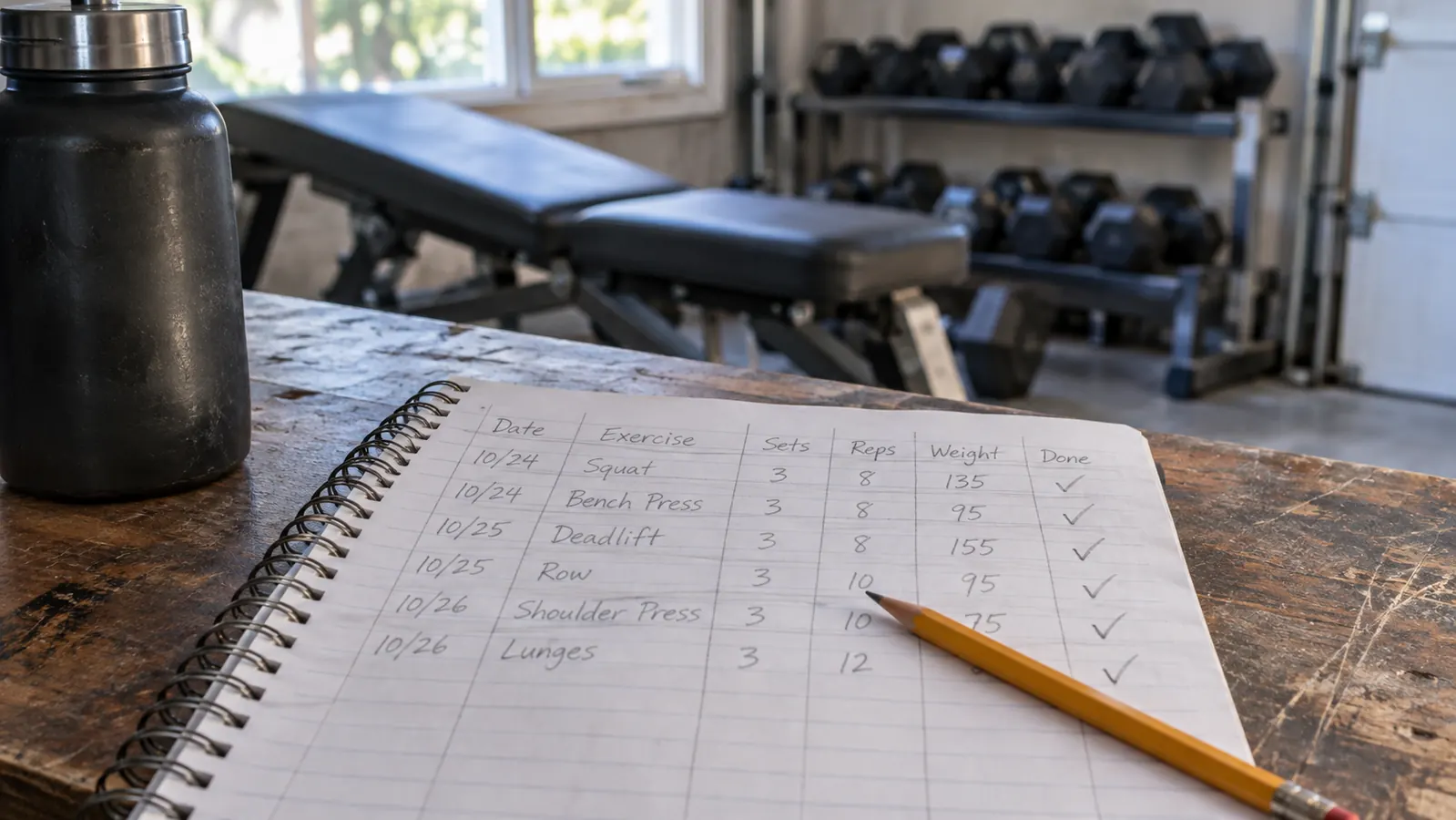
I keep a paper log on the workbench, the same spiral notebook I have used since I started lifting again, and flipping back through it tells the story better than my memory does. November 2024, first week: three sets of lateral raises at 15 lbs, because that was the top of what my shoulders would tolerate after twenty years of nothing. February: 17.5. June: 20. The dial is what allowed that climb. The steps were small enough that I never noticed I was progressing until I read the page back. With fixed hex dumbbells I would have bought one pair at 15 and stayed there, because nobody buys a second pair of dumbbells to move up 2.5 lbs.
The Quick-Adjust Dial After a Year
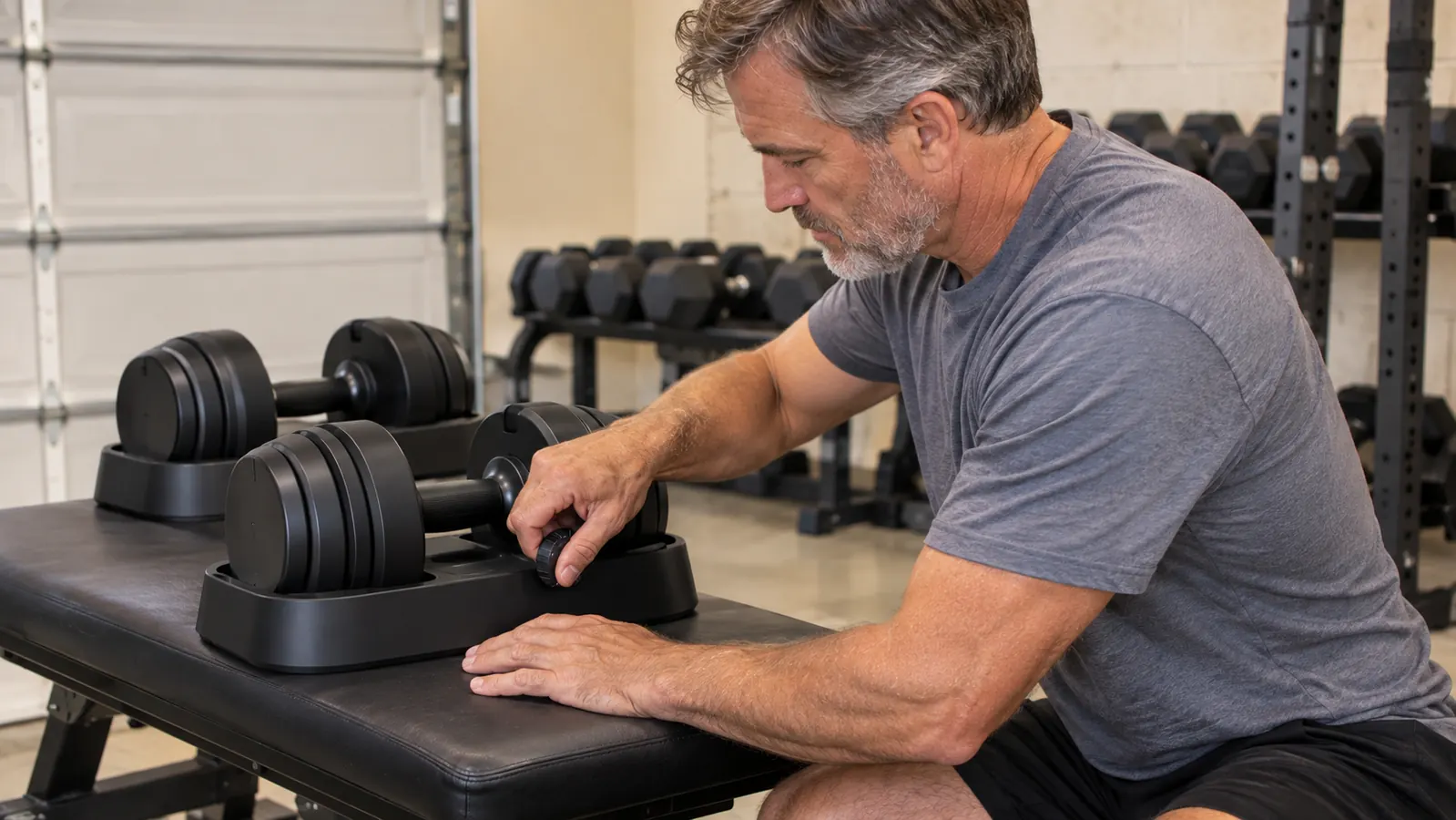
The Lifepro mechanism is a dial at the end of the dumbbell. You seat the dumbbell in its tray, hold the tray down with one hand, turn the dial with the other to the weight you want, then lift. The plates you are not using stay behind in the tray. That is the whole operation, and it takes about three seconds once you have done it a few dozen times.
A year in, the dial still indexes cleanly and the plates lock with no perceptible play. I check for wobble out of habit, the same way I check a torque wrench before I trust it, and I have not found any. The grip is textured and holds fine bare-handed. With chalk it holds better. The one thing I would tell a buyer is that the change has to happen in the tray. You cannot adjust it mid-set with the dumbbell in your hand, and you should not try. That is not a defect, it is how the design works, but it does mean drop sets get broken up unless you plan them.
One thing I checked hard in the first month and still check out of habit: whether the plates that come up are the plates the dial says. A mis-set dial on any adjustable dumbbell means a lopsided lift, and a lopsided lift at 5:30 in the morning is how people get hurt. Mine have never come up wrong. The detents are positive enough that you feel the setting click into place rather than guess at it, and the numbers are readable in a dim garage with one window and a cold bulb. Small thing. It stops being small at the fourth set when you are not fully awake and just want to start the rep.
The other thing worth knowing is the sequence. Going from 20 down to 10 still means passing through the settings. There is no shortcut. In practice I order my sets so I change once or twice per exercise instead of climbing a ladder set by set. That is a small amount of planning and it removes most of the fussing.
How They Fit an 11 by 20 Foot Bay
Each dumbbell measures 13.6 inches long and 6.7 inches wide, and weighs 25 lbs fully loaded. The set ships with a storage rack, and mine sits on the floor beside the bench, right where the hand-off happens for incline work. That footprint is the entire reason I bought them. Two dumbbells plus a tray take up less than a third of what the old plastic tier stand did with eight pairs on it, and the strip of concrete I got back is where I do step-ups for my knee now.
The 13.6 inch length is worth measuring against your own space before you order. These run longer than a fixed hex dumbbell of the same weight because the plates stack along the handle. In a crowded rack that length matters. On the floor beside a bench, it does not. If you are working in a spare bedroom or a narrow basement, put a tape on the floor first and see where the tray lands.
The old setup is worth describing so you can judge the trade. The plastic tier stand held eight pairs, roughly 5 through 40 lbs, and it stood about three feet wide and a foot and a half deep against the wall. That does not sound like much until you subtract it from an 11 foot wide bay where a bench, a rack and a mat already live. Getting rid of it meant I could move the bench back toward the wall and open a clear strip down the middle. The Lifepro trays sit in that strip now, one on each side of the bench, and the floor reads open instead of crowded. In a garage, open floor is the whole game.
Noise, Drops and the Locking Mechanism
I do not drop dumbbells. I set them down. Even so, a loaded dumbbell coming to rest on concrete makes a noise, and the real question is whether it makes a rattle. These do not. The locking mechanism holds the plates tight, so what you hear is the thud of the tray and nothing else. My old hex set had a way of clanking when the plates shifted on the handle, and I got used to hearing it through the kitchen wall at 6 AM. That is gone, which matters more in a house with other people sleeping in it than any spec sheet will tell you.
The routine that keeps them tight is simple. They go back in the tray every time, not on the floor and not leaning against the bench. The tray is what holds them in position for the dial to work, so leaving them out just means a wrestling match on the next set. A year of that habit and there is no rust on the plates, no play at the handle, and nothing that needs tightening.
Where the trays sit matters more than I expected. Mine are on the rubber mats, not the bare concrete, because a tray on concrete rings louder and slides when you press down on it to hold it steady for the dial. On the mat it stays put and the whole operation is quieter. I also leave a couple of inches between the tray and the bench leg so my knuckles clear when I set the dumbbell down after a set of rows. That sounds fussy. It is the kind of thing you figure out in week one and then never think about again, and it is why I would not put these on a bare floor in a bedroom above someone else's ceiling.
Where 25 Pounds Stops and the Barbell Starts
Here is the honest limit. Twenty five pounds per hand is the ceiling. For lateral raises, rear delts, curls and warm-ups, that is plenty and I do not expect to outgrow it. For one-arm rows, 25 lbs gets easy after a few weeks and I have to slow the rep down or add a pause to make it count. For pressing, 25 lbs is a warm-up and nothing more. Heavy pressing stays on the barbell in the rack, and that is fine, because that is what the barbell is for.
If your training is built around dumbbells, this is the wrong set. Someone pressing 60 lb dumbbells for reps will not be served by a 25 lb ceiling, and I would rather say that plainly than sell you the wrong thing and have you find out in March. Match the tool to the job. This one is a light dumbbell replacement, not a dumbbell program.
What I Liked
- Replaces roughly eight pairs of light hex dumbbells with two trays on the floor
- 2.5 lb increments are the right size for shoulder work and warm-up sets
- Dial still indexes cleanly after a year of cold-morning use with stiff hands
- Locking mechanism keeps the plates quiet, which matters in a house with other people asleep
- Textured non-slip grip holds bare-handed or with chalk
- Storage rack included, so the dumbbells have a home instead of a pile
Where It Falls Short
- Ceiling is 25 lbs per hand, so heavy pressing and rows still need the barbell
- You must seat the dumbbell in the tray to change weight, which breaks up drop sets
- 13.6 inch length runs longer than a fixed dumbbell of the same weight
- Going down in weight still means passing through every setting
- One pair cannot be two different weights at once if two people train together
A year in, the dial still clicks to 7.5 with cold hands at 5:30 in the morning. That is the whole test, and it passed.
Who This Is For
These suit a home lifter whose accessory work lives under 25 lbs per hand and who is tired of storing a rack of light dumbbells. That covers most people training in a garage, a spare bedroom or half a basement. If you already own a barbell for the heavy work and you need a pair of light dumbbells for shoulders, arms, warm-ups and knee-friendly movements, this set does the job with a fraction of the floor space and no stand to trip over in the dark. It also suits a household with two lifters at different levels, a parent and a teenager for instance, because the dial goes down to 5 lbs and climbs in small steps. The 2.5 lb increment is the part I would miss most if I went back to fixed weights.
Who Should Skip It
Skip it if your main dumbbell movements are heavy pressing or heavy rows. The 25 lb ceiling will frustrate you inside a month. Skip it if you need to change weight mid-set without putting the dumbbell down, because the design requires the tray. Skip it if you are outfitting a shared space where several people train at once, since one pair cannot be two weights at the same time. And skip it if you already know you want a set that runs well past 25 lbs, because buying this first and a heavier set second is money spent twice. There are adjustable sets that go much higher. If that is your need, start there instead of here.
If your accessory work lives under 25 lbs, this is the pair to look at
5 to 25 lbs in 2.5 lb steps, storage rack included, and a footprint that gives back a strip of your garage floor. Mine have been on the concrete beside the bench for a year.
Amazon Check Today's Price on Amazon →