
The flat bench in my garage had a wobble you could feel through the bar. Not a dramatic wobble. The kind that shows up on the last rep of a set of eight, when your shoulders are already working to stay tight and the bench adds one more thing to manage. I lived with it for four months. Then on a Tuesday morning in April 2024, halfway through a set at 5:40, the whole thing slid an inch to the left. I racked the bar and stood in the cold of that garage deciding what to do about it.
What I did was order the YOLEO Adjustable Weight Bench and sell the old flat bench to a neighbor for what I had in it, which was nothing, because it had been given to me. That was about a year and a half ago. Since then the YOLEO has been sat on, pressed on, stepped on and reset more times than I can count, by me and by my fifteen year old son Cole, and it has not slid an inch on those mats since the day I set it down. The listing carries a 4.6 average across roughly 9,800 ratings, which tells you it has been through a lot of garages besides mine. This is what eighteen months of daily use looks like from the inside.
The Quick Verdict
A stable, quick to reset bench that solved the only real problem I had. The pad is firm rather than plush and the width takes a week to get used to. If your current bench walks on the floor, this is the fix.
Amazon Check Today's Price →A bench that stays exactly where you put it
Eighteen months of 5:40 AM sets and it has not shifted once. If the wobble is the thing keeping you from pressing at home, this ends it.
Amazon Check Today's Price on Amazon →How I've Used It
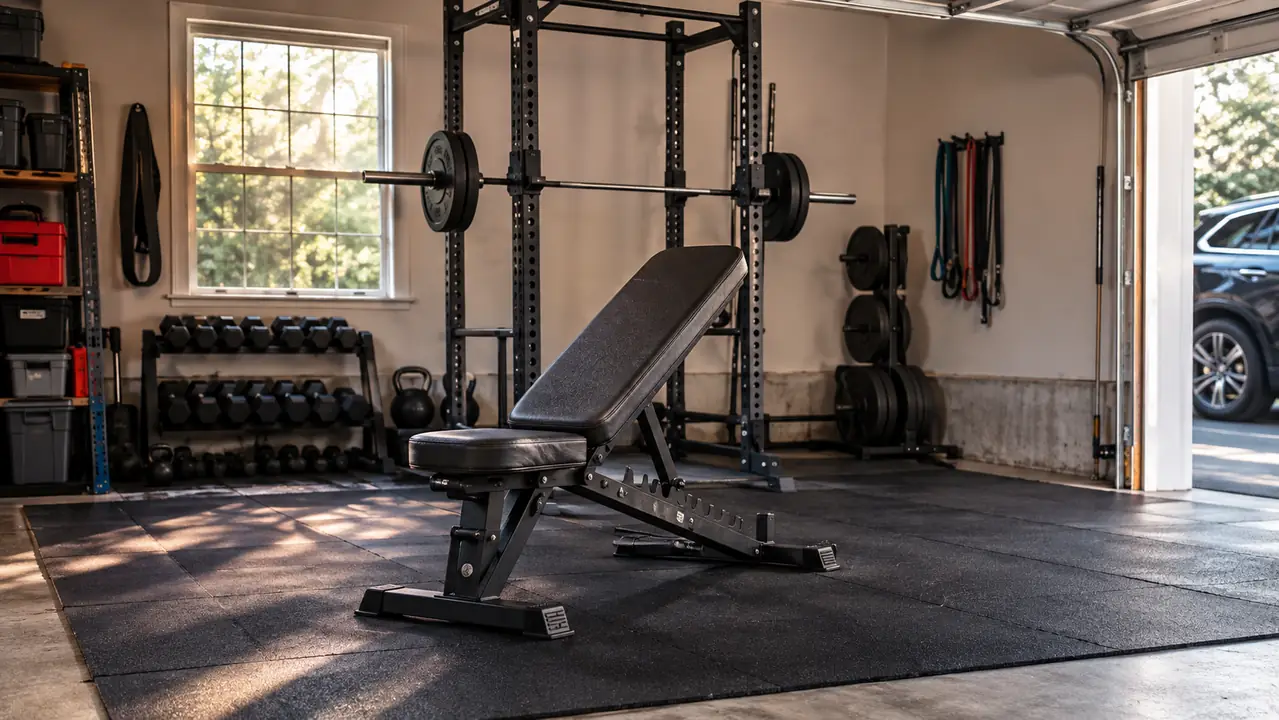
The bench lives at the far edge of the 8 by 10 mat area, about three feet in front of the power rack, with the adjustable dumbbells on their trays beside it. Four mornings a week, 5:30 to about 6:20 before I head out on service calls, I pull it into the rack for barbell bench press. That is the whole reason I bought it and I will not pretend otherwise. The rest of the week it earns its space on incline dumbbell press, one arm rows with a dumbbell braced on the pad, and step-ups.
The step-ups are not a bench exercise, but they are the reason the bench stayed. I crawl through attics for a living and my left knee started filing complaints around the time I turned 43. Stepping up onto the pad with a dumbbell in each hand, controlled down, no bounce, has done more for that knee than anything else I have tried. A flat bench works for this too. An adjustable one works better because I can set the back pad up a stop or two and keep my torso more upright on the bad days. Before I landed on step-ups I tried sitting on the bench and doing leg extensions with a dumbbell hooked over my foot. That lasted two weeks and did nothing for the knee, and it also worried me, because a dumbbell slipping off a foot mid rep in an empty garage at five in the morning is a bad way to start a workday. Stepping up with the weight in both hands put the load where the knee could take it, and I could stop a set the moment anything felt wrong.
Cole uses it for incline dumbbell work and for rows, and he is not careful with equipment the way a 46 year old who paid for it is careful. He drops onto the pad instead of lowering himself. He drags it instead of lifting it. Nothing has come loose. I checked the frame bolts in month three, out of habit more than worry, and again at the year mark, and I have not had to tighten anything on it.
What 84 Positions Actually Means at 5:40 in the Morning
The number YOLEO puts on the listing is 84, and it comes from 7 back adjustments times 4 seat adjustments times 3 leg adjustments. I want to be straight with you about that, because 84 sounds like a marketing figure and in a sense it is. You are not going to use 84 configurations. You are going to use three, maybe four.
What actually matters is that seven stops on the back pad means the gap between flat and the steepest incline is small. On a flat bench your choice is flat or nothing, so every incline press happens at whatever angle a stack of folded towels gives you. With seven stops I can find a setting a few degrees off flat that my shoulders tolerate, and a second setting around 30 degrees that I use for dumbbell press. The four seat positions matter more than I expected, because the seat angle and the back angle together decide whether your lower back is supported at the bottom of a press. I use two of the four. The other two exist and I am sure somebody needs them.
The three leg adjustments are for decline work, which I do not do, so I cannot tell you much about them beyond the fact that they are there and they hold. The honest limitation is this: changing the back angle means getting off the bench and resetting it by hand. There is no way to do it from a seated position. It takes a couple of seconds and at 5:40 in the morning with a bar in the rack that is nothing. But if you run circuits where you flip between flat and incline with a dumbbell in each hand, you will be putting the dumbbells down first every time.
Build Quality After Eighteen Months
Here is the real test of any bench. Does it still feel like one piece of equipment after a year and a half, or does it feel like a collection of parts that happen to be near each other? Mine feels like one piece. The frame is alloy steel per the listing and the whole bench weighs 23.2 pounds, which is light enough that I pick it up one handed and move it out of the way when I need the bay clear. Light is usually a warning sign on gym gear. Here it is not, because the weight that matters is the load on the pads, not the mass of the frame.
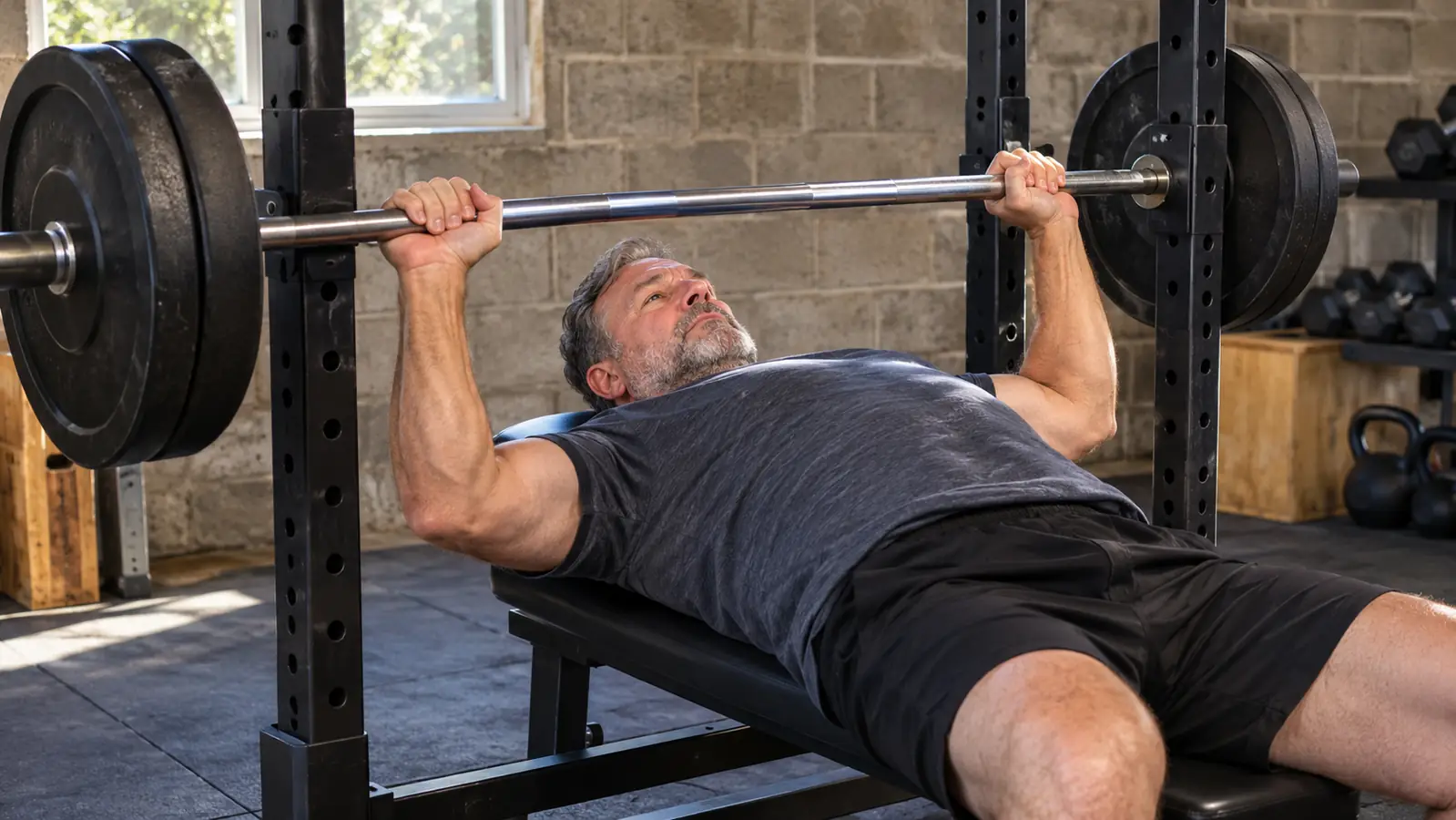
The listing gives an ASTM certified capacity of 827 pounds and a maximum user weight of 330 pounds. Those two numbers do different jobs and it is worth knowing which is which. The 330 figure is the one that applies to a person sitting on it. I am about 205, and I have had 245 on the bar over my chest on this bench with no creak, no flex I could feel through my back, and no sense that anything was about to give. Cole is 15 and 150 pounds soaking wet, so he is nowhere near either number.
The pad is firm. That is a complaint and a compliment at the same time. After a long incline session I can feel the pad through my shoulder blades, and a plush bench would feel better in that moment. But a soft pad on a bench is worse than a firm one, because you sink into it and lose the position you spent the set building. Firm is the right call for pressing. It is the wrong call if you want to lie on it and watch television, which is not what a bench is for. In February I wiped the pad down with a damp rag to get the winter grit off it, and the surface came back with no scuff and no soft spot. The stitching along the edges has not opened anywhere. Eighteen months of Cole dragging it across the mats and kicking the leg post with his shoe has not torn it either.
Fit and Footprint in an 11 by 20 Foot Bay
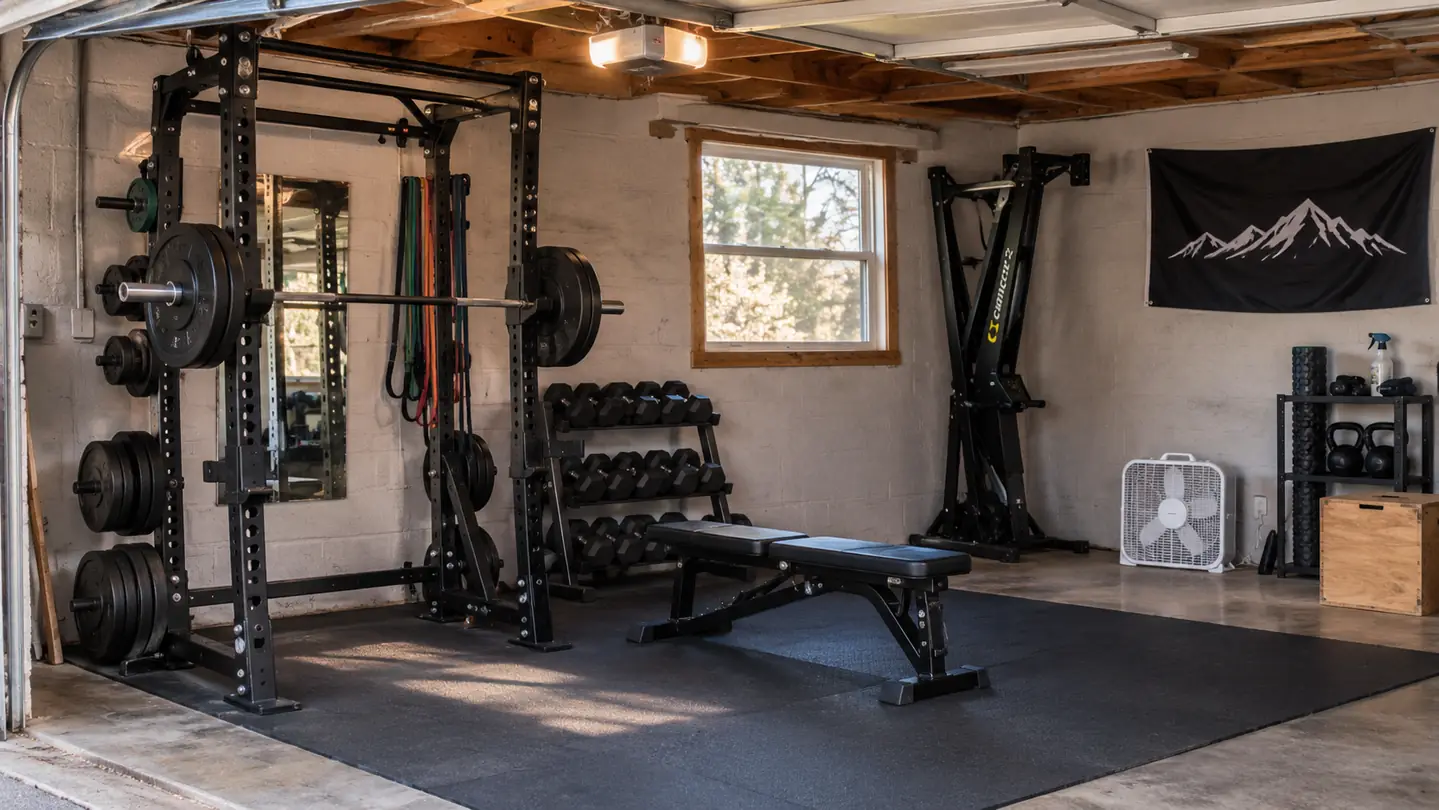
The listing gives the bench as 41 inches deep by 12.6 inches wide by 42.5 inches tall. In a bay that is roughly 11 by 20 feet and already holds a power rack, a rowing machine, a barbell, 230 pounds of plates and a mat area, that matters. This bench does not dominate the room. It tucks. When the truck needs the left bay clear I pick it up and lean it against the wall, and it takes up about as much room as a broom. I measured the walkway before I ordered anything. From the front edge of the mats to the shelf where the fan sits is a shade over six feet, and with the bench pushed into the rack there is still room to load a plate on both sides without turning sideways. That sounds like a small thing until you have loaded a bar in a tight bay with your back against a wall.
The 12.6 inch figure in the width column reads like the pad width rather than the base, and that is how it feels in use. The pad is narrow. Nothing about it feels narrow when you are actually under a bar, because your shoulders are set and you are not going anywhere. But if you are a broad lifter who likes to spread out on a bench, you will notice it for the first week and then you will stop noticing it. I noticed for about a week.
It also does not walk. That was the failure of the old bench. You would set your feet, press, come back down and be a half inch out of position, and over a set of eight that adds up to pressing crooked. On the rubber mats this one stays put, session after session. The only sound it makes is the pad taking your weight when you sit down. In a house with a teacher who is asleep at 5:40 and a teenager who should be, that quiet is worth something.
Two Pins and No Tools: The Assembly Claim
YOLEO says the bench ships 98 percent assembled, ready in about five seconds once you open the box and insert two pins, with no tools. I read that and figured it was listing copy. Every product says something like it. Then the box showed up on the porch and I cut the tape and slid the thing out and it was, in fact, already a bench. Two pins went in. That was the whole job. Five seconds is a stretch if you count finding a knife and breaking down the cardboard, but the assembly itself took less time than the box did. I timed it the first week because I did not believe the number on the listing, and from flat on the floor to the angle I press at, with both pins seated, ran to just under a minute, most of it me walking around to check it from the other side. There is no screw to set, no bolt to snug, nothing that could be wrong in a way you would not notice until a bar was over your face.
I mention this because I assembled the power rack alone in one Saturday afternoon, about two and a half hours of sorting bolts and holding uprights with my knee. If every piece of home gym equipment arrived like this bench, more people would finish the job and fewer garages would be full of half built racks. Nothing needed a wrench. Nothing needed a second person. Nothing was missing from the hardware bag, because there was no hardware bag.
What I Liked
- It does not slide or walk on rubber mats, which was the entire reason for the purchase
- Seven back positions means a real setting between flat and steep, not a token in between stop
- Arrived 98 percent assembled, two pins, no tools, no hardware bag
- ASTM certified 827 pound capacity with a 330 pound maximum user weight
- 23.2 pounds, so one person can move it out of the way
- Seven back, four seat and three leg adjustments hold their position and do not slip mid set
Where It Falls Short
- The pad is firm and you feel it through the shoulder blades on long incline sessions
- Resetting the back angle means getting off the bench and doing it by hand
- The three leg positions are for decline work, which plenty of home lifters never use
- The pad is narrow, and broad lifters will notice it before they stop noticing it
- Light frame weight means you have to be deliberate about setting it down, not dropping it
The wobble was the whole problem. Everything else about this bench is ordinary, and ordinary is exactly what I want from a piece of steel I put my neck over four mornings a week.
Who This Is For
You train alone in a garage, a basement or a spare bedroom and you want one bench that covers flat, incline and the occasional decline without eating floor space you do not have. You are under 330 pounds. You already own a bar and plates or a set of adjustable dumbbells. You are tired of a flat bench that shifts under you on the last rep, and you are not interested in paying for a bench with features you will never touch. That is me exactly, and this bench has done the job for eighteen months without a single morning where I thought about it instead of the set.
Who Should Skip It
Two groups. If you are at or near the 330 pound maximum user weight, buy something rated higher and do not push a number on a listing. And if you want a bench you can reset without getting up, this is not that bench, because every angle change is a hands on job. I would also send you elsewhere if you need a soft, forgiving pad for high rep work, or if you are a broad lifter who needs the full width of a competition style bench. Those are real needs and this is not built for them. For everyone else standing in a cold garage at 5:40 wondering why their bench keeps moving, this is the one.
Eighteen months in, I would buy it again tomorrow
It solved the only problem I had, and it has not developed a second one. Same bench I have been pressing on since April 2024, and the ratings back up the experience.
Amazon Check Today's Price on Amazon →