
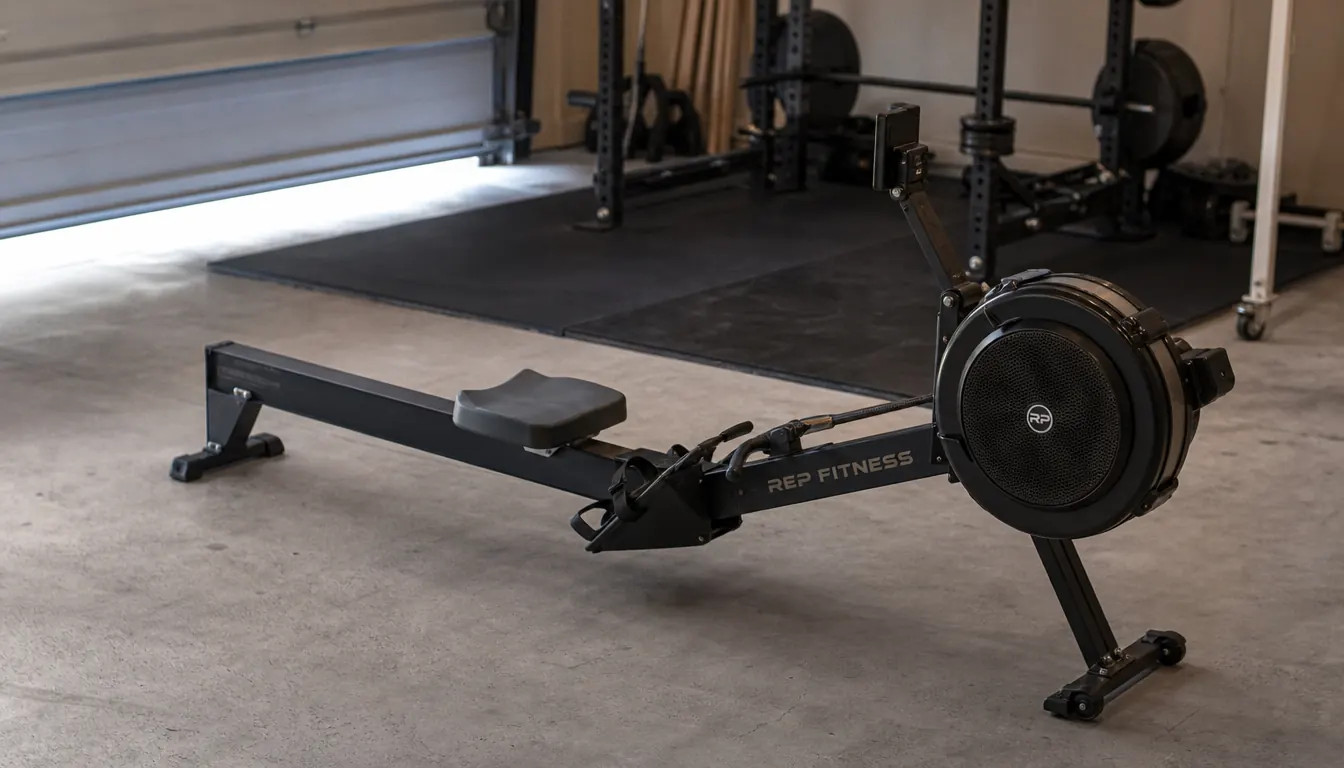
My left knee has been angry since about 2019, back when I spent a whole summer crawling through attics in Knoxville running flex duct. Running was the first thing to go. By the fall of 2025 I wanted something that could get my heart rate up without all the pavement pounding, and a rowing machine was the obvious answer. The problem was space. My gym is the left bay of a two-car garage, roughly 11 by 20 feet, and it already held a power rack, a bench, a pair of adjustable dumbbells and two rubber mats laid side by side. There was not a lot of floor left for a new toy.
I bought the Merach Q1S Magnetic Rowing Machine in September 2025. It measures 65 inches deep, 19.3 inches wide and 24.8 inches tall, and it weighs 42 pounds. Fourteen months later it is still in the bay, still getting used two weekday mornings and one weekend morning, and I have a fair picture of what it does well and where it irritates me. Here is that picture, roughly in the order I noticed things.
The Quick Verdict
A quiet magnetic rower that fits a single garage bay, assembles in half an hour and holds up to regular use. The monitor is plain and the app is an extra rather than a reason to buy.
Amazon Check Today's Price →Measure your bay first, then check the footprint on the listing
The Q1S is 65 inches long and 19.3 inches wide. If that clears your wall and your truck door, the rest of this is straightforward.
Amazon Check Today's Price on Amazon →How I've Used It
My schedule runs 7 to 5 with on-call weekends, so training happens at 5:30 in the morning before I leave the house. Four mornings a week I lift. Two of those mornings I row, plus one session on the weekend when Cole is at the ballfield or still asleep. Twenty minutes at a time, steady, no intervals. That is the whole routine. I am not training for a race and I am not chasing a split.
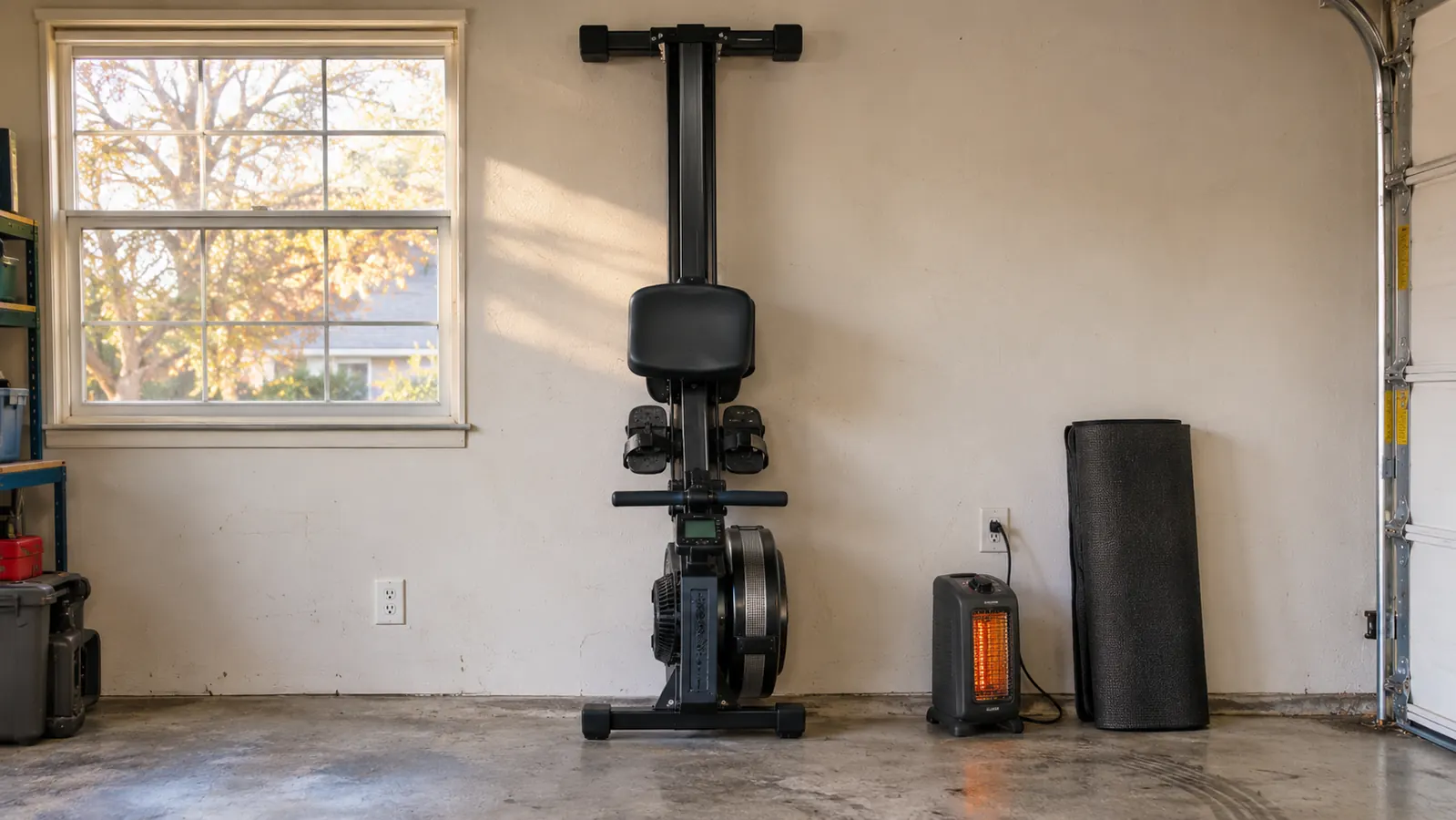
What I wanted from it was simple: twenty minutes of hard breathing that my knee would tolerate, on a machine I could stand up against the wall when the truck needed the bay. The Merach does both of those things. It sits on the bare concrete next to the rubber mats, and when I am done I tip it up on end against the wall. My bench and rack do not move. That last part matters more than any spec sheet, because a machine you have to rearrange the garage for is a machine you stop using by February.
The first two weeks were humbling. Rowing looks like arms and it is not. My lower back was more tired than my legs, which told me I was pulling with the wrong half of my body. Once I slowed the drive down and let my legs do the work, twenty minutes stopped wrecking me. If you have never rowed, budget a couple of weeks of looking foolish before it clicks.
I also learned to keep the session boring on purpose. Twenty minutes at a pace I can hold, three mornings a week, is a habit I can keep with a job and a teenager. The mornings I tried to make it a workout were the mornings I skipped the next day. That is not the machine's fault, but it is worth saying out loud, because a lot of cardio gear gets bought with a plan the buyer will never actually follow.
Assembly: One Person, About Half an Hour
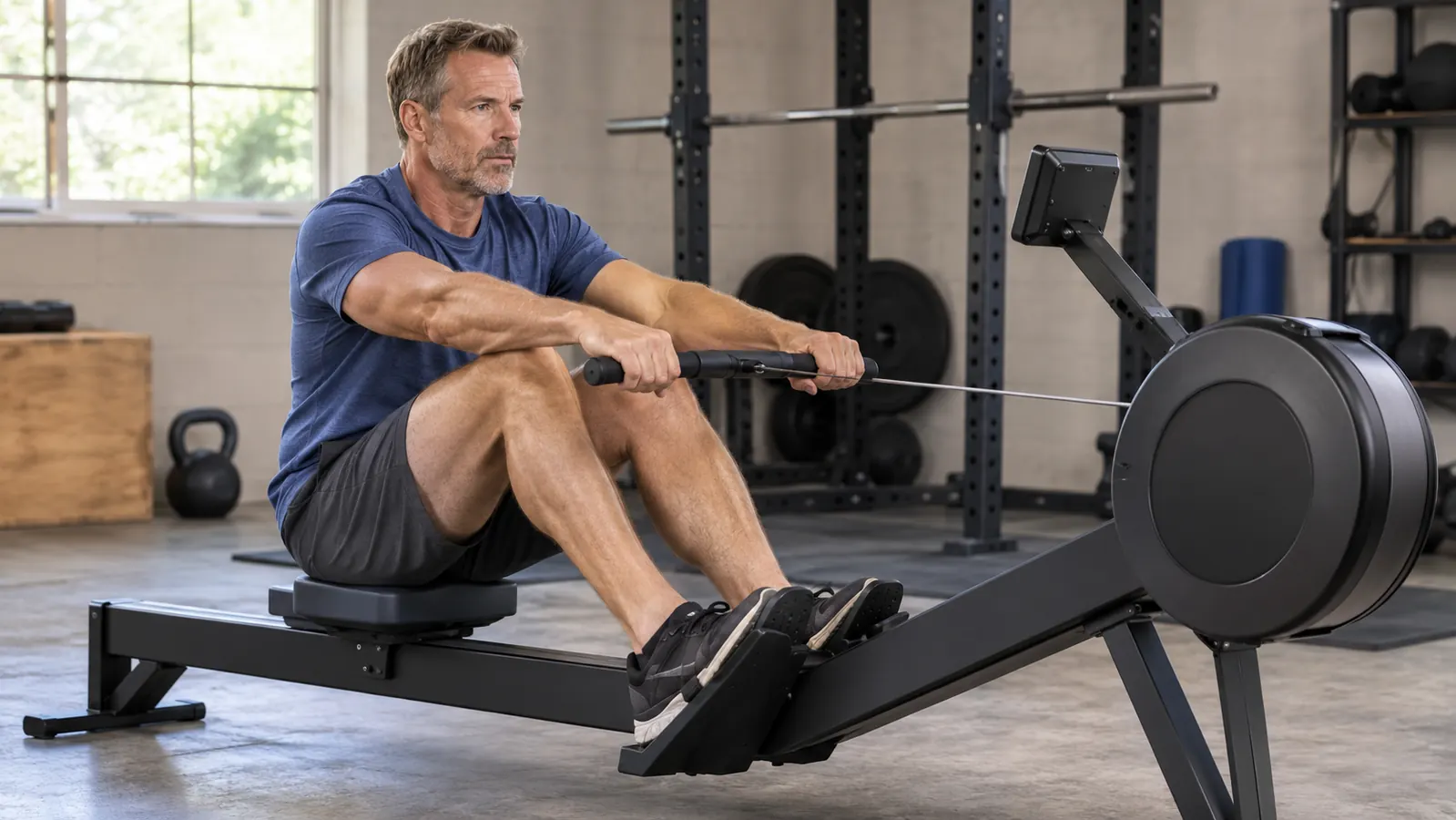
The listing says most people can assemble it in under 30 minutes, and that matched my experience. I opened the box on a Saturday morning, laid the parts out on the mats and worked through it alone. The included parts kit and the manual were enough. No trips to the hardware store, no stripped bolts, no swearing loud enough for the neighbors to hear.
The one thing I would tell you: have your tools and your floor space sorted before you start. Once the rail is together it is 65 inches of machine, and sliding it around a crowded bay on your own is annoying. I assembled mine exactly where it lives and never had to move it afterward.
The Footprint Question: 65 Inches in an 11 by 20 Foot Bay
A rower is a long machine, and the number people underestimate is depth. 65 inches is a little over five feet, and it has to sit somewhere it can stay without you stepping over it. In my bay it runs parallel to the garage door track with about two feet of clearance behind it for the drive and the recovery. That works. If I had tried to park it across the bay at an angle, I would have been climbing over it every morning at 5:30, and I would have resented it.
Height matters too. The machine tops out at 24.8 inches, well below the seat of my bench, so it does not block my one window or crowd the rack. And at 42 pounds I can move it with one hand, which is the thing I underestimated before I bought it. It is light enough that standing it against the wall is a ten second job rather than a chore I talk myself out of.
If your space is a spare bedroom instead of a garage, the math changes in your favor. Carpet, a doorway, a wall you can lean it on. The footprint is the same 65 inches, but you will not be fighting a truck for the same real estate. The thing to check either way is the two feet behind it. That is the number that gets forgotten.
What the Magnetic Resistance Actually Feels Like
The resistance is magnetic and adjustable, and the feel is smooth and quiet rather than heavy. There is no water splashing and no fan roaring at you. When you pull, you get resistance, and you get it back on the return without the flywheel grabbing. For steady twenty minute rows, that is exactly what I want.
What it is not is a machine that will punish you. If you are a former college athlete looking for something that leaves you flat on the concrete, this is not it. The load is adjustable and there is enough there to make twenty minutes honest, but the Merach is built for conditioning, not for all-out intervals. I have a barbell for the heavy days. This is the machine I use on the days my knee decides what I am allowed to do.
The 350 pound maximum weight is worth mentioning because it is generous for a machine this light. That is a real number on the listing, not a guess, and it means a bigger lifter can use it without wondering whether the rail is going to complain. Cole is fifteen and still growing and he uses it at a completely different setting than I do, which is the sort of thing a household machine has to survive.
Noise: The Reason It Stays in the Garage
I train at 5:30 in the morning with a teenager asleep upstairs and a wife who teaches middle school and needs her sleep. Noise was not a side note for me. It was the deciding factor. The magnetic rower is quiet. The loudest thing about my session is my own breathing and the box fan in the summer.
For comparison, the dropped plates on my rubber mats are louder than the rower. By a lot. If noise is the reason your home gym has become a source of household tension, this is the kind of machine that fixes the problem instead of adding to it.
The loudest thing about a 5:30 AM row is my own breathing. Dropped plates on the mats are louder than the machine, and that is not close.
The Monitor, the Metrics, and the App
The display is an LCD and it tracks five things: time, distance, speed, calories burned and stroke count. That is the list. It is battery powered, so there is no cord running across the garage floor to trip over at 5:30 in the dark, which in a bay with one outlet is a real convenience rather than a bullet point.
Fourteen months in, the display has been reliable. No dead segments, no resetting itself mid-row, no fuss. I read it, I note the stroke count, I get on with my morning.
The app is there, with courses and programmed workouts, and it syncs your session data. I use it maybe one row in four, mostly on weekends when I have time to follow something instead of just pulling. The rest of the time I watch the clock and get on with my day. The app is a nice extra. It is not the reason to buy the machine, and if it vanished tomorrow I would still row the same twenty minutes.
How It Has Held Up After 14 Months
Fourteen months of two to three sessions a week, in an unheated garage that hits the nineties in August and drops into the thirties in January. Nothing has loosened. The rail is still true, the seat still rolls without developing a flat spot, and the resistance still changes when I move the setting. The warranty is 12 months from the date of purchase, and I have now passed that mark without needing it, which is the only review of a warranty that means anything.
The honest wear item is dust. A garage is a dirty place and the rail picks up grit. I wipe it down with a rag every couple of weeks and it takes two minutes. If you never clean it, I would expect the seat to start feeling grainy. That is true of every rower in every garage, so it is not a knock on this one, just a thing to know before you decide you have a problem.
The other thing I have noticed is that nothing rattles. Cheap gear announces itself on the return stroke after a few months. This has stayed tight, and I have not had to tighten anything beyond the initial assembly.
What I'd Change
Two things. First, the monitor is plain. Five metrics on a basic LCD is enough for how I use it, but if you are the sort of person who wants a big screen and a virtual course running in front of you, you will find this thin. Second, the app carries more of the guided workout load than I expected. The machine itself gives you resistance and a number. The programming lives on your phone.
Neither of those is a deal breaker at this level. They are the difference between a very good conditioning machine and a machine that tries to be a coach. I bought it to sweat for twenty minutes and not wake the house, and it does that.
What I Liked
- Fits a tight bay at 65 inches deep and 19.3 wide, and tips up against the wall in seconds
- Quiet enough for a 5:30 AM row with the house asleep upstairs
- Assembles in about 30 minutes, one person, no extra hardware
- Battery powered LCD keeps cords off the garage floor
- 350 pound weight limit is generous for a machine this light
Where It Falls Short
- The monitor is plain: five metrics on an LCD and not much else
- Not the machine for maximum-effort intervals
- Guided workouts live in the app, which I use less than I expected
- Garage grit collects on the rail and needs a wipe down
Who This Is For
This is for the person with a garage bay, a spare bedroom or a basement corner who wants conditioning that does not wreck their knees or their household's sleep. Adults 35 to 60. Working people, parents, folks who let a gym membership lapse because the twenty minute drive never fit the day. If you want a machine that fits a defined footprint, assembles without a fight, stays quiet and holds up to a few sessions a week, the Merach Q1S is a sensible buy.
It also suits anyone training around a cranky joint. I am not a physical therapist and I am not going to tell you what your knee needs. What I can tell you is that twenty minutes on this machine does not leave my left knee worse than it found me, which is more than pavement ever did.
Who Should Skip It
Skip it if you are chasing a hard interval session and want a machine that fights back. Magnetic rowers at this size are smooth, and smooth is not the same as brutal. Skip it if you want a big console with a screen you can watch, because this is a small LCD and a phone app, not a built-in television. And skip it if your bay is tighter than about seven feet in one direction, because 65 inches plus the room to drive and recover is the real footprint, and no amount of tipping it against a wall fixes a bay with no wall space to spare.
If the footprint fits, the rest of this is settled
65 inches long. 19.3 inches wide. 42 pounds. Assembled in half an hour. Current price and the full spec sheet are on the listing.
Amazon See the Q1S on Amazon →