
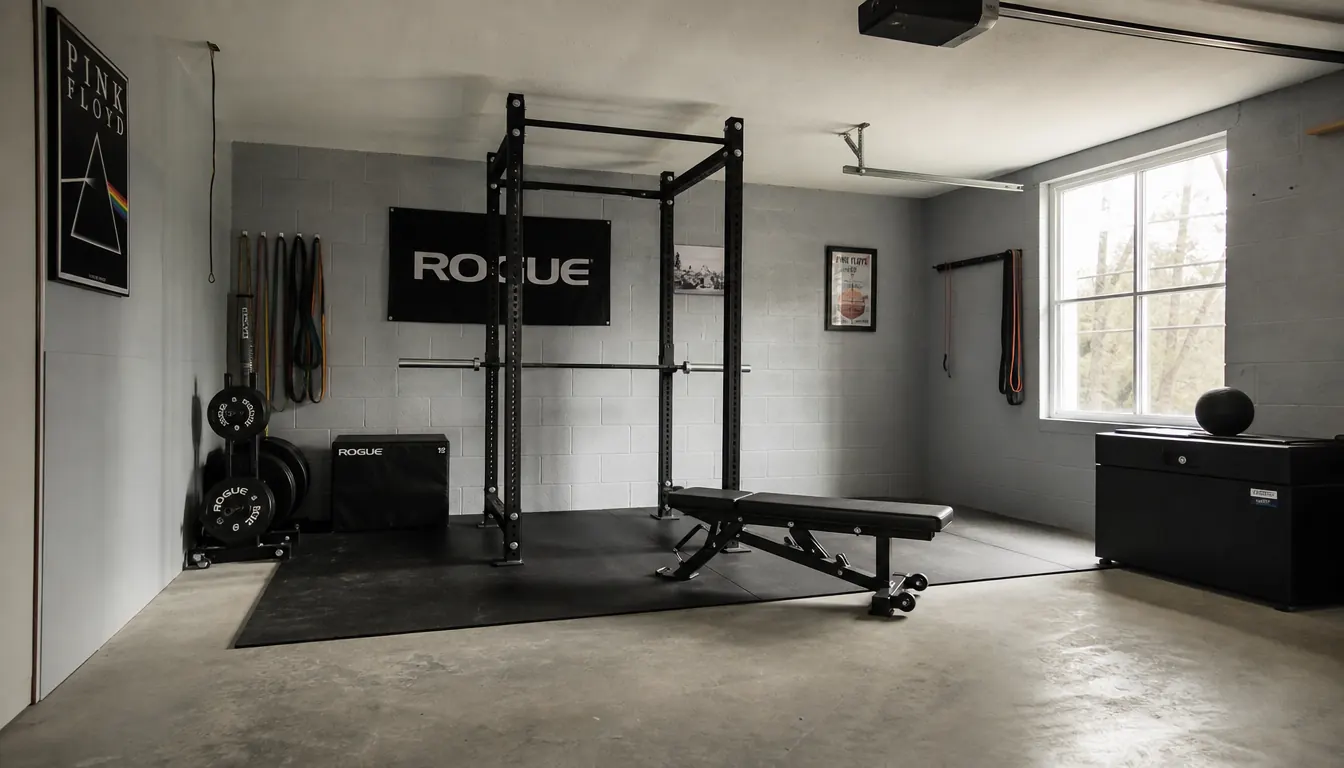
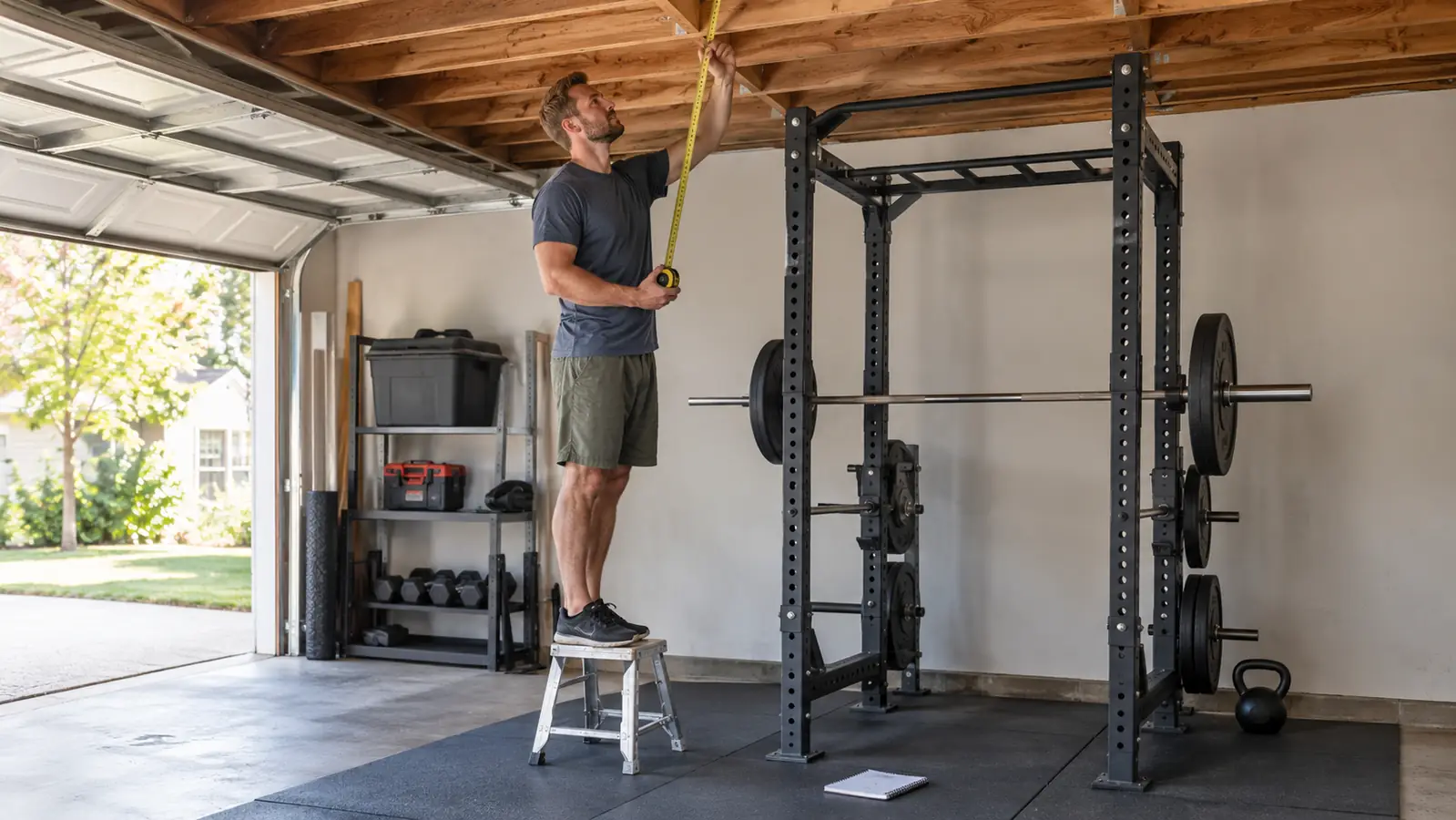
Eight-foot ceilings talk a lot of people out of a power rack. I understand the worry. You picture a squat rack punching through the drywall, or a pull-up bar you have to fold yourself under like a suitcase. Before I bought anything I measured my garage bay three times with a tape and once with a laser, because a rack that does not clear the joists becomes a very heavy clothes hanger. My bay is 11 feet wide, 20 feet deep and 8 feet to the ceiling. The CAP Power Rack Stand with Pull-Up Bar has been standing in it since October 2023, and it fits with more room than I expected.
Not all of that is solved by buying a short rack. Some of it comes down to how you use the space, what you bolt down and what you leave alone. Below are ten reasons this particular rack works under a low ceiling, with the honest limits kept in rather than edited out. If you want the long version of how the frame, the welds and the finish have held up, that write-up covers two full years of it.
The rack that clears 8 feet with 11 inches to spare
Assembled height is 85 inches. My ceiling is 96. That gap is the difference between a pull-up bar you duck under and one you can actually train on. Covered by a 30 day manufacturer warranty.
Amazon Check Today's Price on Amazon →Eighty-five inches tall, which leaves 11 inches over the bar
The assembled height of the CAP rack is 85 inches. My ceiling is 96. I did that subtraction before I ordered, and it is the single reason this rack is in my garage instead of a return box. There is enough air above the pull-up bar to keep my head forward on strict reps rather than folding up to miss the joists. If your ceiling is 7 feet 6 inches, do the math first and skip this rack entirely.
A 46 by 50 footprint that fits a bench inside the uprights
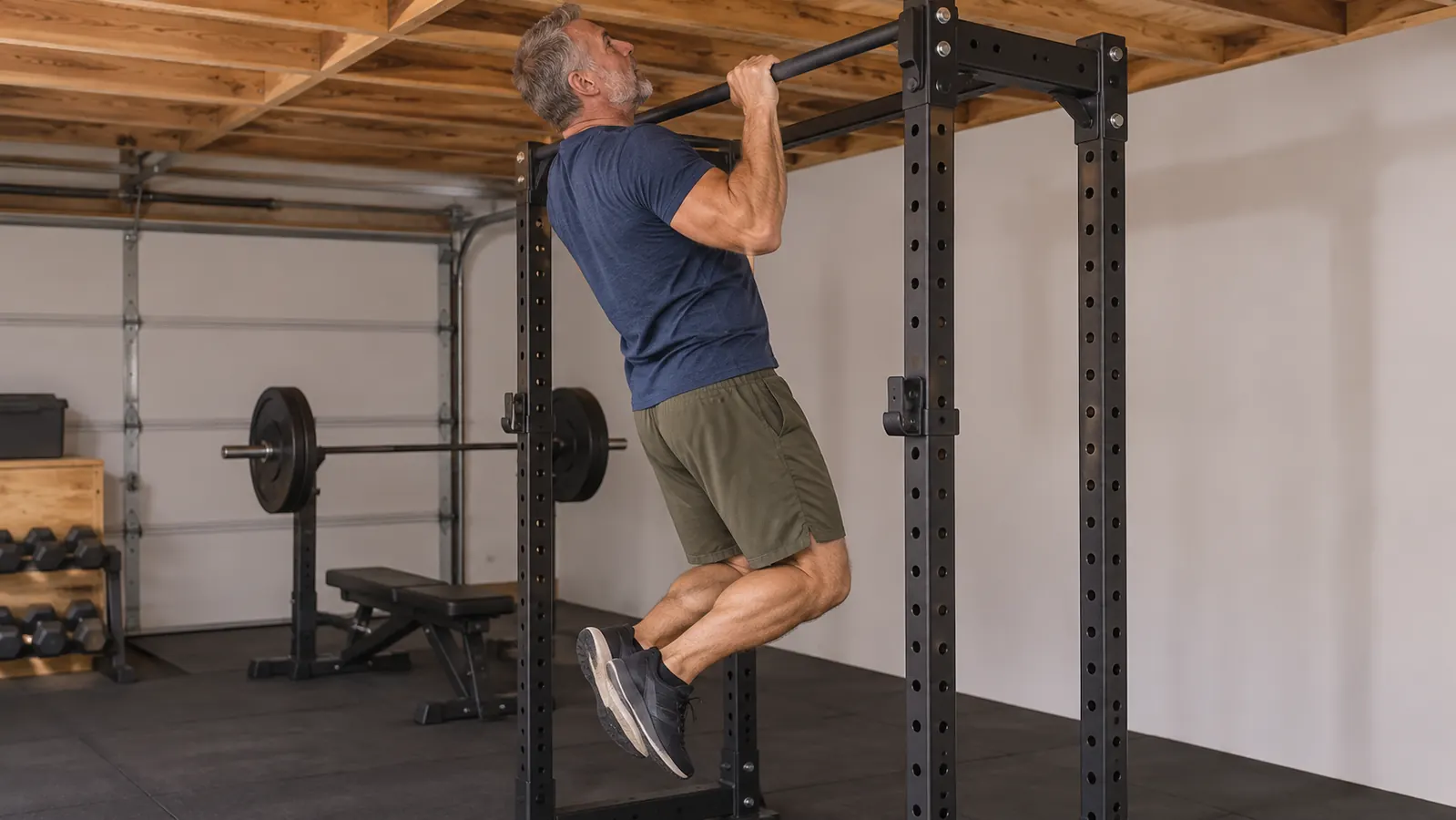
Width is 46 inches, depth is 50. My bay is 11 feet across, so the rack sits against the wall with a walkway wide enough to carry a plate in each hand. The depth is the part that earns its keep: my adjustable bench fits inside the uprights for bench press, which means one frame does the job of a rack and a bench press station. In a one-bay garage, that matters more than any feature on the box.
It goes up in one afternoon with one person
I assembled mine alone in about two and a half hours on a Saturday. The CAP box arrives at 47 by 12 by 5.5 inches and it is heavy enough that you should plan to drag it, not carry it down a driveway. Two wrenches, a ratchet and a cleared floor are the whole tool list. Lay the bolts out in muffin tins in the order the instructions call for them, because they are not sorted by step. Nothing about the build is fiddly. It is just slow.
Nothing gets bolted to the concrete
Mine sits on rubber mats and touches nothing else. No anchors, no holes in the slab, no conversation with a landlord. A rack that is not anchored can walk across the floor when you rack a heavy squat, but with plates on the storage pegs the thing is stable enough that I have not chased it once in two years. If your floor is sloped for drainage, shim the low post and check it with a level before your first working set.
The pull-up bar is part of the frame, so you lose no floor
A separate pull-up tower eats another 3 or 4 square feet and gives you one more thing to trip over at 5:30 in the morning. Here the bar is built into the top of the rack, which is why height becomes the first number you check and the last thing you stop thinking about. It takes a standard overhand grip. I do strict reps with no kipping, and the frame does not rock or shift under me.
Built-in weight storage keeps the plates off the slab
The rack has weight storage built into it. My plates live on the pegs instead of a leaning stack against the wall, and that changed three things: the plates are at waist height when I load, they add ballast down low, and I stopped tripping over the pile in the dark. Before this, the bottom plate was always the one I needed. Load both sides evenly and the rack stays planted.
Eleven and twelve-gauge steel is why I stopped shopping
The tubing on this rack is 11 and 12-gauge steel, and CAP says it meets and exceeds ASTM testing standards. I am not a metallurgist and I cannot verify a standard from my garage, but I can tell you the square tube does not flex when I dump a reracked squat into it, and two years of that has not loosened a single bolt. I owned a cheap bench that wobbled from the day I built it. This is not that.
You will press overhead outside it, and that is fine
A standing overhead press puts the bar higher than the top of the rack. My joists are at 8 feet and the plates finish within a few inches of them, so I press in front of the rack, on the mats, with a wide stance and my eyes up. What the rack does is squats, bench inside the uprights and pull-ups. Knowing which lift goes where before you buy is the difference between a useful rack and a frustrating one.
The clang stays in the garage, mostly
Steel on steel is loud. Racking a squat is a sound that goes through a wall and lands in the kitchen, which is why I put rubber down over the whole lifting area before the rack ever arrived. The rack itself does not rattle or buzz, which is more than I can say for the hand-me-down bench it replaced. If your setup sits above a bedroom, buy the flooring first and the rack second. The order matters more than the brand.
One bay still holds the truck, the rower and the bench
Eleven by 20 feet holds the rack, an adjustable bench, a pair of adjustable dumbbells on their trays and a rowing machine that folds against the wall. The truck still parks in the right bay. That is the real test of equipment in a working garage: not how it looks on day one, but whether you can still park a vehicle in February. Two years in, everything has a home and I still have a garage.
What I'd Skip
If your ceiling is under 7 feet 6 inches, skip this rack. At 85 inches tall there is no room left for a head above the bar, and a pull-up bar you cannot use is just a cap on the frame. Skip it too if you want to press overhead inside the uprights or hang rings from a 9-foot ceiling. And skip the impulse to buy the rack before the flooring. I laid rubber first in October 2023 and bought this a week later, and every clang since has confirmed the order was right.
Assembled height is 85 inches. My ceiling is 96. That 11 inches is the whole reason this rack is in my garage.
Measure your ceiling tonight, then decide
Height, width, depth. Three numbers on a scrap of paper and you will know inside a minute whether this rack fits your garage the way it fits mine. Mine has carried two years of four mornings a week without a wobble.
Amazon Check Today's Price on Amazon →