
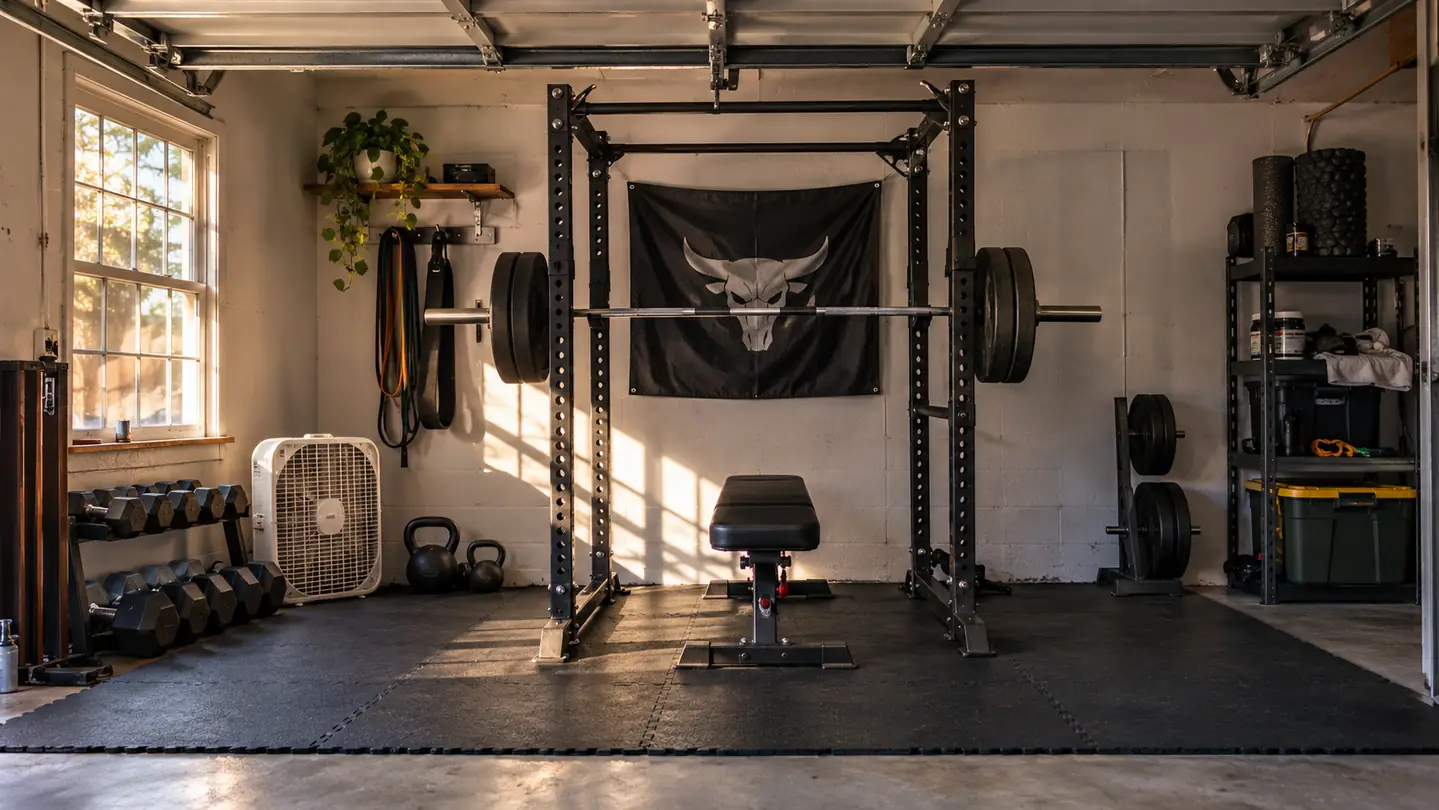
The CAP Power Rack was the second thing I bought for the garage gym, a week after the rubber mats went down in October 2023. I already had a used 7-foot Olympic bar and about 230 pounds of iron plates off Facebook Marketplace, and no safe place to put any of it overhead. Squatting out of a pair of sawhorses is fine right up until it isn't. I wanted uprights I could set a bar on, a pull-up bar I could reach at 5:30 in the morning without dragging a step stool out, and nothing bolted into a concrete slab I might have to undo someday. The CAP rack has stood in the left bay of my two-car garage ever since, on the mats, unbolted, holding a bar four mornings a week.
This is not a first-week impression. I have owned it about two years, which is long enough for the shine to come off and long enough to know exactly which parts annoy me. I lift from 5:30 to 6:20 before I leave for service calls, and my left knee is cranky from too many years crawling through attics, so my warm-up takes longer than it used to. Everything below comes from that routine, in that one garage bay. Nothing was sent to me. Nobody paid for this.
The Quick Verdict
A light, simple, unbolted rack that clears an 8-foot ceiling and handles squats, presses and strict pull-ups without drama. It is a stand, not a heavy cage, and I would not pretend otherwise.
Amazon Check Today's Price →85 inches tall, which is the number that decides everything
If your ceiling is 8 feet and your floor is a slab you would rather not drill, this is the rack that fits both. Current price and stock are on the listing.
Amazon Check Today's Price on Amazon →How I've Used It
The whole thing arrived in one long box I dragged to the garage door by myself. The listing puts the assembled weight at 59.51 pounds, and the package weight at 28.12 kg, which felt about right for what I hauled in. I assembled it alone on a Saturday afternoon in roughly two and a half hours with a socket set and a combination wrench. No helper, no trip to the hardware store, one walk back inside for a second size of socket.
The first morning on it I had the bar set too high, unracked it, and found I could not get under it without going up on my toes. Fixing that means stripping the bar, moving the rests and loading it again, which is twenty minutes I do not have at 5:30. Now I mark the height with a strip of tape on both uprights and check it before a plate goes on. Small habit, but it is the difference between starting the first set at 5:40 and giving up and making coffee.
It does three jobs. Squats happen in it, because that is the entire reason to own a rack. Presses come off the uprights at a height I marked with tape, and then I carry the bar out front to finish. Pull-ups happen on the built-in bar across the top, which has turned out to be the most-used thing in the garage besides the barbell itself, mostly because it takes thirty seconds and no setup.
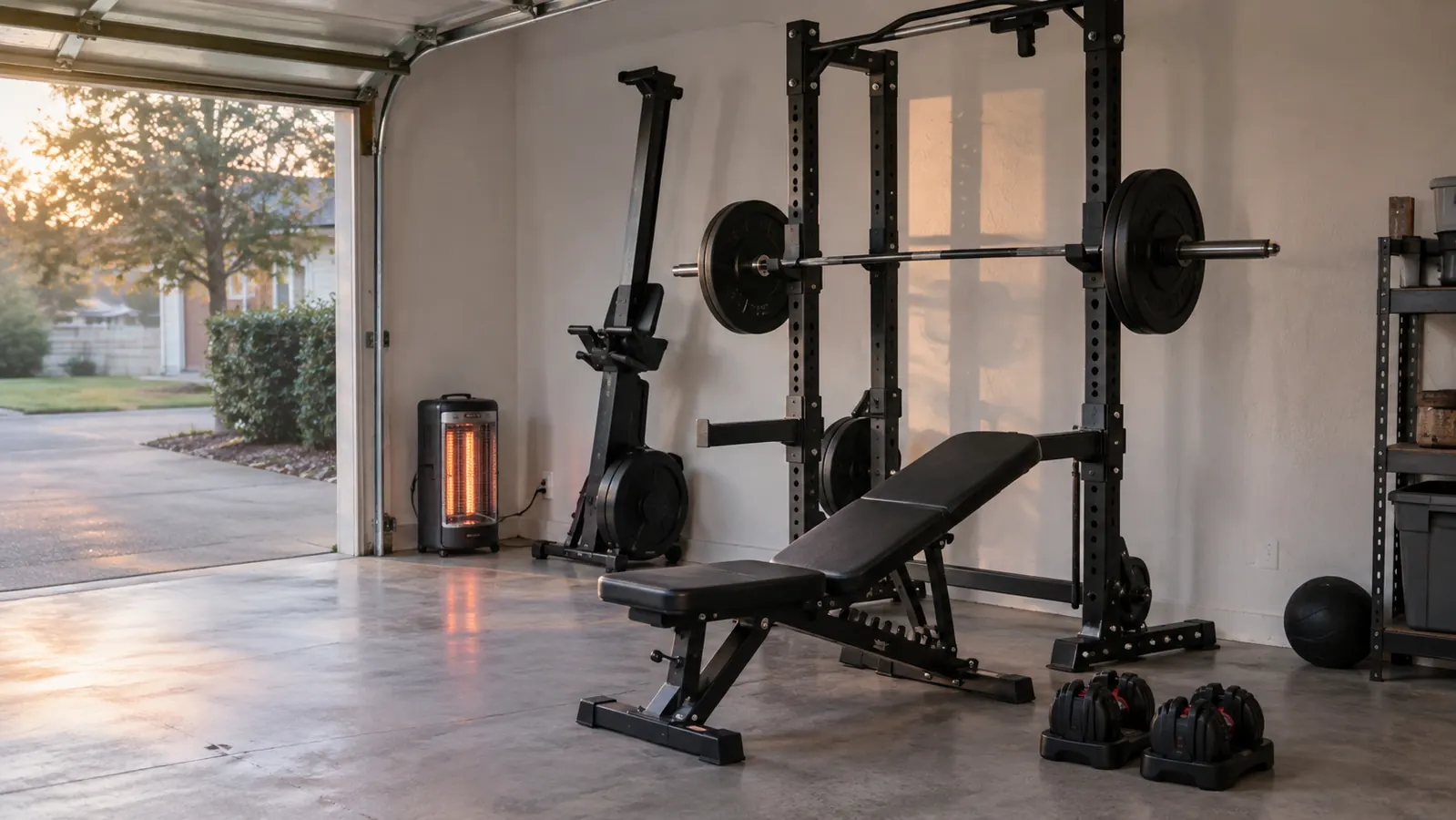
My week is four mornings: a squat day, a press and pull-up day, and two mornings that start with rows and finish with dumbbell work. The rack is involved in about half of that. The rest is a bench, a pair of adjustable dumbbells, or the rower on the bare concrete beside the mats. I am 46, I played football in high school, I did nothing for twenty years, and I started again at 43. Nobody would mistake me for a competitor.

What 11 and 12 Gauge Steel Actually Means in a Garage
The frame is 11 and 12-gauge steel tubing, and the listing says it meets ASTM testing standards. In daily use, that translates to uprights that do not bow when I set a loaded bar down on them, and welds that have not cracked or rusted in a garage that swings from humid Tennessee summer to a space heater in January. It is not the heaviest steel you can buy. A commercial cage weighs several times what this does, and you feel that difference the moment you bump into one. But there is a real gap between "not commercial" and "flimsy," and this rack sits on the good side of that line for one man in one bay.
Assembled, it measures 46 inches wide, 50 inches deep and 85 inches high. That footprint is why it works here. My bay is roughly 11 by 20 feet, the truck still parks in the right side, and everything I own has to live inside a tight rectangle. Forty-six inches wide leaves me room to walk around the side of the rack with a plate in each hand, which matters more than it sounds like it should when you are setting up alone at dawn.
Before I ordered anything I measured that bay three times with a tape, because I had already been burned once. My first idea was a pair of sawhorses with the bar across them, and it lasted two sessions. They walked apart on the concrete every time I set the bar down, and one morning the bar rolled off the far side with 185 pounds on it and I stood there watching it bounce. That is the whole argument for a fixed width. The CAP frame is 46 inches across and it does not move.
The listing carries a recommended maximum load. I have never come close to it. My plates total around 230 pounds and most of that is on the storage pegs, not on the bar. If you are a powerlifter moving serious weight, buy a cage built for that job. If you are a working adult trying to squat twice a week without hurting yourself, this is more rack than you will ever use.
The weight storage is the part I underrated. Two pegs at hip height take the plates I am not using, which keeps the floor around the rack clear and means I am not bending down to bare concrete with a bad knee between sets. My spare iron lives there permanently now. The built-in bar across the top and the storage are part of the frame rather than bolt-on extras, and after two years neither has loosened or sagged.
Two Years In: What Held Up
The honest answer is almost everything. The CAP uprights are still straight. The hardware is still tight, and I have re-torqued bolts twice in two years, once after the first month when everything settled, and once last spring because I was already underneath with a wrench for something else. The pull-up bar has not loosened. The weight storage holds my spare plates at hip height so I am not stepping over iron in the dark.
What shows wear is cosmetic. The paint scuffs where the bar sits and where plates slide onto the storage pegs. There is dust in every crevice because it is a garage and garages are dusty. None of it changes how the rack works, and I would take scuffed paint over a frame that flexes any morning of the week.
The closest thing to a problem came last February, during a cold snap when the garage sat around 40 degrees in the morning. I heard a rattle on the left upright when I racked a squat, put a wrench on the base bolts, and got maybe a quarter turn out of two of them. That is normal for bolted steel that gets cycled four mornings a week. I tightened them, the rattle went away, and it has not come back.
The one thing I would flag is the warranty. It is a 30-day manufacturer warranty, which is short for something you plan to keep for a decade. Mine has needed nothing, so it has cost me nothing, but go in knowing what you are buying. If a weld fails in month four, that conversation is yours to have.
Eleven inches between the top of the pull-up bar and the ceiling is the whole reason this rack works in my garage. It is also why every rep I do on that bar is strict.
Living With It: Space, Noise and an 8-Foot Ceiling
At 85 inches tall, the rack clears my 8-foot ceiling with about 11 inches to spare. That single number decides whether a rack is usable in a normal garage. If the bar sat closer to the ceiling, I would be doing pull-ups with my knees bent and my head pushed forward, which is a quick way to wreck a shoulder. Instead I can hang with my head neutral and pull straight up.
Noise was the reason I bought mats before I bought anything else. Dropped plates on bare concrete carried into the kitchen and made my wife flinch at 5:45 in the morning. The rack itself adds very little. It is the iron that makes noise, not the frame. Setting a loaded bar back onto the uprights gives a solid steel clank, and that part is unavoidable.
There is one more noise to plan for. When the bar lands on the rack instead of being guided onto it, the frame rings for a second, and in a garage with a hard floor that carries into the house. I set the bar down the way I would set down a plate, deliberately, and nobody has complained. The box fan in July is louder than the rack is.
The footprint is the other daily consideration. 46 by 50 inches is small enough to leave standing all the time, which means I use it instead of dreading setup. The bench sits in front of it. The dumbbells live on their trays beside the bench. The rower folds against the wall when the truck needs the bay. None of that arrangement survives if the rack is three feet wider.
I have moved it exactly once, to sweep out two years of grit from underneath, and it slid six feet across the mats with the plates off. You cannot do that with a cage bolted into concrete, and it is the main reason I would buy this style again. It shifts an inch or two if I rerack a heavy squat carelessly, and I have decided I can live with that.
Rack vs Squat Stands: Why I Went This Way
I considered a pair of independent squat stands first, because they cost less and take up almost no floor. What stopped me was the walkout. Stands require you to carry the bar backward out of the hooks and find your stance with nothing around you, and at 5:30 in the morning with a cranky knee, that is the moment a lifter gets sloppy. A rack lets you set your feet first and squat between the uprights.
The second reason was pull-ups. Stands do not give you a bar overhead, and the pull-up bar is where a lot of my upper body work happens now. Buying a separate pull-up bar and mounting it would have cost extra and put more holes in the wall. The third reason is simpler. I am alone in this garage every morning. Having the uprights on both sides of me feels different when nobody is spotting.
What I Liked
- 85 inches tall, which fits an 8-foot ceiling with room to work
- 46 by 50 inch footprint suits a single garage bay or spare room
- Sits unbolted on mats, so it can be moved for sweeping or a house move
- Assembled alone in about two and a half hours with basic hand tools
- Pull-up bar and weight storage are part of the frame, not add-ons
- Just under 60 pounds assembled, so one person can shift it
Where It Falls Short
- It is a stand, not a full cage, and it moves slightly on a hard rerack
- 30-day manufacturer warranty is short for equipment you keep for years
- Paint scuffs at the contact points where the bar and plates sit
Who This Is For
This rack suits someone with an ordinary garage, an ordinary ceiling and an ordinary amount of patience for assembly. It is for the lifter who wants to squat and press safely, do pull-ups without driving to a gym, and still park a vehicle indoors. It is for people like me, who started again in their forties after twenty years off, and it is for a teenager learning to squat with a parent in the room. My son Cole uses it most weekends, and I like that he is inside a rack rather than under a bar he hauled off the floor himself.
It also suits anyone renting, or anyone who does not want holes in a slab. Nothing about this purchase requires a drill, which is more than most racks can say.
Who Should Skip It
Skip it if you are moving real weight or training for a meet. The steel is 11 and 12-gauge, not the heavy tube a commercial gym uses, and a strong lifter will notice. Skip it if your ceiling will not clear an 85-inch rack with a bar in your hands. Skip it if you want a rack with a lat tower, cable attachments and a dozen accessories, because this is not that product and no amount of wishful thinking makes it one. Skip it if a 30-day warranty is a dealbreaker for you.
None of that means it is a bad rack. It means it is a specific rack, and the fit question comes down to ceiling height, floor space and how much weight you intend to move. Get those three right and it does its job quietly for years.
Measure your ceiling before you measure anything else
85 inches tall, 46 by 50 on the floor, unbolted on rubber mats, four mornings a week for two years. If those numbers fit your space, today's price is on the listing.
Amazon Check Today's Price on Amazon →