
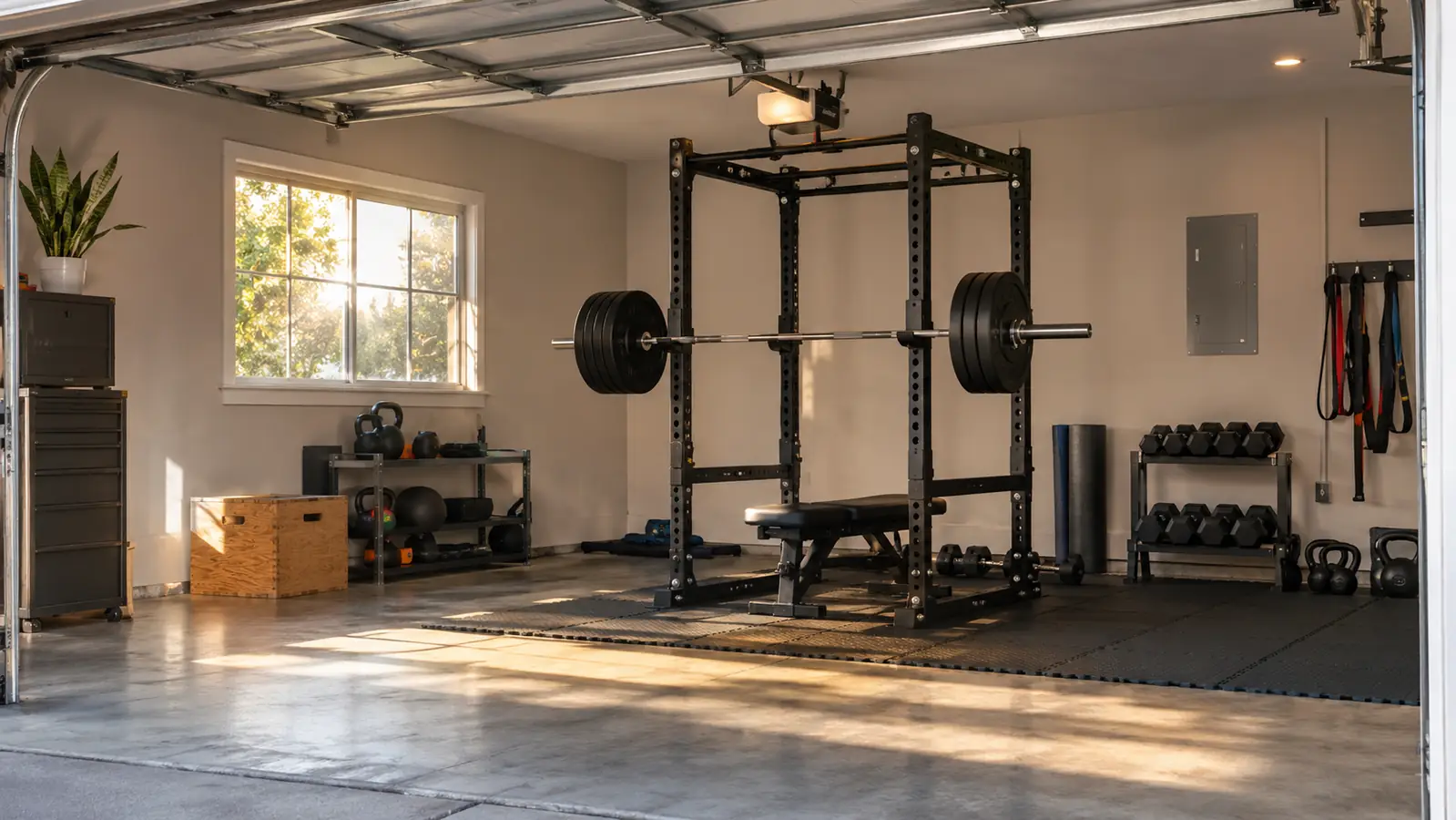
The first question anybody asks when they see the rack in my garage is whether a pair of squat stands would have done the same job for less money and half the floor. It is a fair question. I have run the CAP Power Rack Stand with Pull-Up Bar since October 2023, four mornings a week, and I have helped two neighbors set up squat stands in garages smaller than mine. This is not a guess dressed up as an opinion.
Short answer: in a bay like mine, roughly 11 by 20 feet with an 8 foot ceiling, the rack earns its footprint because it does three jobs at once. Squat stands do one job, and they do it well. If you only squat, or you rent, or the space has to go back to being a parking spot every night, buy the stands and put the difference into a better bar.
My setup, so you can weigh it against yours. Bare concrete, two 4 by 10 foot rubber rolls side by side for an 8 by 10 lifting area, the rack sitting on the mats, a bench inside it, dumbbells on the floor beside the bench, and a rower on the bare concrete next to the mats. The truck parks in the right bay. Everything in the left bay has to fit around a vehicle that has to leave at 6:30 in the morning.
| CAP Power Rack | Squat Stands | |
|---|---|---|
| Floor space | One 46 by 50 inch rectangle that stays put | Two small footprints you can pick up and lean on a wall |
| Steel | 11 and 12 gauge steel, about 59.5 lb assembled | Varies wildly by brand, check the gauge before you order |
| Stability under a heavy squat | One rigid frame, nothing to shift mid-rep | Two independent posts, each with its own base |
| Pull-ups | Pull-up bar built into the top of the frame | Nothing overhead to hang from |
| Bar and plate storage | Built-in bar storage and weight storage | Plates and spare bar live on the floor |
| Benching | Bench sits inside the frame, bar racks where the bench is | No frame to bench inside |
| Overhead press clearance | 85 inches tall, pull-up bar crosses the top, so I press in front of the frame | Short enough to leave the whole bar path clear |
| Moving or stashing it | One piece, heavy, it stays where you put it | Carry each post out of the way in one hand |
| Assembly | About two and a half hours alone on a Saturday | Two posts, two bases, done before the coffee goes cold |
| Buy-in | More steel and more parts, so more to spend up front | Less material, less to spend |
| Best for | A dedicated lifting corner with 8 feet of ceiling | Renters, shared bays, squat and press only |
Two of those rows are the whole argument. The rack wins on what it lets you do without buying a second piece of equipment. The stands win on floor, money and the freedom to make the bay a garage again. Everything else is detail you can work around.
Where the CAP Power Rack Wins
Stability is the first thing, and it is not a small thing. The rack is one rigid frame, 46 inches wide, 50 inches deep and 85 inches tall, built from 11 and 12 gauge steel and weighing around 59.5 lb assembled. When I walk a heavy squat back in, there is one object in front of me and it does not move. With independent stands, each post has its own base and its own idea of where it wants to be. On a decent set of stands that is a mild annoyance. On a light set it is a wobble you feel at the bottom of a rep, and you start loading lighter to avoid it. That is how a piece of equipment quietly caps your progress.
A neighbor two doors down bought a light pair of stands in the spring of 2024 for the corner of a one-car garage. First session he set them 44 inches apart, squatted, and both posts had crept an inch by his last set. He tightened every bolt, tried again, and they crept again. He now keeps a piece of chalk in the tray and marks two spots on the concrete so he can reset the stands before every session. That is not a dealbreaker, but it is a chore you repeat forever, and chores are what make a person skip a Tuesday.
Second is the pull-up bar across the top. It is the single reason I own this instead of a pair of stands. I do strict pull-ups with my head kept forward and my feet well clear of the mat, and I have never once wondered whether the bar would hold. Third is storage. The frame has built-in bar storage and weight storage, so the bar I am not using and the plates I am not loading have somewhere to sit that is not the floor. In 11 feet of width that matters more than it sounds. Stands give you nothing to hang anything on, so everything ends up in a pile you step over for two years.
Fourth is the bench. Mine sits inside the frame for bench press, and I can rack the bar without dragging the bench around the garage or waiting on a spotter I do not have at 5:30 in the morning. With stands you are either benching outside them with someone standing over you, or you are not benching. That alone was worth the extra floor to me.
Where Squat Stands Win
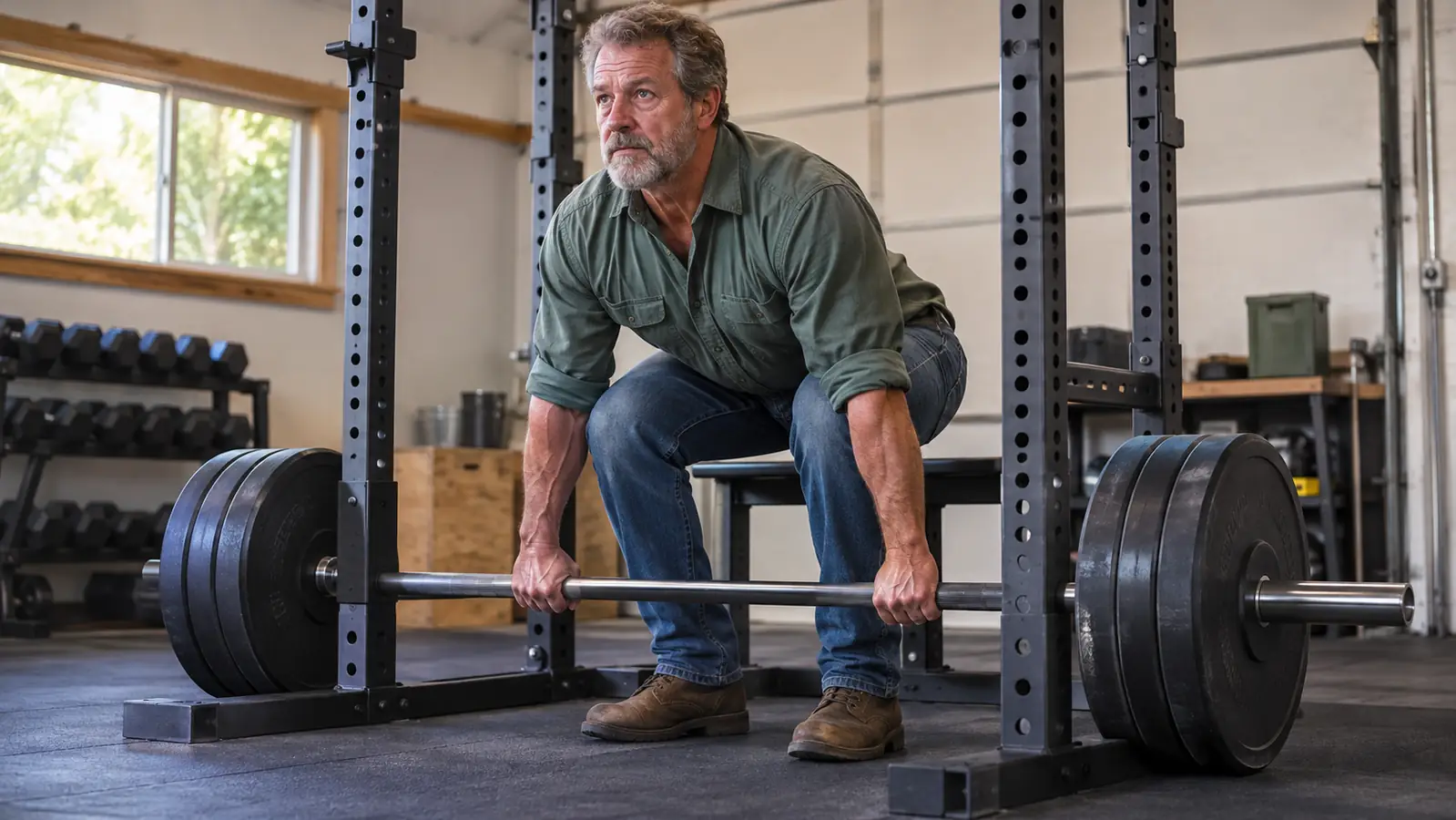
Floor is the obvious one, and it is not a small thing. The CAP rack takes a 46 by 50 inch rectangle and it stays there, every day, whether you are training or not. Squat stands are two small squares you can carry to the wall when the bay needs to be a garage again. If you rent, if you park inside, or if you share the space with a table saw, that flexibility is worth more than any feature I listed above. I would not talk a renter out of stands.
Overhead press is the second. The pull-up bar crosses the top of my frame at 85 inches and my lockout with a loaded bar is above that, so I unrack, take one step forward and press in front of the rack instead of inside it. I measured it once with a tape to stop arguing with myself about it. Standing at the bar with arms locked, my hands finish around 92 inches off the mat against a frame top of 85. There is no version of pressing inside this rack for me, with a 7 foot bar or a short one. So I press in front, which means I think about where the plates land if I fail a rep. Stands remove that arithmetic completely and cost you nothing in the process.
Assembly is the third. The rack took me about two and a half hours alone on a Saturday and arrived in a box 47 by 12 by 5.5 inches, around 28 kg, that I carried in myself. Stands are two posts and two bases. You will be lifting before I had the first upright standing.
One frame that squats, benches and hangs a pull-up bar in the same 46 inches of floor
If your ceiling clears it and your corner is yours to keep, the CAP Power Rack covers three jobs without a second purchase. Check the height against your joists before you order, then read the current price and the review count for yourself.
Amazon Check Today's Price on Amazon →Living With It in an 11 by 20 Foot Bay
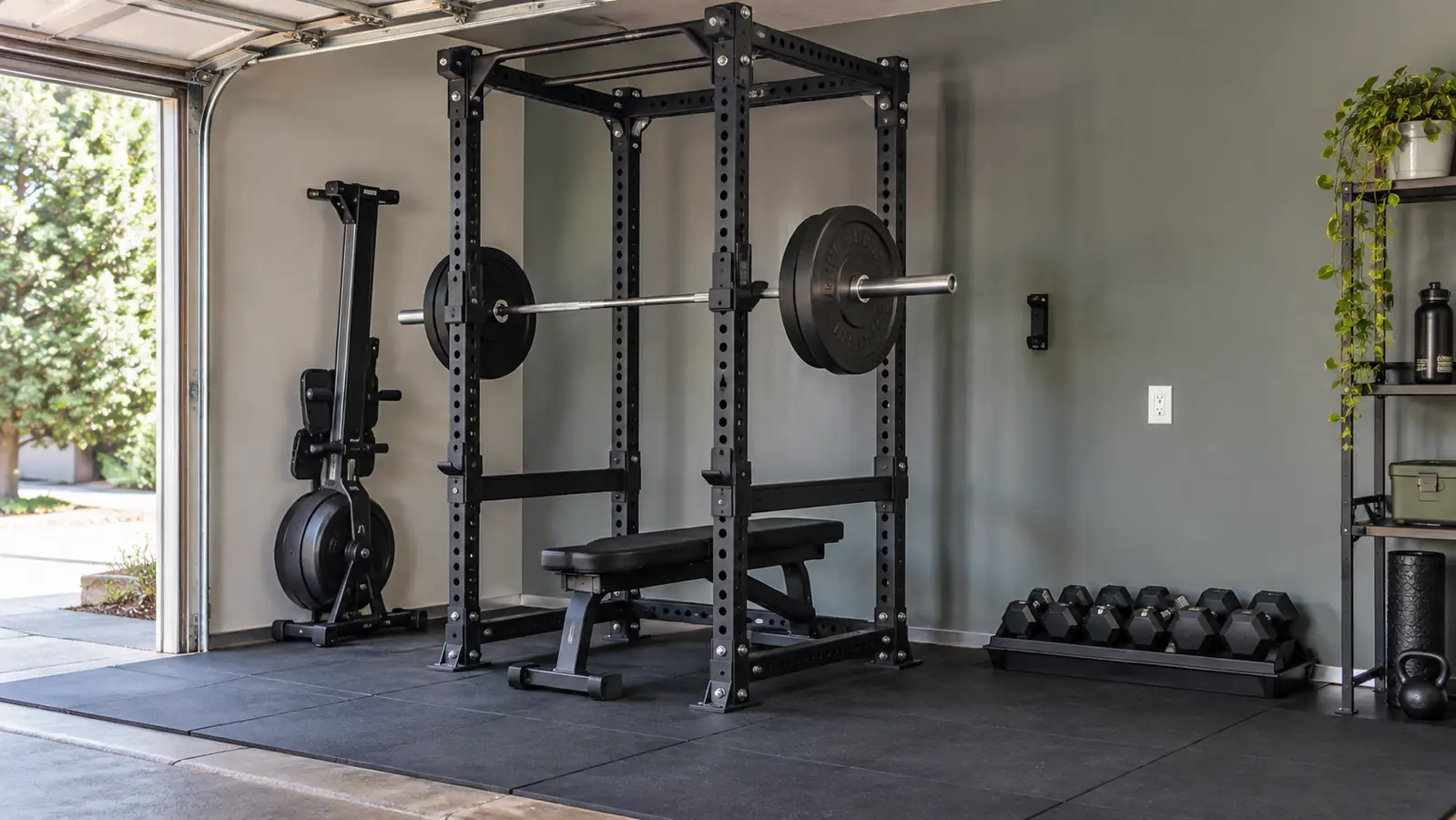
The rectangle is real. Forty six inches by fifty inches parked in the middle of an 8 by 10 mat area leaves me walking room on three sides and enough space in front to load plates without stepping off the rubber. The bench lives inside the frame when it is not in use, which keeps the floor clear for everything else. The dumbbells sit on their trays beside the bench and the rower folds against the wall when the truck needs the bay. That is the entire gym, and it fits because the rack is the only thing in it that does not move.
Height is the number to check before you buy anything. Mine stands 85 inches tall under an 8 foot ceiling, which leaves roughly 11 inches of air above the pull-up bar. That is enough for strict pull-ups with my head forward. It is not enough to kip, and I do not kip. If your ceiling is lower than 8 feet, measure the rack and measure your lockout before you order, because a frame that is too tall for the room is a very heavy thing to send back.
I measured mine from the mat, not from the slab, because the mats are 3/8 inch and that is the surface the bar sits on. Ninety six inches to the joist, just under that to the mat. Keep the frame at 85 and you have ten or eleven inches of working air. The other thing to measure is the garage door track. Mine stops short of the left bay, but a neighbor's track hangs low enough across his bay that a pull-up bar would have been a head injury waiting to happen. Measure the track, not just the ceiling, and stand where you would actually hang.
Two and a half hours alone on a Saturday, no bolts in the concrete, and the frame has not walked an inch in two years.
Assembly, Noise and Daily Wear
I bolted nothing to the floor. The rack sits on the mats under its own weight and it has not shifted. That was deliberate: I did not want four holes in the concrete if I ever change the layout of the bay. Assembly was one afternoon, maybe two and a half hours, working alone with a socket set. Nothing arrived bent and nothing was missing, which is more than I can say for the hand-me-down bench this replaced.
The box came out of the truck bed and down the driveway on a hand truck in one trip, and I laid every part on the concrete in the order the instructions listed it. That took about ten minutes and saved me an hour of hunting through cardboard. Uprights first, then the crossmembers, then the pull-up bar last, because it is the heaviest single piece and I did not want it overhead while standing on a step stool. The second upright took the longest, because I leaned it against the garage wall and started every bolt by hand before tightening anything, which is the only safe way to do it alone.
Noise is the part nobody warns you about. Before the mats went down, dropped plates rang off the concrete and carried straight into the kitchen. With 3/8 inch rubber underneath, the rack itself is quiet. What you hear is the bar on the frame and the plates on the sleeves, which is the sound of lifting rather than the sound of the house coming apart. Two years in, the frame is still square and no joint has loosened up that a wrench did not fix in under a minute.
The Trade Nobody Mentions
The case for stands rests on money and floor, and both are real. What gets left out is what happens eighteen months later when you want to bench, or you want pull-ups, or you want somewhere to hang the bar between sets. The people I know who started with stands mostly ended up with a rack anyway, and the stands went to a corner or to a kid. Buying once is not a slogan. It is what happens when you are honest about what you will want to do in two years rather than what you are doing this month.
The counter is just as honest. A pair of stands you actually use beats a rack you cannot fit, cannot afford, or cannot put away before your wife needs the bay. I have watched that happen too. The best piece of equipment is the one that survives the argument with your schedule and your square footage, and for plenty of people that is not the bigger frame.
Who Should Buy Which
Buy the CAP Power Rack if you have a corner you can claim, a ceiling at or above 8 feet, and a plan that includes squats, bench and pull-ups. It suits a garage, a basement with real height, or a spare room you have already written off as a bedroom. It suits anybody who trains alone before work and wants the bar to be in the same place every single time. It also suits a household where a teenager might start lifting, because the frame is not going anywhere and neither is the bar. Mine has taken two years of four-mornings-a-week use and a fifteen year old swinging on the pull-up bar, and it still looks like the day I assembled it.
Buy squat stands if you rent, if the space has to convert, if your ceiling is low, or if you genuinely only squat and press and have no interest in the rest. There is no shame in that. It is a smaller commitment and it puts you under a bar this week instead of next year. Just measure the ceiling, check the steel gauge before you order, and be honest with yourself about whether a bench is coming later, because that is the purchase that usually forces the upgrade.
If you already know the bay is yours, stop shopping twice
Squats, bench and pull-ups from one 46 by 50 inch footprint, 85 inches tall, on 11 and 12 gauge steel. Confirm your ceiling clearance, then look at the current price and the review count.
Amazon Check Today's Price on Amazon →