
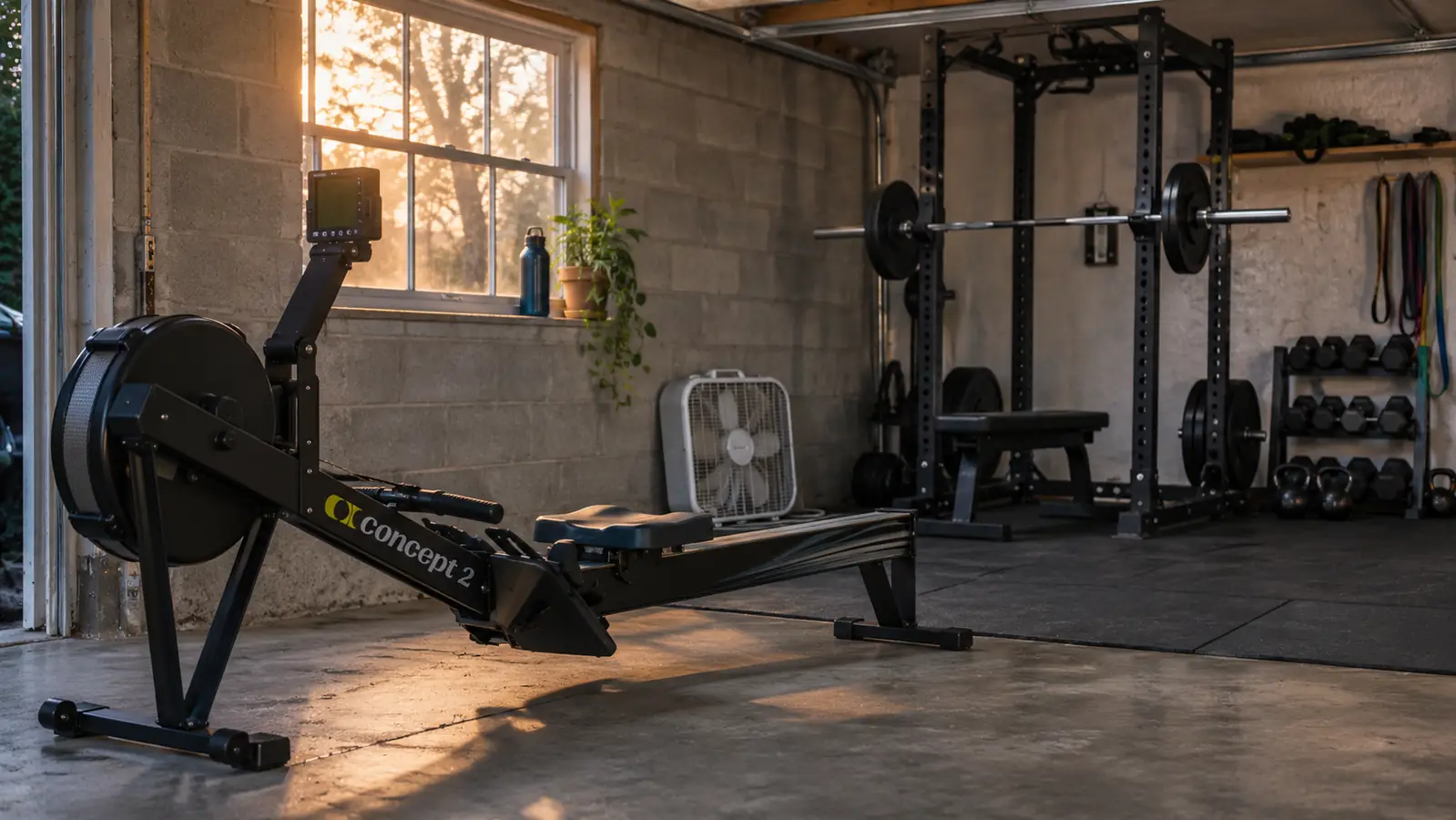
Conditioning is the first thing that falls apart when you train in a garage. You buy the rack, you buy the plates, you plan four lifting mornings a week, and then your left knee flares up after a summer of running hills and the only cardio you have left is walking to the mailbox. That was me in the summer of 2025. Forty-six years old, an HVAC service tech who spends half his day crawling through attics, and a knee that had been filing complaints since spring.
So I did what I do with a furnace: figured out what would fit the space, run quiet, and hold up. A treadmill was out. Too long, too loud on bare concrete, and too much of a reminder of the knee. I bought the Merach Q1S Magnetic Rowing Machine in September 2025, put it in the left bay of my garage, and have rowed on it about fourteen months now. What follows is the setup process, in the order I would do it again if I were starting over tomorrow morning.
The machine that fits a one-bay garage without eating the bay
65 inches long, 19.3 inches wide, 42 pounds, and it folds up against the wall when the truck needs the room. That is the whole reason it is in my garage and a treadmill is not.
Amazon Check Today's Price on Amazon →Step 1: Measure the bay before you measure anything else
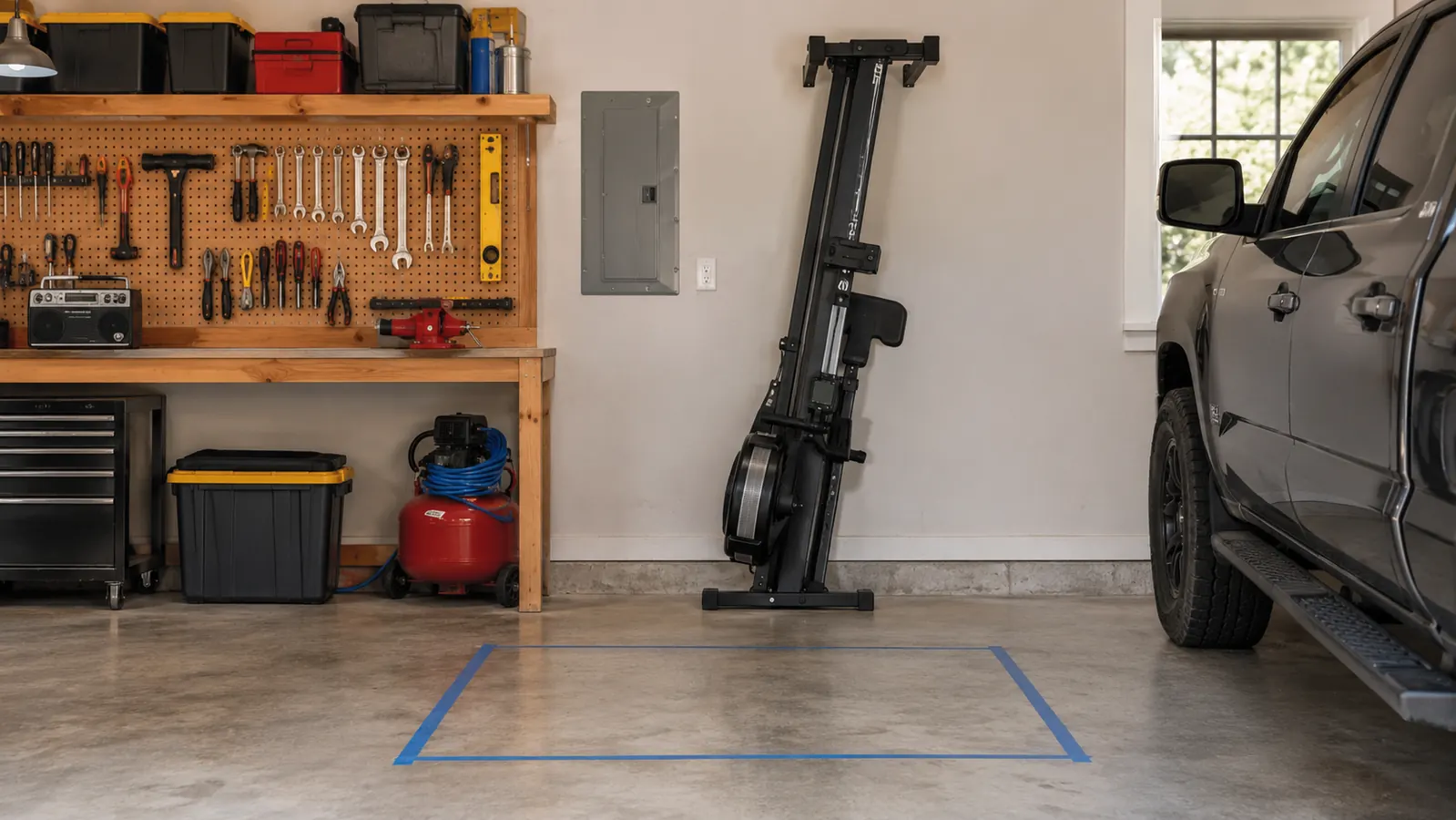
My garage is a two-car attached, and I only get the left bay. Call it 11 by 20 feet with an 8-foot ceiling, bare concrete, one window, no heat and no air. The truck lives in the right bay, so whatever I put in the left bay has to leave a walking path and has to get out of the way when the truck pulls in crooked. Before I bought anything I put a tape on the floor and marked out the footprint I could live with.
The Merach Q1S is 65 inches deep, 19.3 inches wide and 24.8 inches tall at the rail, and it weighs 42 pounds. In a bay that is 20 feet deep, 65 inches of rower leaves more than twelve feet to walk past it, which is the number that mattered to me. Nineteen inches wide is narrower than the bench is long. If you have a one-car garage, measure the wall to wall span with the car parked and subtract three feet for a door to swing. That is your real budget.
Height is the thing most people forget. My ceiling is 8 feet and the rower is under 25 inches tall, so there is nothing to duck. If your garage has a low soffit or a hanging shelf over the bay, check it before you order. I have seen a guy buy a rower for a garage with a 7-foot clearance and then row with his head craned forward like he was going under a bridge.
Before I ordered anything I tried three layouts on a scrap of paper, and two of them fell apart the moment I walked the bay with a tape in my hand. Layout one put the rower along the back wall under the window, which looked tidy until I noticed the garage door track on that side comes in about fourteen inches at the top and my shoulder would have been inside it. Layout two ran it straight down the middle of the bay, which is the layout everybody defaults to and the one that lasts about a month. Layout three is the one I kept: parallel to the wall, nose toward the rack, tail toward the door. When the truck pulls in, I do not have to think about it.
Step 2: Give the machine a home that is not the middle of the floor
The reason garage cardio dies is not the machine. It is that the machine lives in the middle of the floor, you have to move it to park, and after three weeks you stop moving it and start resenting it. So before the first row, I decided where it would stand when it was not in use, and I marked that spot with two strips of tape on the concrete.
The Merach folds up and stands against the wall on its end. I tip it up, lean it against the studs beside the rack, and it takes a strip of wall about two feet wide. When I want to row I drop it back onto the taped outline, which is a foot off the mats and about four feet from the rack upright. Nothing to bolt down, nothing to unfold twice a week. It is 42 pounds, so one person can move it without a plan.
The wall spot took a little trial and error. I first leaned the frame against the finished drywall between the window and the rack, and after two weeks there was a faint grey mark where the rail had been resting. I cut a scrap of the 3/8 inch rubber roll left over from the floor project, maybe a foot square, and set it under the end that touches the wall. No more mark, and the machine does not shift when the garage door comes up and the air moves through. The whole fix took five minutes and a piece of scrap I already had.
The rule I made for myself: it never stays out overnight. Not once. The morning it stays out is the morning the bay starts turning into a storage closet with a rowing machine in it, and I have watched that happen to a friend's home gym twice.
Step 3: Put the rows on the calendar before you put them in a workout
I lift from 5:30 to 6:20 in the morning, four days a week, before I get in the van. That is not dedication, it is the only window that survives my on-call weekends. So the conditioning had to fit inside a window that already existed, not create a new one. I row on two of those four mornings and once on the weekend, 20 minutes a session.
Twenty minutes is the honest number. Thirty minutes sounds better on paper and I know exactly what would have happened to it by the second week of January. Three sessions a week at 20 minutes is 60 minutes of conditioning I actually do, and 60 minutes you do beats 90 minutes you skip.
Noise was the other reason the rower won. My flooring situation means I am not dropping plates at 5:45 anymore, but I still remember the sound carrying into the kitchen above. The magnetic resistance on the Q1S is quiet enough that Dana has never once mentioned it, and she mentions things. The fan and the box fan in summer are louder than the machine.
The missed sessions are the part nobody writes about. I am on call two weekends a month, and when a compressor fails in a restaurant kitchen on a Saturday morning, the row does not happen. What I do instead of trying to make it up is skip it and take the next scheduled one. Chasing a missed session by stacking two in a day is how you turn a 20-minute habit into a punishment you dread. Fourteen months in, I have probably missed around thirty sessions out of a hundred and eighty or so, and the program still works, because the default is that I row, not that I decide fresh each morning whether I feel like it.
Step 4: Learn the stroke before you chase the numbers
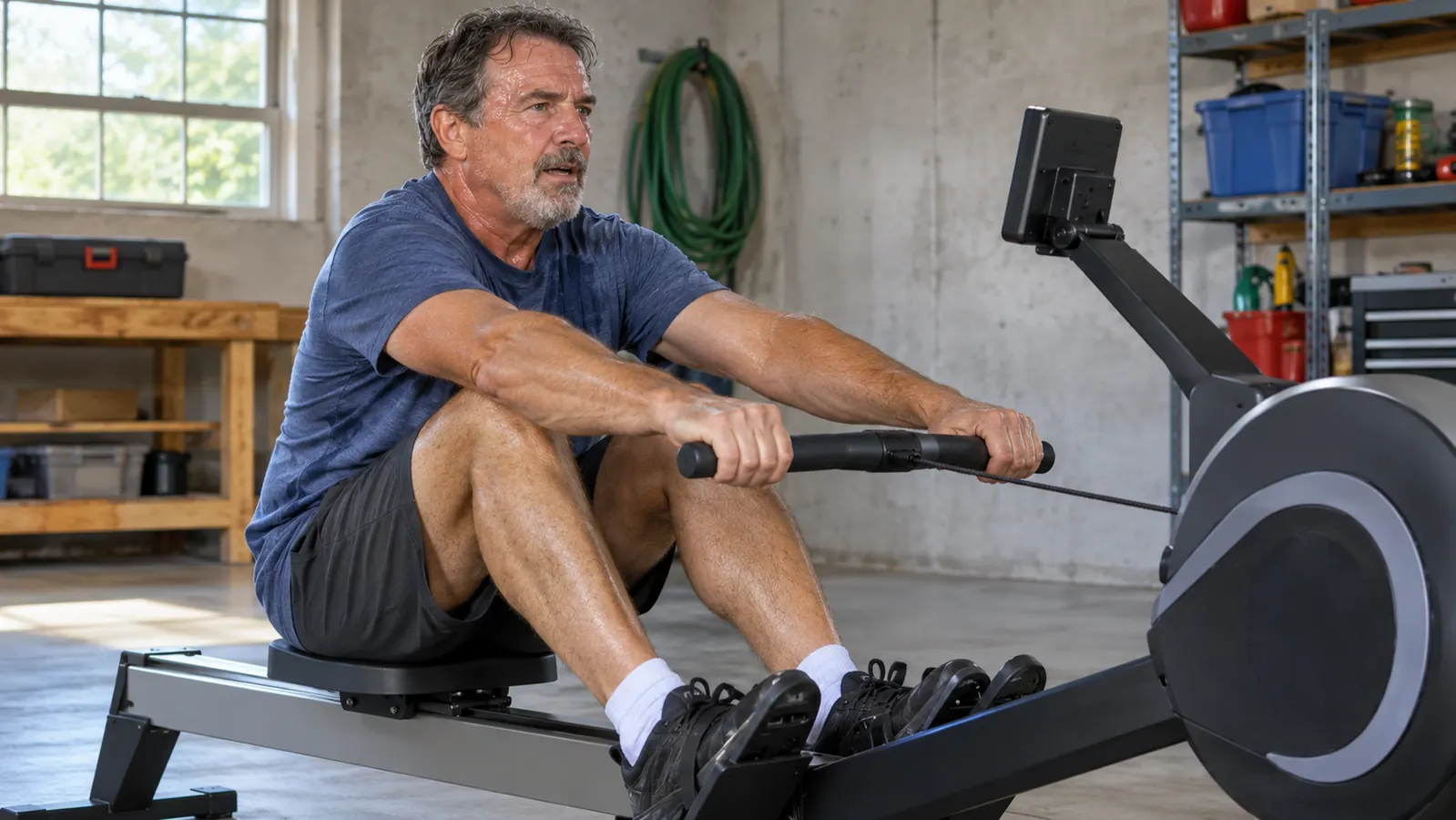
The monitor is an LCD that tracks time, distance, calories burned, speed and stroke count. My first two weeks were a mess of chasing distance and pulling with my arms, which is exactly backwards and exactly how you end up with a sore lower back and no conditioning. Slow down. Legs first, then the back swings, then the arms finish, then the reverse going forward. Rowing badly is more tiring and less useful than rowing well.
I spent a week rowing at what felt embarrassingly slow, watching the stroke count stay steady rather than spiking and dropping. Once the sequence was automatic, the numbers on the monitor finally meant something, because they were measuring the same stroke every time instead of a different sloppy one every thirty seconds.
Here is the specific mistake, because it is easier to point at than to describe. Week one I was pulling something north of thirty strokes a minute with my arms, breathing hard, feeling like I had done real work. By week three, after I slowed the recovery down and let the legs start the drive, I was at a lower stroke count for the same 20 minutes and working harder the entire time. That is the opposite of what the display told me at first. Speed rewards a short, fast, useless stroke. Stroke count sitting next to time tells you the truth about whether the work was real.
What I actually look at now is time and stroke count. Distance and speed are on there and I glance at them, but the two numbers that tell me whether I am working or just sitting on the machine are how long I have been on it and how consistent the strokes are. Calories burned is the number I ignore, because it flatters you for leaning forward.
Step 5: Add time and resistance, not intensity
The Merach has adjustable magnetic resistance, and the temptation in month one is to crank it to the top and treat it like a strength exercise. Do not. Resistance on a rower is closer to gearing than to weight on a bar. Start at a setting where you can hold a conversation in short sentences, and stay there until 20 minutes feels routine rather than heroic.
The machine is rated to 350 pounds, which is more headroom than my situation needs, but it is worth noting if you are a bigger guy who has been told a folding rower will not hold him. The warranty runs 12 months from the date of purchase, and assembly took me about half an hour, which matched what the listing claimed.
My progression over fourteen months has been boring on purpose. Twenty minutes at a steady effort, three times a week, with the resistance nudged up a notch when the current setting stopped feeling like work. That is it. I am not going to tell you what it did for my knee or my waistline, because I am not a coach and your body is not mine. What I can tell you is that I have done it consistently for over a year, which is more than I managed with a gym membership for three.
What Else Helps
The rower sits on bare concrete next to the rubber mats, and that is deliberate. The mats are 8 by 10 and they live under the rack and bench. Putting the rower on concrete keeps the footprint honest and keeps me from dragging it across a mat edge every session. If your concrete is cold in winter, a small space heater pointed at the bay takes the edge off in about fifteen minutes, and a box fan does the same job in July.
The Merach app has courses and programmed workouts on it, and I use it sometimes, mostly on the weekend session when I want something other than my own counting. Most mornings I just use the monitor and get on with it. If you are the kind of person who needs a voice in your ear, the app is there. If you are not, you will not miss it.
One thing I would do in the same order again is floor first, cardio second. The IncStores rolls went down in October 2023, so by the time the rower arrived the floor situation was already settled and I knew exactly where the mats ended and the bare concrete began. If you are starting from nothing, do the floor under your rack and bench before you buy any cardio at all, because the rower does not need a mat and the lifting area does. The rolls smelled strongly of rubber for a few weeks and I aired the garage out with the door open. That is normal and it fades.
Twenty minutes, three mornings a week, on a machine that folds up and leans against the wall. That is the whole conditioning program, and it has survived fourteen months of a 7-to-5 job with on-call weekends.
Measure your bay, mark the floor, and stop skipping cardio
The Q1S stores against the wall, takes about 30 minutes to assemble, and runs quiet enough for a 5:30 AM garage. It is the setup that survived a year in mine.
Amazon See the Merach Q1S on Amazon →