

The first thing I did when I cleared the left bay of my garage was measure it. Eleven feet wide, twenty feet deep, eight foot ceiling. That is not a gym. That is a parking space with a bench in it. I had a used barbell, a rack, and a bench, and I had already learned that fixed dumbbells would eat the room alive. A rack of 5 to 25 pound pairs takes more floor than the bench. So I bought one pair of Lifepro adjustable dumbbells in November 2024 and left them on their trays beside the bench. A year later they are still there, and I still use them four mornings a week.
This is not a review that promises a new body. It is a setup guide for someone with a spare corner, a concrete floor, and about forty minutes before work. The adjustable dumbbell solves a space problem. It does not solve a discipline problem. What it does is remove the excuse that the room is too small and the gear is too cluttered.
Put the 5 to 25 pound range on one tray
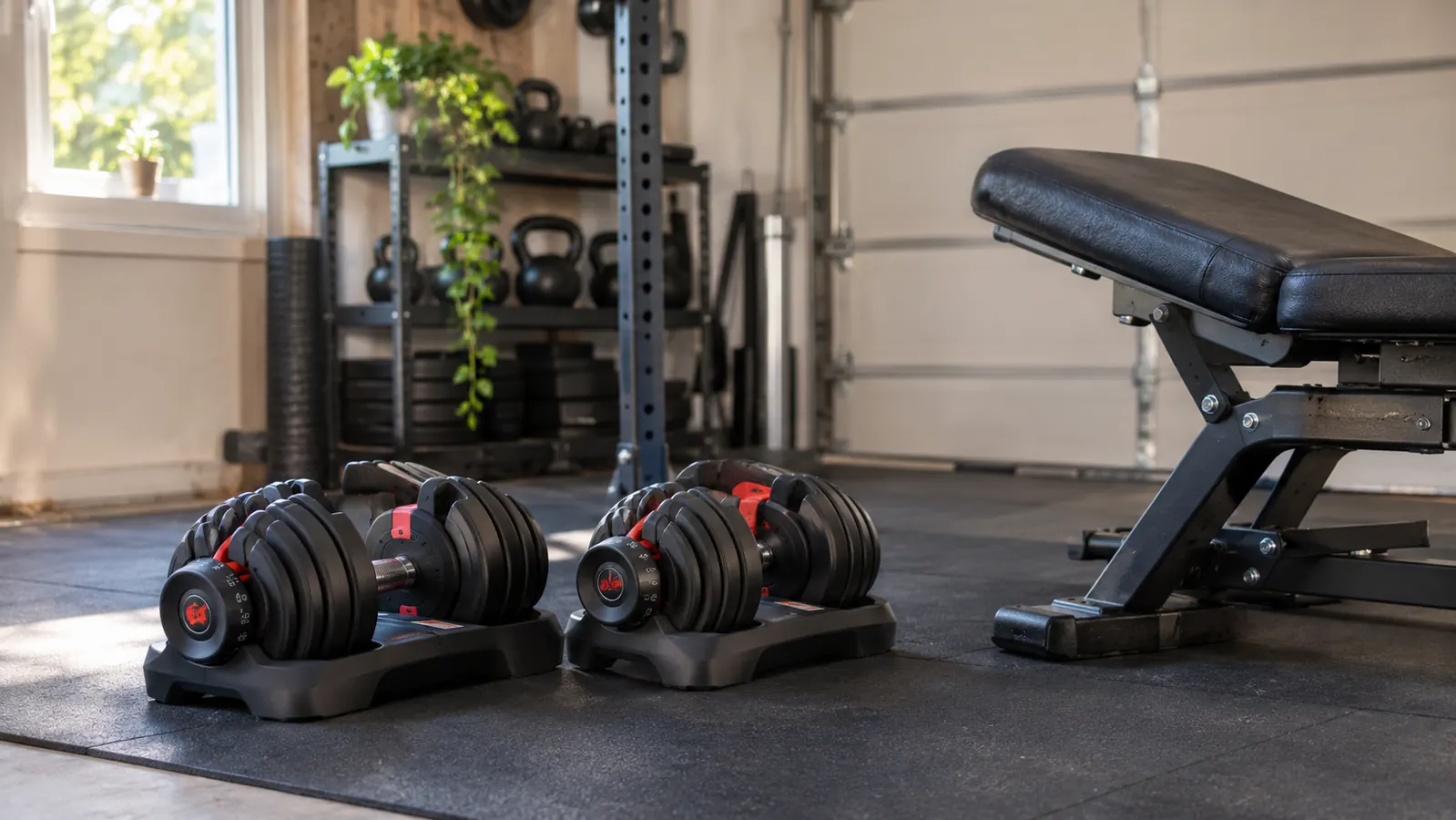
One pair covers warm ups, rows, raises, curls and accessory work without a rack of fixed weights. The quick adjust dial moves in 2.5 pound steps, and the pair stores on its trays beside the bench.
Amazon Check the Lifepro Adjustable Dumbbells on Amazon →The Setup, Step by Step
Step 1: Measure the footprint, not the fantasy
Before I bought the Lifepro pair, I taped a rectangle on the floor where the trays would sit. Each dumbbell is listed at 13.6 inches long and 6.7 inches wide. Two of them side by side, plus a little room to lift them off the tray, took a strip of floor about the size of a doormat. That strip had to fit between the bench and the wall without blocking the walk path to the rack.
I put the strip at the head of the bench, on the side away from the door. That way I can sit on the bench, pick up the pair, and set it down without stepping backward into the rack. In an eleven foot wide bay, one clear walk path matters more than one extra piece of equipment. If the weights live in the path, you will move them every session, and then you will stop using them.
Measure your ceiling too. Mine is eight feet, and the pull up bar on the rack sits about eleven inches below it. I do not press dumbbells over my head with a wide stance in that bay. I press on the bench or seated, and I keep my overhead pressing to a range that clears the ceiling. A small room asks you to plan the movement, not just the storage.
Step 2: Give the pair one permanent home
The worst thing you can do with adjustable weights is carry them around the garage. They end up under the truck, behind the mat, or on a shelf where you cannot reach them with one hand. Mine live on the floor beside the bench, on their trays. That is the home. It is close enough to the bench that I can start a set without walking, and far enough from the rack that I am not tripping over them when I squat.
A permanent home also protects the pair. The alloy steel construction and the textured non slip grip are built for daily use, but they are not built to be thrown into a corner. I set them down on the trays, not on the bare concrete. The trays keep the pair together and keep the dials out of the dust that collects on a garage floor.
If you have to move a car, a stroller, or a box to get to your weights, the weights lose. That is true for a pair of adjustable dumbbells and it is true for a rack. The Lifepro pair is small enough to keep in the room full time, which is the only storage plan that survives a busy week.
Step 3: Build the session around five patterns
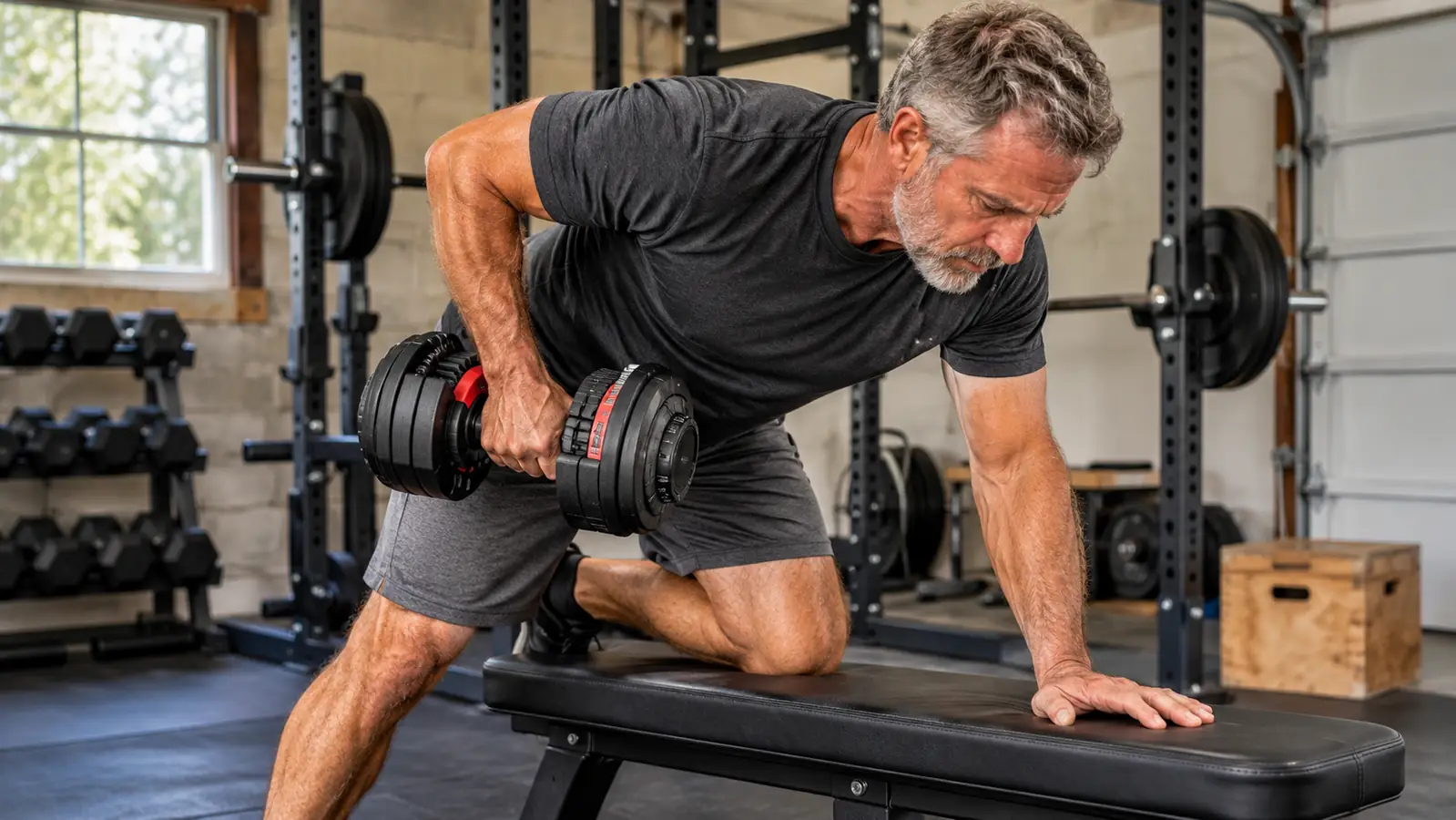
I use the Lifepro pair for five patterns: a one arm row, a floor press, a goblet squat, a lateral raise, and a curl. That covers a pull, a push, a squat, a shoulder raise, and an arm accessory. The 25 pound top end means heavy pressing stays on the barbell. That is not a flaw. It is the job. The pair is there for warm ups, accessory work, and the days when a full barbell session is not going to happen.
A typical Tuesday starts at 5:35. I do three sets of ten on one arm rows, three sets of twelve on floor press, two sets of fifteen on goblet squats, two sets of fifteen on lateral raises, and two sets of twelve on curls. Rest is about sixty seconds. I am done by 6:10. The whole session uses one pair and one bench, and I never leave the mat.
Cole, my fifteen year old, uses the same pair on weekends. He sets the dial lower for raises and higher for rows. The 2.5 pound steps matter for him because a five pound jump is a big jump when you are fifteen and still filling out. The pair adjusts to him without a second set of weights taking up floor space.
Step 4: Progress in small steps and check the lock
Progression with adjustable dumbbells is not about adding a plate. It is about adding a small step and owning it. The dial moves from 5 to 25 pounds in 2.5 pound increments. That means a lateral raise can go from 12.5 to 15 without a five pound leap. For a small room and a pair that tops out at 25, those small steps are the whole game.
Before every set, I check the locking mechanism. The dial has to sit on a number, and the lock has to be engaged. I give the dumbbell a short pull to make sure nothing moves. That takes five seconds. It is the same habit as checking a ladder before you climb it. You do it because the cost of skipping it is not worth the time you save.
I keep a notebook with the date, the movement, the weight, and the reps. When I hit the top of my rep range on three sets, I go up one step. When I miss reps two sessions in a row, I stay put. That is not fancy programming. It is a way to make a small pair of weights last longer than the novelty of a new purchase.
Step 5: Make the room quiet and safe
Concrete is loud. I bought the rubber mats before I bought the rack because dropped plates were chipping the floor and the noise carried into the kitchen. The dumbbells get set down, not dropped. Even a 25 pound dumbbell makes a sharp crack on bare concrete, and in a garage under a kitchen, that crack travels.
The room has one window, a box fan in summer, and a small space heater in winter. I keep the walk path to the truck clear, and I keep the pair on the side of the bench that does not face the door. When I finish, the dumbbells go back on the trays. The mat gets a quick sweep once a week because dust and grit will wear the grip over time.
I also check the floor around the bench for small rocks or grit before I lie down for floor press. A small room means you are close to the walls and close to the door, and a small piece of grit under your back is a distraction you do not need at 5:30 in the morning. The setup is not complicated. It just has to be repeatable.
The Weekly Plan I Actually Follow
I lift four mornings a week, 5:30 to 6:20. Two of those mornings are dumbbell days, one is a barbell squat and press day, and one is a row and pull up day. The dumbbell days are not the main course. They are the days that keep the week from falling apart when work runs late or my knee is sore.
Monday is rows, floor press, goblet squats, lateral raises, and curls. Wednesday is a shorter session: rows, floor press, and a carry. Friday is barbell work, and Saturday is the rower plus pull ups. If I miss Wednesday, I do not try to cram it into Friday. I just pick up the pair on Saturday morning and do the short session while Cole is getting ready for practice.
The pair makes that possible because it is already out. I do not have to move the truck, dig a dumbbell out of a rack, or change a plate. I pick up the pair, set the dial, and start. That sounds small. In a garage gym, small is the difference between a session that happens and a session that gets postponed.
Mistakes I Made So You Do Not Have To
My first mistake was buying a second set of fixed dumbbells for the garage. They took up a corner, collected dust, and made the room feel smaller. I sold them. My second mistake was storing the adjustable pair on a shelf above the bench. I had to reach over my head every time I wanted to start a set, and I stopped using them for a month. The floor beside the bench is the right home.
My third mistake was trying to make the pair do everything. It will not replace a barbell for heavy squats or heavy pressing. It is not meant to. If you buy a 5 to 25 pound pair and expect it to carry a full strength program by itself, you will be disappointed. If you buy it to fill the gaps, it will earn its space.
The last mistake was ignoring the lock. I once started a set without checking that the dial had settled. The weight did not fall, but it shifted, and that was enough to make me stop and check every time. Now the check is part of the set. It takes five seconds and it keeps the session boring, which is what a garage gym should be.
What Else Helps
The Lifepro pair did not replace my bench, rack, or mats. It made them more useful. The YOLEO bench gives me a place to press and row, the CAP rack holds the barbell for squats and pull ups, and the IncStores mats give me a floor I can set weights on without waking the house. The pair fills the gaps between those pieces. It is the warm up, the accessory work, and the backup plan on a morning when I do not have time to load the bar.
If you row for conditioning, the Merach rower is the other piece that earns its floor space in my garage. It folds and stands against the wall when the truck needs room. I use it for twenty minutes on the days my knee is cranky. The dumbbells and the rower do different jobs, and neither one needs a room of its own.
If you already own a bench and a mat, the pair is the next piece I would add. If you do not own a bench, buy the bench first. A pair of dumbbells on the floor with no bench limits you to rows, curls, and raises. A bench opens floor press, incline press, one arm rows, and step ups. The pair and the bench are a team. Neither one needs a rack of fixed weights beside it.
The pair does not replace my barbell. It replaces the five minutes I used to spend hunting for the right fixed dumbbell, and that is why it stayed in the room.
If the room is small, make the weights fit the room
The Lifepro pair goes from 5 to 25 pounds with a dial, stores on its trays, and leaves the floor for the bench and the rack. That is the whole argument.
Amazon See the Lifepro Adjustable Dumbbells on Amazon →