
I put a 45 lb plate through the concrete in my garage in October of 2023. Not on purpose. I was finishing a set of rows, set the plate down harder than I meant to, and heard the crack from three feet away. When I knelt down there was a divot the size of a quarter and a hairline running out toward the wall. Dana heard it inside the house with the door shut and the television on. That was the morning I stopped pretending a bare slab was good enough for a lifting area.
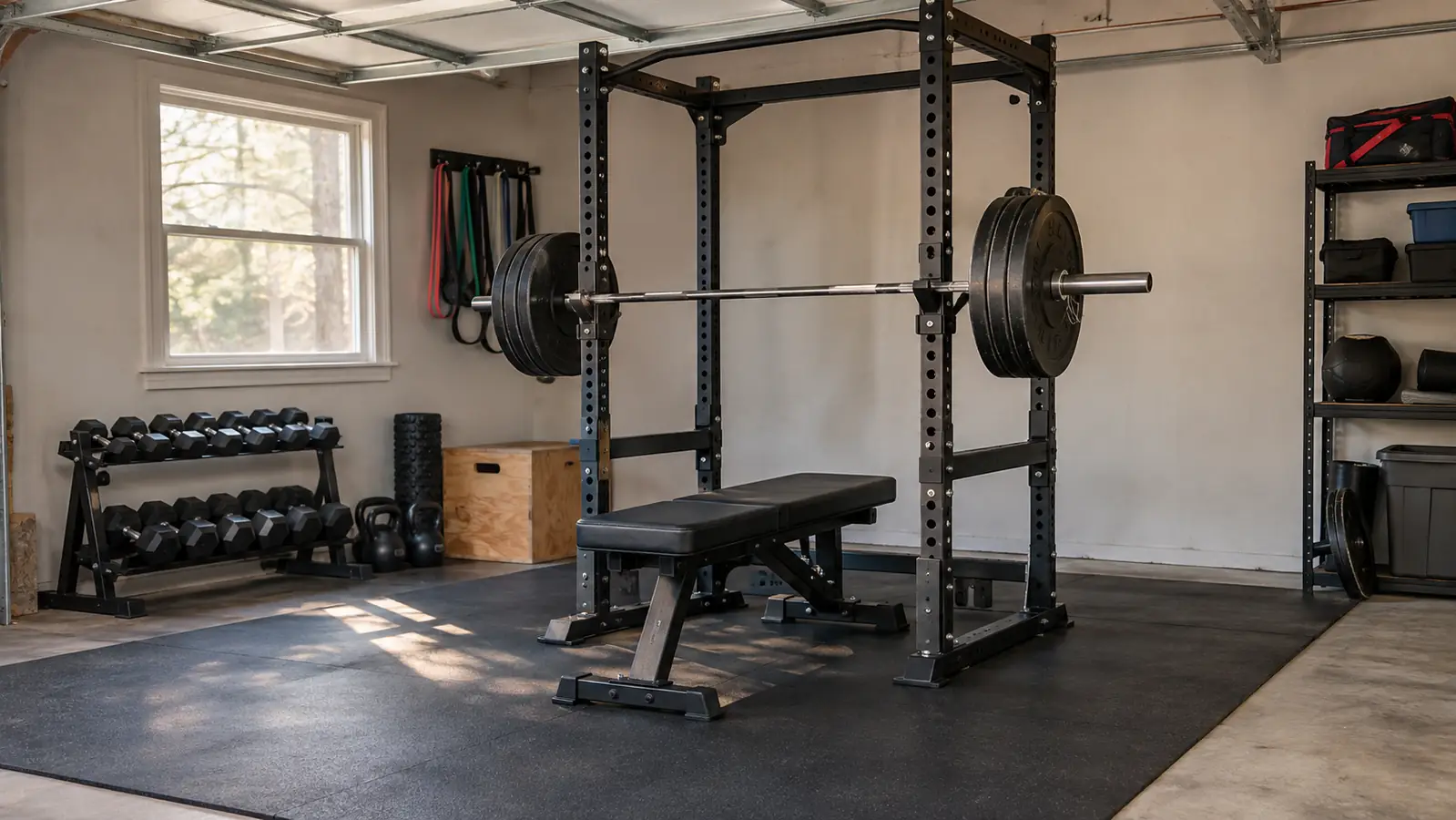
Two weeks later I had two rolls of the IncStores Tough Rubber Roll in the 3/8 inch, 4 by 10 foot size sitting in the driveway. I unrolled them side by side in the left bay, which gave me an 8 by 10 foot lifting area under the rack and the bench, and left the rower on bare concrete beside it. I have trained on that floor four mornings a week, 5:30 to 6:20, for about two years now. Here is what held up, what did not, and who this roll actually makes sense for.
The Quick Verdict
Two years of dropped iron and sweaty mornings without a tear, a split or a curled edge. The three weeks of rubber smell at the start is the honest cost.
Amazon Check Today's Price →The Floor That Stops the Second Mistake
Two 4 by 10 rolls covered my whole 8 by 10 foot lifting area with one seam down the middle. Measure your bay and pick a thickness before you order.
Amazon Check Today's Price on Amazon →How I've Used It
The layout is simple. The left bay of my attached garage is about 11 by 20 feet, bare concrete, one window, an 8 foot ceiling, a box fan in summer and a small space heater in winter. The rubber covers the back 8 by 10 of it, where the rack and the bench live. Two 4 by 10 rolls laid side by side gives you that 8 by 10 footprint with a single seam running the 10 foot length down the middle and nothing else.
Measuring is where most people get this wrong, so here is what I did. I pulled a tape across the bay three times because the first number I wrote down was wrong. The concrete pad is 11 feet 4 inches wide and 20 feet 2 inches deep, but the wall framing eats a few inches on the left and the water heater sits in the front corner. The usable rectangle for the rack and bench came out at 8 by 10, which is exactly two of these rolls. I left the front 10 feet of the bay bare on purpose, so the truck door has room to swing and so I have somewhere to stand when I sweep the rubber off.
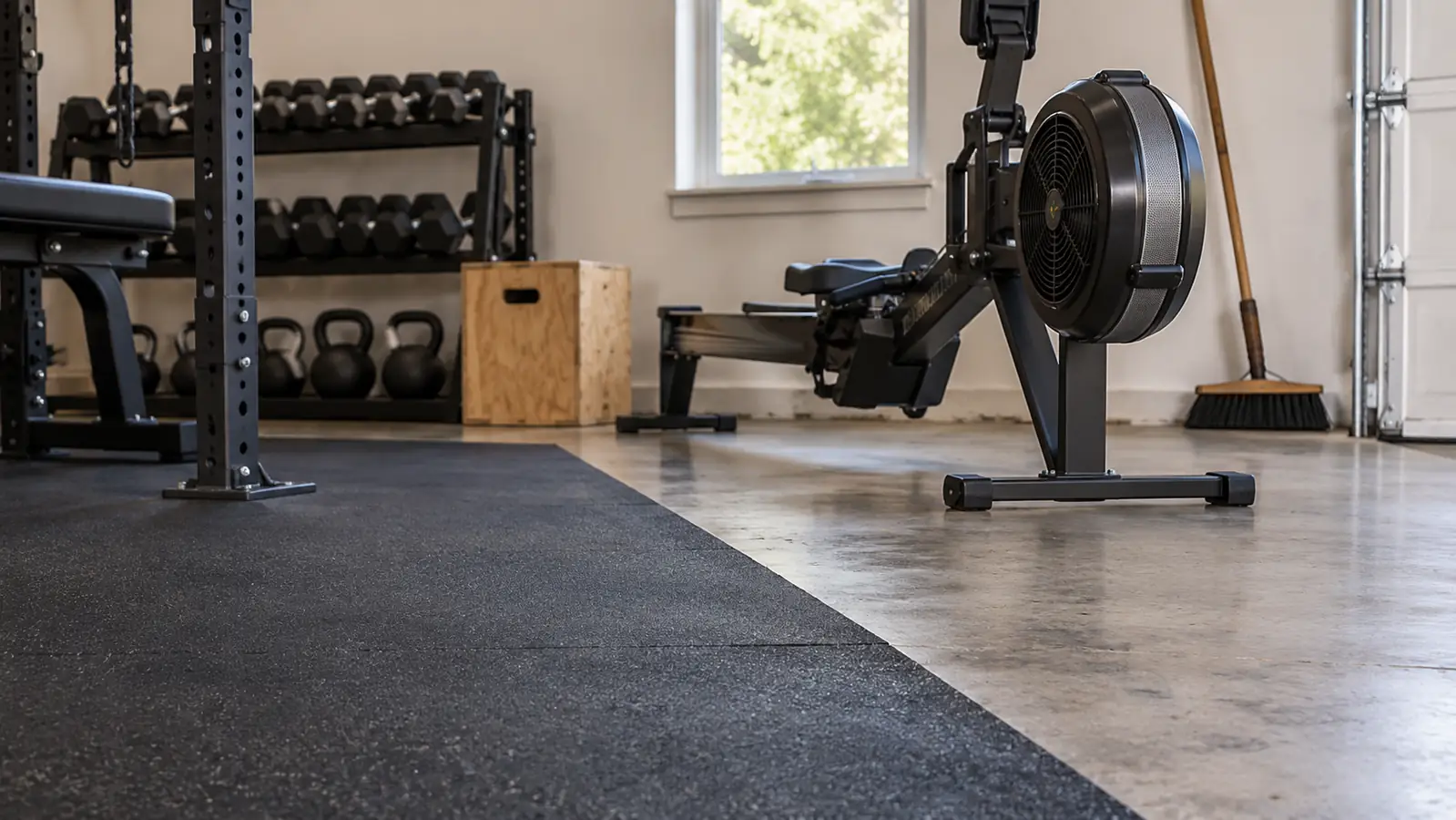
Everything heavy sits on the rubber. The CAP power rack stand, the bench, the dumbbells on their trays. The rower sits on the bare concrete next to it because that is where it fits, and honestly a rower does not need rubber under it. The truck parks in the right bay, so nothing on this floor gets driven over or dragged across. That matters for how the surface has aged, and I will come back to it.
Installation took one afternoon, and most of that was moving gear and sweeping. The rolls come rolled up tight, so they need time to relax flat. I unrolled mine in the driveway in the sun for a couple of hours, dragged them in, and let them sit overnight before I set the rack back down. If you drop them in place and load them the same afternoon, expect the ends to fight the curl for a week or two. Sweep first. Grit under a roll is what makes a high spot you will feel through a shoe forever. The only trimming I did was on the front edge of one roll, where the pad was not quite square to the wall. A straightedge and a sharp utility blade handled it in about four passes, and the cut came out cleaner than I expected.

What 3/8 Inch Rubber Actually Does Under a Rack
The roll I bought is 3/8 inch thick, which is the middle of the IncStores range. They run 1/4 inch for lighter setups, then 3/8, then 1/2 and 3/4 for commercial gyms, horse stalls and heavy loads. Each roll covers 40 sq ft, and the sizes run from about 12 sq ft up to 200 sq ft in a single piece. That range is the reason I went with a roll instead of interlocking tiles: no grid of edges to lift, and no gaps for chalk dust and grit to live in.
Handling them is worth knowing about before you order. A 4 by 10 roll at this thickness is heavy enough that one person can carry it but not comfortably, and it wants to unroll itself while you are doing it. I moved mine one at a time on a hand truck with a strap around the middle. If you are hauling them down basement stairs, get a second person. I also thought hard about 1/2 inch and decided against it, not because it would not work but because the extra thickness buys nothing under a rack that never leaves the floor, and it makes the roll heavier and the edge taller where it meets the bare concrete.
What 3/8 buys you over 1/4 is a real answer to a dropped plate. A 1/4 inch mat is a surface protector. It stops scuffs and it takes the hard edge off noise. It does not do much about a 45 lb plate landing corner-first from waist height, and it certainly does not protect concrete from that. At 3/8 the rubber compresses enough that the plate hits and stops instead of passing the impact straight down into the slab.
What 3/8 does not buy you is a competition platform. If you are doing heavy Olympic lifts and bailing out of the hole, you want 3/4 inch over a plywood core. I do not lift that way, and my ceiling is too low for it anyway. For squats, bench, rows, presses and step-ups, 3/8 is the right thickness for the job, and the shock absorbing layer is doing visible work rather than just sitting there looking industrial.
Pull the roll back after two years and the concrete underneath is undamaged and dry. That is the whole test, and it passed.
Dropped Plates, Noise, and the Concrete Underneath
The noise difference is the part I did not expect to care about. On bare concrete, a set of rows with iron plates sounded like someone hitting the floor with a hammer, and it went through the wall into the kitchen. On the rubber it is a dull thud. Not silent. Dana can still hear me if she is standing in the hallway. But it stopped waking the house at 5:30, and that alone was worth the afternoon of work.
Sound also travels down, which I did not think about until it stopped. My garage slab runs under the kitchen. Before the mats, every dropped plate came through the floor as a thump under the table. That is gone. I have not had a single complaint about a morning lift in two years, and my wife teaches middle school. She does not have patience for a hobby that wakes her at dawn.
Here is the specific test I keep coming back to. Sometime in the first winter I was doing rows and lost my grip on a plate at the top of the pull. It came down flat from about waist height onto the rubber maybe a foot from the rack post. The sound was a single dull knock and then nothing. I stood there for a second waiting for the crack and it did not come. I checked the spot that night with a flashlight and there was a scuff in the surface dust and nothing else. On the bare slab, that same drop is what put the divot in my floor eight months earlier.
The concrete is the part that actually matters. Two years in, I have pulled the roll back twice to sweep and to look. Under the rack there is no cracking, no powdering, no staining, and no low spot where the plates land. Compare that to the divot I put in the bare section in eight months of use. That chipped patch is still there, right where the rower stands now, and I look at it every morning as a reminder of what the slab was doing before.
The Smell, the Seams, and the Edges
The smell is real and I am not going to pretend otherwise. For the first two or three weeks the garage smelled like a tire store, strongest on warm afternoons. I left the garage door open during lifts and ran the box fan, and it faded on its own. It never got into the house and it never bothered me while training. By week four I could not pick it up unless I put my face down near the rubber.
The seam down the middle of my 8 by 10 area has stayed tight. I did not tape it and I did not glue it. The two rolls sit against each other and the weight of the rack holds them in place. There is a very slight lip you can feel with a bare foot if you drag across it, and I have never caught a shoe on it. If you walk across the floor in socks it would annoy you. If you lift in shoes, you will forget it is there by the second week.
The cut edges are where these rolls need a little thought. The edge is square and clean, but it is a cut edge, and on a bare slab a corner will want to lift slightly over time. Mine has stayed down because the rack sits on it. In an open area with nothing holding it, plan on something at the edge eventually: a trim strip, a piece of equipment, or a wall. Care is a damp cloth and nothing else, which is one of the better things about a solid rubber surface.
Two Years In: What Held Up
Nothing has torn. Nothing has split at the seam. There is no chunk missing where a plate lands and no permanent dent under the rack feet. There is a faint set of depressions where the rack has stood for two years, which is normal for rubber under a static load and which lifts out if you move it. The surface has gone slightly less grippy where I stand for squats, and I mean slightly. I still do not slide, even in a sweaty morning session in July with the fan going.
Once a month or so I pull the whole thing apart, which takes about twenty minutes. I lift the rack feet one at a time, drag the rolls out toward the door, sweep the concrete, sweep the back of the rubber, and put it back. What comes up is grit, chalk dust, a few dead box elder bugs in the fall, and that is it. No mold, no damp smell, no stuck patches where a spilled drink went under. The concrete under the rubber is a slightly different shade than the exposed slab, which is just two years of the exposed part collecting dust. Wipe the surface with a damp cloth and it looks like the day I dragged it in.
Cole trains on it with me a couple of mornings a week when baseball season allows, and he is harder on a floor than I am. He drops things. He drags the bench. He leaves a barbell on the rubber instead of racking it. None of that has marked the surface beyond dust. He also does his step-ups on the rubber for the knee work, and that is where a bare slab would have been worst: a hard surface and a kid landing on one leg.
The warranty is five years, which is longer than I expect to need for this use. If it fails early it fails early, but the usual failure for cheap rubber flooring is not a sudden tear. It is curling at the edge or crumbling under load. Neither has happened. The whole point was to stop damaging a slab I cannot easily replace, and the slab is still intact. I would buy the same IncStores roll again at the same thickness.
What I Liked
- 3/8 inch thickness absorbs a dropped 45 lb plate instead of passing the impact into the slab
- 40 sq ft per roll covers a real lifting area with one seam and no grid of tile edges
- Available from 1/4 inch up to 3/4 inch and up to 200 sq ft, so you can match thickness to the job
- Two years of four morning sessions a week with no tear, split or crumbling
- Five year manufacturer warranty
- Wipes clean with a damp cloth, no finish to maintain
Where It Falls Short
- Strong rubber smell for the first few weeks, worst in warm weather
- Arrives rolled tight and needs time to relax flat before you load it
- The cut edge can lift at a corner if nothing holds it down
- 3/8 inch is not a platform; heavy Olympic lifting with a bail-out wants 3/4 over plywood
- The seam is invisible underfoot in shoes and noticeable in socks
Who This Is For
This roll makes sense if you have a concrete slab in a garage or a basement, you already have a rack or a bench on it, and you are tired of chips, dust and noise. It suits a lifter working alone in a bay who does squats, presses, rows and deadlifts with iron plates and wants the floor to stop being the thing that breaks. It also suits someone finishing a bay who wants one continuous surface instead of a puzzle of tiles, since a single roll covers up to 200 sq ft with no joints at all.
Who Should Skip It
Skip it if you lift heavy enough that you routinely drop from overhead, or if you are training competition lifts and need a real platform. Go to 3/4 inch over plywood for that. Skip it if the space has to be perfect on day one and cannot air out for a few weeks, because the smell will be there. And skip it if you need a floor you can take apart and move, because a 4 by 10 roll is a commitment once it is down and it is not going back in the box.
Measure the Bay First, Then Order the Roll
Two 4 by 10 rolls gave me an 8 by 10 foot lifting area with one seam. Know your footprint, pick a thickness to match the work, and buy once.
Amazon Check Today's Price on Amazon →