
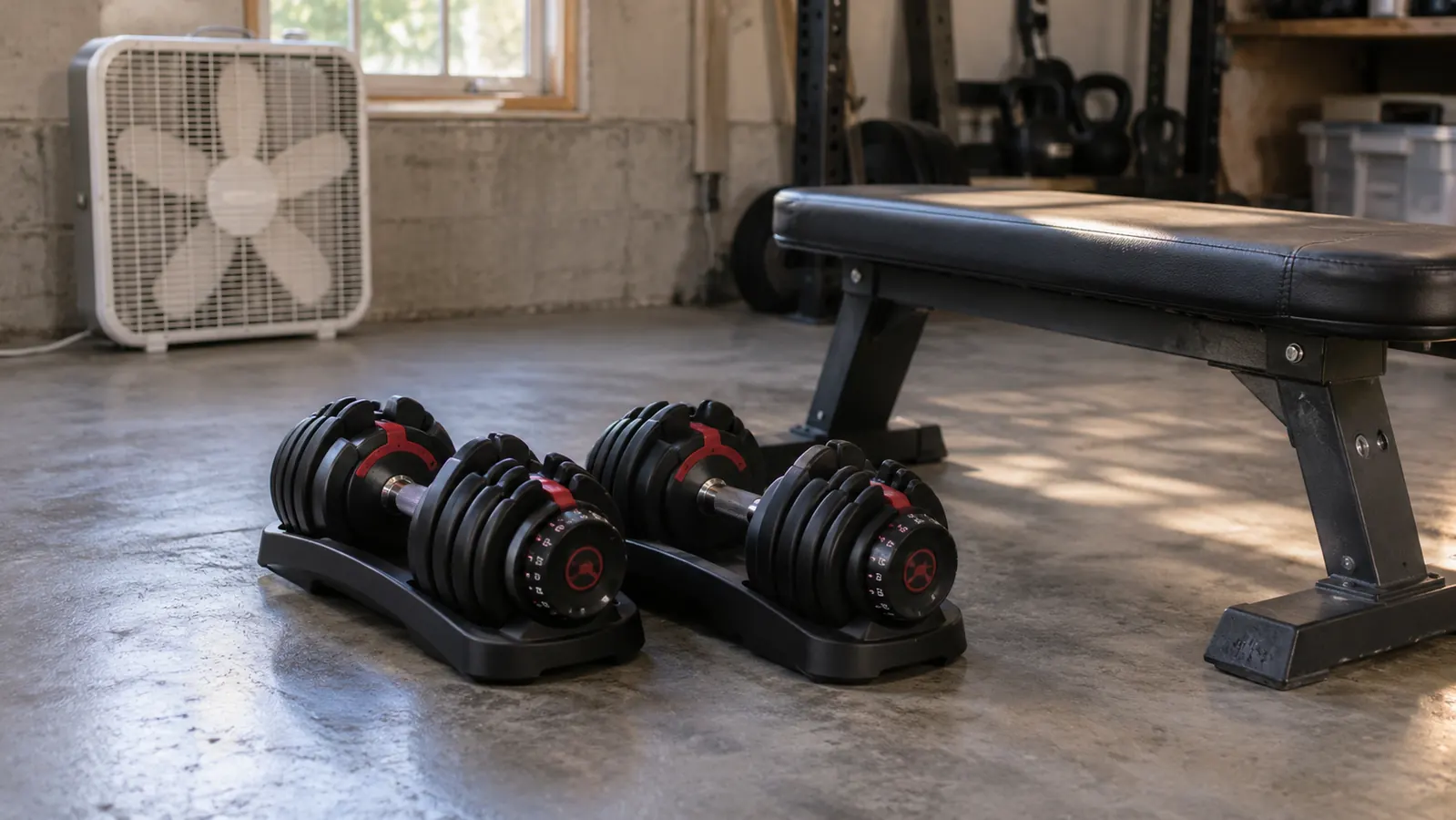
Adjustable dumbbells are a compromise you make once and then live with every week, and almost nobody selling them tells you which part of the compromise they picked for you. I bought the Lifepro Adjustable Dumbbells in November 2024 for the left bay of my garage, an 11 by 20 foot slab of concrete with a box fan for summer and a small space heater for January. What I wanted was one pair for curls, raises and warm-up work, without running ten fixed pairs along the wall of a bay that also has to hold a rack, a bench and a rower. A year of four-mornings-a-week use later, I can tell you what they solved and where they still cost me time.
The short version, because that is how I would want it: the Lifepro pair does light and medium work well, the 2.5 lb steps are genuinely useful, and the 25 lb ceiling per dumbbell is the thing that decides whether these belong in your garage. If your heavy pressing already lives on a barbell, as mine does, that ceiling is a non-issue. If you were hoping one pair would replace a dumbbell rack, it will not, and no clever design was going to change that.
The Quick Verdict
A solidly built 5 to 25 lb pair that quietly does the accessory work, with a ceiling that makes the decision for you.
Amazon Check Today's Price →The 25 lb Ceiling Decides This Purchase. Here Is What It Costs Today.
One pair, 5 to 25 lbs per dumbbell in 2.5 lb steps, quick-adjust dial, storage rack included. Check today's price on Amazon before you commit.
Amazon Check Today's Price on Amazon →How I've Used Them for a Year
My week is four mornings, 5:30 to 6:20, before I head out on service calls. Two of those mornings I row for 20 minutes and then do accessory work. One weekend session I lift with my son Cole, who is 15 and plays high school baseball. The dumbbells come out on most of those days. They live on the floor beside the bench on their trays, about six feet from the rack. Nothing dramatic has happened in a year. No plate has failed to seat, no handle has loosened, and the textured grip is still doing its job. For gear that gets picked up and set down a few hundred times, that is the review.
What I actually use them for: curls, lateral raises, one-arm rows, rear delt work, warm-up sets before overhead press, and the light stuff I do for my left knee. That knee has been cranky since my attic-crawling years, so a lot of what I do is unglamorous and light. Which is exactly the range these cover. Squats and heavy pressing stay on the barbell in the rack. I want to be clear about that, because it is the honest picture. The Lifepro pair is not my main lift. It is the pair I grab when the barbell is the wrong tool for the job.
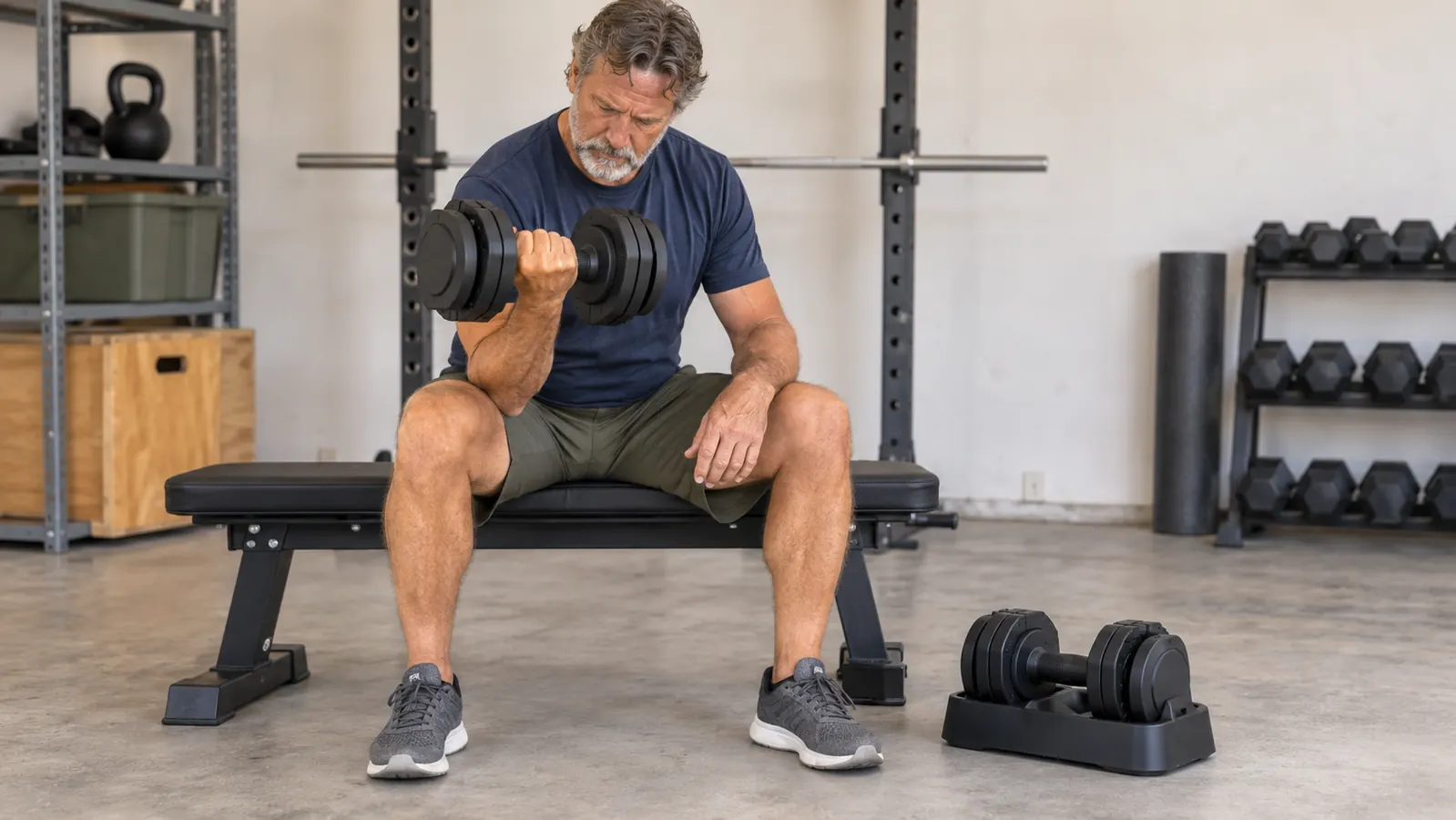
Cole uses them more than I expected. He will do curls and presses with the 15s and 20s while I finish something else, and the dial makes it simple for him to drop to a lighter setting without hunting for a different pair. In a two-person garage that matters more than any spec sheet suggests. One pair covers a 46 year old doing rehab work and a 15 year old doing his first real arm work in the same session, and that is not something a fixed set does without buying four of them.
What I underestimated was how often I would reach for them without thinking. When the pair sits two feet from the bench and a change takes seconds, you stop skipping the small stuff. I do more rear delt and rotator work now than I did when the only option was loading a barbell for it. The only thing that changed is distance and friction. That is not a line on the box. It is what happens when the gear is in the room with you instead of on a wish list.
The one thing I would flag about daily use is storage discipline. The pair comes with a matching storage rack, and using it is not optional in my book. Setting a dial dumbbell straight down on concrete puts the impact right where the mechanism lives. I have done it twice in a hurry and winced both times. On the trays, the load goes where it should. That is a fifteen second habit that I think buys years, and it is the sort of thing the listing mentions once and nobody reads.
What 2.5 Pound Jumps Actually Change
Fixed dumbbells step in 5 lb increments. That is fine at 25 and miserable at 46 with a shoulder that complains. Going from a 15 to a 20 is a 33 percent jump. Going from 15 to 17.5 is under 17 percent. Over a year, that gap is the reason I have been able to keep adding small amounts of work to lateral raises without my shoulder flaring and making me quit the movement altogether. The 2.5 lb increment reads like a marketing line on the page. In the garage it is the most useful thing about the product.
The catch is that those small steps only run from 5 to 25 lbs. Above 20 they stop feeling small, because you are close to the ceiling. Going from 22.5 to 25 is the last move available. Once you are pressing the 25s for clean sets of ten, these have nothing left to give on that movement. I hit that on overhead press inside four months. It is not a defect, exactly. It is the shape of the product, and it is why I keep saying the ceiling decides the purchase.
There is also a floor on the range, not just a ceiling. Five pounds is the lightest setting. If you are rehabbing a shoulder and need to start at two or three pounds, this pair cannot do it, and you will want a band or a light fixed dumbbell to bridge the first few weeks. I got around it with bands I already owned. Worth knowing if the reason you are buying is a joint that is currently angry at you.
The Dial, the Lock, and the Noise
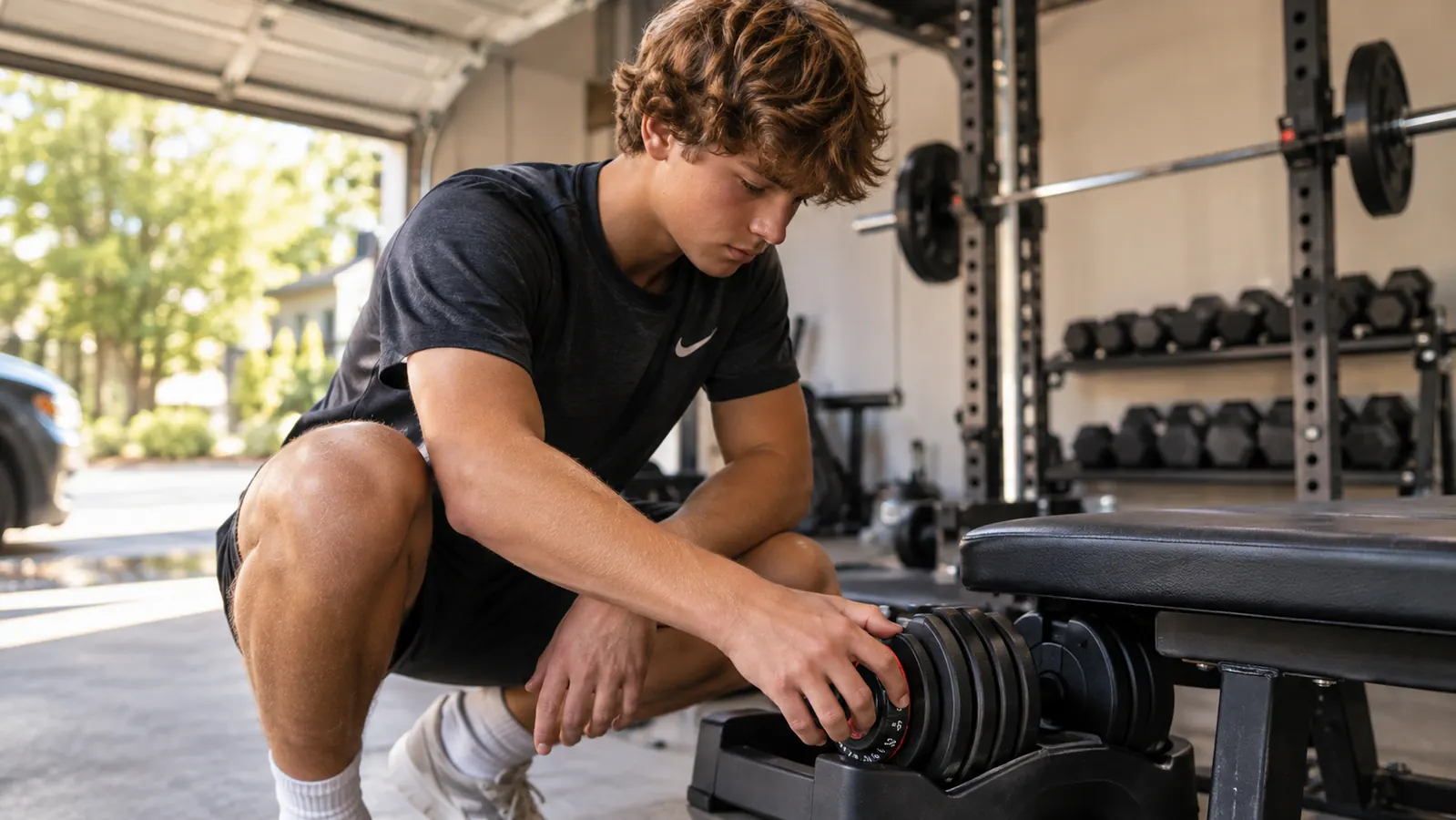
The adjustment is a dial. You turn it to the weight you want, the plates seat, the locking mechanism holds them, and the grip is textured enough that it does not slip in a bare hand. What I do every single time is give the dumbbell a shake over the mat before I lift it. Not because the lock has ever let go. Because I am the kind of person who checks, and a year of checking has produced zero surprises. The alloy steel has held up in a garage that swings from humid Tennessee summer to cold January mornings without any spotting I have found.
Noise is where I expected trouble and did not get it. I was braced for plates rattling mid-set and I have never heard it. What I do hear is the dumbbell meeting the floor at the end of a set, and the trays take most of that. Dana teaches middle school and is asleep at 5:30, and the wall between the garage and the kitchen is not thick. These have never been the thing that woke her. The rower is louder, honestly, and the rower is not loud.
One thing worth knowing before you order: the listing is written to cover both a single dumbbell and a pair, so read the option you are selecting carefully. I bought the pair and I would do it again, but a single one would have been a mistake for my setup, since half the work I do is one-arm rows and half is symmetrical pressing. It is a small detail buried in a bullet point, and it is the kind of thing that turns into a return.
Footprint and Storage in an 11 by 20 Foot Bay
Each dumbbell is 13.6 inches long by 6.7 inches wide. That is roughly a shoebox, and it is the whole argument. Ten fixed pairs from 5 to 25 in 5 lb steps, racked on a wall, eats six feet of a bay that also has to hold a rack, a bench, a rower and a walkway. My pair sits in about two square feet next to the bench. When the truck needs room in the winter, I slide the whole setup under the bench and forget it is there. That is not a small thing in a space this size. It is the reason I bought these instead of another rack.
The other footprint benefit is that nothing sits at shin height in the walkway. My bay has a path from the door to the bench and I have clipped a plate tree before. The pair on trays sits low and out of the way. If your garage doubles as storage for anything else, and mine does, that low profile matters more than the square footage number suggests.
Ten fixed pairs would hang on six feet of my garage wall. This pair takes two square feet and covers both my light work and my son's.
Where They Fall Short
The ceiling is the obvious shortfall, and I have covered it. The less obvious one is rhythm. Every weight change is a stop: set the dumbbell down, turn the dial, pick it back up. With fixed dumbbells you grab the next pair and keep moving. On straight sets that costs ten seconds and does not matter. In a superset or a circuit, where the whole point is to keep moving, it breaks the flow every single round. I stopped doing dumbbell circuits with these for that reason. If your training is circuit-based or timed, that is a real cost, and you should know it before you buy.
Second honest complaint: these are not something you want to drop. I do not drop dumbbells anyway, but if you finish a set of rows by letting the weight go from hip height, think about that. There is a mechanism in the middle of these, and mechanisms do not care for impacts. Treat them like equipment and they will last. Treat them like a fixed pair and you will be writing the one-star review, and it will not be the product's fault.
Third, and this is small but real: the grip texture that works fine bare-handed gets slick once the humidity climbs and my hands are wet. A towel fixes it. Chalk fixes it faster. But if you are the type who wants to grab and go without a towel on the bench, you will notice it in July.
What I Liked
- 2.5 lb increments make small progress possible without a shoulder flare-up
- 5 to 25 lbs per dumbbell covers accessory work, warm-ups and knee-friendly volume
- Sits in about two square feet beside the bench instead of six feet of wall
- Dial and locking mechanism have been faultless across a year of near-daily use
- Alloy steel and textured grip have held up in an unheated, un-air-conditioned garage
- One pair serves a 46 year old doing rehab work and a 15 year old in the same session
Where It Falls Short
- 25 lbs per dumbbell is a hard ceiling and it arrives fast on overhead press
- Five pounds is the lightest setting, so early rehab work needs bands instead
- Every weight change is a stop, which breaks circuit-style training
- Not something you should drop, so it rewards careful lifters only
- Grip gets slick in humid weather once your hands are wet
Who This Is For
Adults who already own a barbell or a rack and want a lighter pair for accessories, warm-ups and joint-friendly work. People training in a garage, spare bedroom or basement where floor and wall space is the binding constraint, not motivation. Anyone working around a knee or shoulder who needs to add weight in small steps instead of 5 lb leaps. Households where two people of very different strength share one gym. And anyone honest enough to admit they will do more curls, raises and rows at home than heavy pressing, which is most of us past 40.
One more thing on fit: these suit a lifter who is consistent more than a lifter who is strong. The people I know who get the most out of an adjustable pair like this are the ones showing up four mornings a week doing moderate work for years, not the ones chasing a number on a whiteboard. If that is you, the ceiling stops being a limitation and starts being a description of your training.
Who Should Skip It
If these would be your only weights, skip them. A pair that tops out at 25 lbs runs out of room on pressing and rowing inside six months, and then you are buying twice. Skip them if you train in circuits or timed intervals, because the dial stop will wear you down. Skip them if you plan to drop weight at the end of a set. And skip them if you are already stronger than average, because that ceiling is not a suggestion, it is a wall. In those cases a heavier adjustable pair or a set of fixed dumbbells is the honest answer, even if it costs you wall space.
If 25 Pounds Covers Your Accessory Work, This Pair Earns Its Two Square Feet
See the full 5 to 25 lb range and current pricing on Amazon. One pair, quick-adjust dial, storage rack included.
Amazon Check Today's Price on Amazon →A year in, I would buy the Lifepro pair again, for the same reason I bought them the first time: they fit the space I have and the work I actually do, not the work I imagined doing at 22. The lifter I am now does a lot of light quality reps and saves the heavy work for the barbell, and this pair is built for precisely that. Read the ceiling honestly, decide whether it covers you, and the rest of the decision takes about ten seconds.