
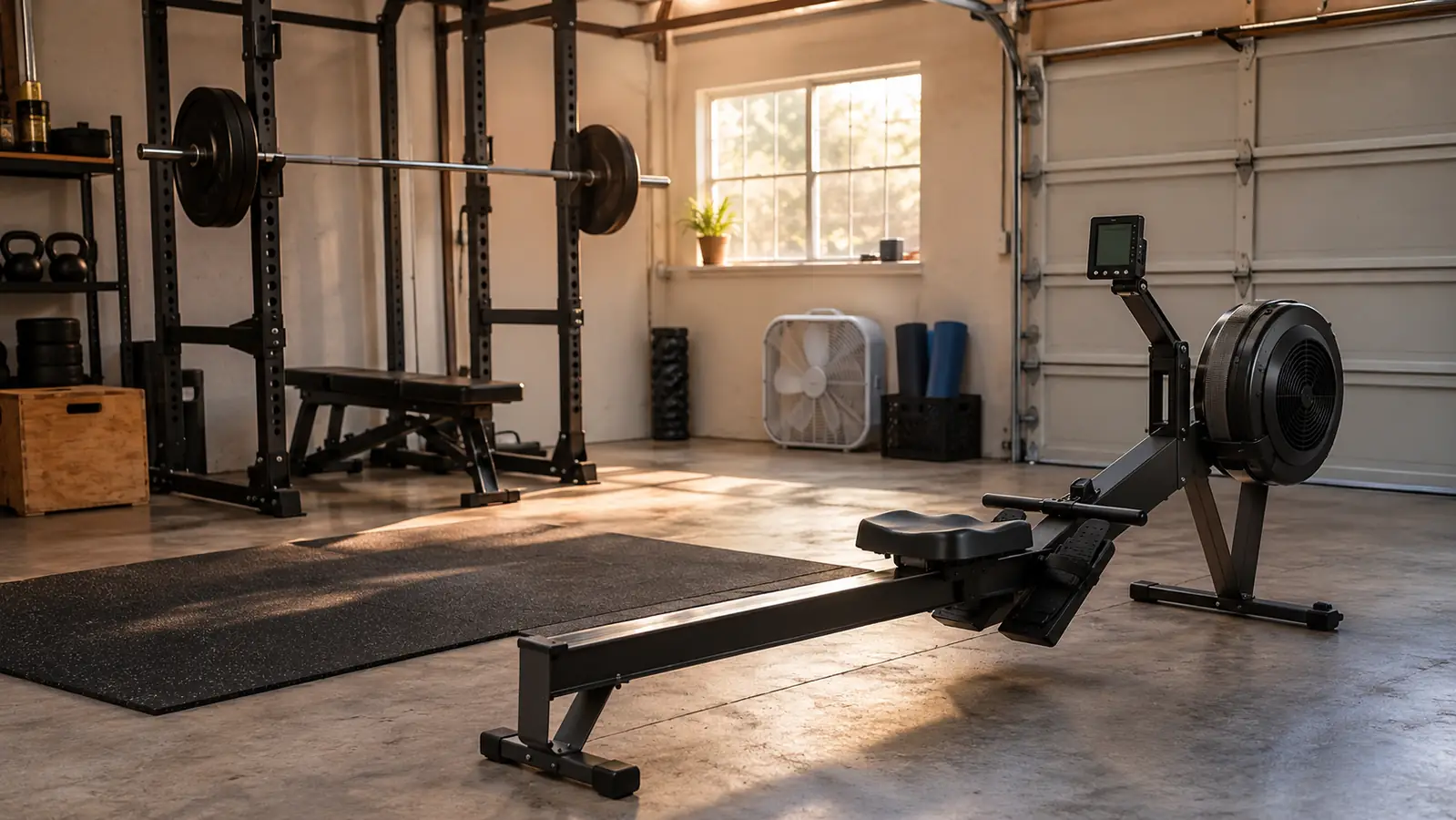
I bought the Merach Q1S Magnetic Rowing Machine in September 2025 because my left knee had quit on running. Fourteen months later it is still on the bare concrete in the left bay of my garage, still getting used three mornings a week, and I still have a short list of things about it that irritate me. Most of this review is that list, plus the reasons I have not replaced it.
That is not a knock. It is how I buy gear now. I am 46, I run service calls five days a week with on-call weekends, and I have spent enough money on equipment that looked good in a listing and fell apart in a cold garage. So when I say a machine has held up, I mean I have put a wrench on the bolts. And when I say something about the Merach is annoying, I mean I have noticed it a few hundred times.
The Quick Verdict
Quiet, compact and reliable for steady twenty-minute rows in a small home gym. The stroke is flat next to a water rower, the seat gets thin past 25 minutes, and the resistance tops out before real sprint work.
Amazon Check Today's Price →The cardio machine your house will not hear at 5:30 in the morning
Battery powered, 42 pounds, and it stands against the wall when the truck needs the bay. Fourteen months in an unheated garage and nothing has loosened.
Amazon Check Today's Price on Amazon →How I've Used It
The space is one bay of a two-car attached garage, roughly 11 by 20 feet. The rower sits on bare concrete. Two rubber rolls to the left hold the rack and the bench. One window, no heat, no air, a box fan in summer and a small space heater in winter. The truck parks in the right bay, so the rower has to get out of the way most nights.
My week runs like this: four mornings, 5:30 to 6:20, before I head out on calls. Two of those mornings start with twenty minutes on the rower, and I usually add a third session on Saturday. Call it 40 to 60 minutes of rowing a week. That is nowhere near athlete volume. It is the amount a working person with a teenager and an on-call rotation actually gets done, and I think a machine should be judged on that number rather than on a spec sheet.
Before the rower I tried running. That lasted about five months in 2024 and ended with my left knee swollen enough that I was icing it on the tailgate after work. I tried a hand-me-down treadmill next, a free one from a neighbor, and it lasted one winter in the unheated garage before the belt started slipping and the deck rusted. So the rower was the third attempt, and I bought it with a specific job in mind: twenty minutes of conditioning that would not put load through that knee. It has done that job. I have not iced the knee after a row once in fourteen months.
Cole is 15 and plays baseball. He has used it maybe a dozen times when weather kept him inside, and he rows harder than I do. He is 5 foot 8, I am 5 foot 10, and neither of us has had a mechanical problem with it in fourteen months.
Fit: What 65 Inches Does to an 11 by 20 Foot Bay
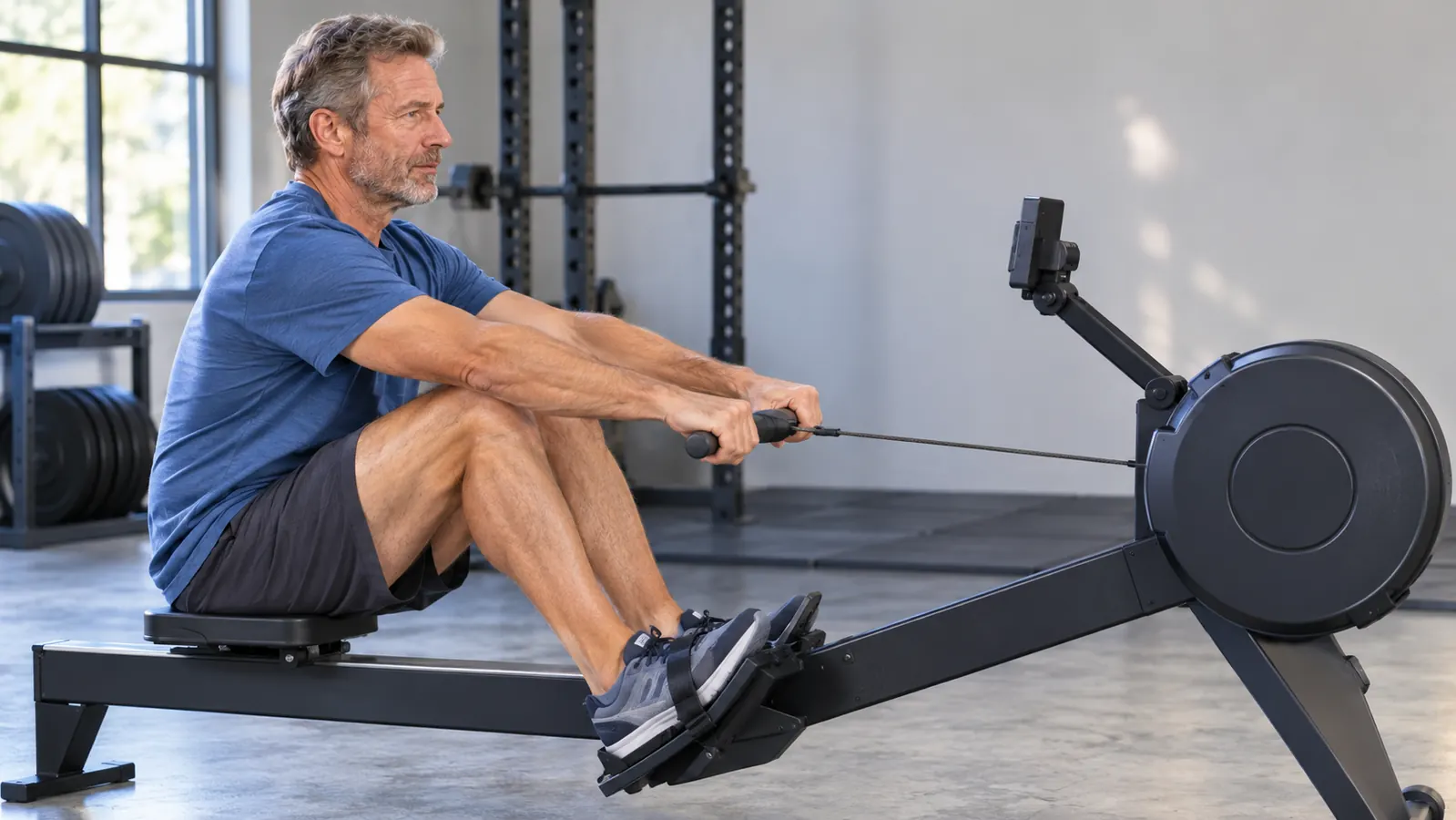
The listed footprint is 65 inches deep by 19.3 inches wide by 24.8 inches high. In practice that is a machine you lay along a wall, not one you tuck into a corner. In my bay it eats a strip about five and a half feet long, and I need another two and a half feet behind it to get on and off without cracking my knee on the rack.
Before I ordered I did the thing I do with any piece of equipment: I taped the footprint on the floor. Two strips of painter's tape, 65 inches long and about 19 wide, laid along the left wall where I thought it would go. Then I stood in the space behind the tape and pretended to get on and off. That took ten minutes and it saved me a return. The tape showed me that running it across the back wall, which is where I wanted it, put the handle about six inches from the rack upright and left no room to swing my arms. Moving it along the left wall solved it.
So the number I would print on the box is this: about eight feet of length to use it, five and a half to store it. In an 11 by 20 foot garage with a truck in the other bay, that ruled out running it sideways across the back wall, which is where I wanted it. It lives along the left wall now and the layout works, but it was a decision I had to make before the box arrived, not after.
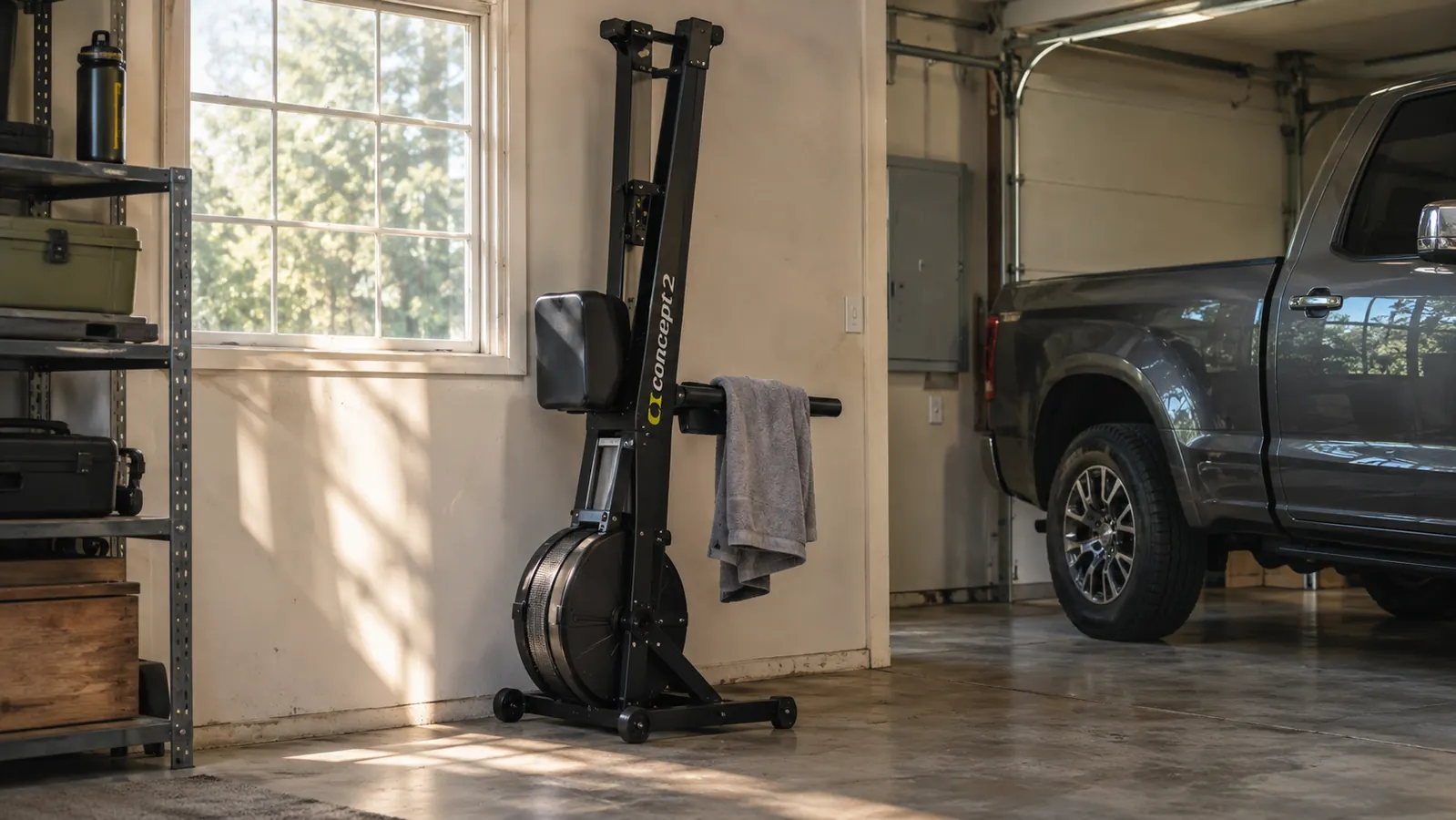
When the truck needs the bay, the machine tips up and stands against the wall beside the door. It weighs 42 pounds, so one person can move it with no help and no grunting. I do it in about fifteen seconds. That single fact is why the rower has survived in this garage while a hand-me-down treadmill did not survive one winter.
Assembly, Which Took Less Than the Listing Claims
The listing says 30 minutes for most users. I had it out of the box and together in about 25, working alone on a Saturday, and I am not quick at this kind of thing. The parts kit was complete. Nothing was missing, nothing was bent, and the manual matched the hardware bags.
I did it on a Saturday morning in September 2025, on the concrete, with the garage door open and a socket set on a towel beside me. The step that took the longest was the rail to the front frame, not because it was hard but because I did it twice. I had the bolts finger tight and the rail slightly out of square, and I had to back them out and start again. That is on me, not on Merach. The manual says to leave them loose until every piece is in place, and I read that line after the fact.
The one thing I would pass on is to open the box flat and take the pieces out in order instead of dumping them on the floor. The hardware is bagged by step and it only stays organized if you keep it that way. I worked on the concrete with a towel under the rail so I did not scratch it while I was putting it together.
What the Stroke Actually Feels Like
Here is the honest part, and it is the part most write-ups leave out. It does not feel like a boat. Magnetic resistance is smooth and it is quiet, and both of those are the reason I bought the thing, but there is no catch at the front of the stroke the way there is with water or with air. You pull, the handle comes back, and the effort is even the whole way through.
Resistance adjusts, and I keep it around the middle for steady rows and move it up a couple of steps for intervals. What you get at the top of the range is a heavier pull, not a harder one. The machine never fights back. If you have rowed a water rower and loved the wet, chunky feel of it, this will read as flat to you, and you should believe that before you buy.
I would rather have flat and quiet at 5:30 in the morning than loud and authentic with my wife and son asleep forty feet away. That was the trade and I made it with my eyes open. What took me a month to accept was the seat. Twenty minutes is easy. Thirty is where I start shifting around and thinking about the towel.
Fourteen months, three mornings a week, one unheated garage. The only thing I have had to replace is the towel I folded over the seat.
Noise, Which Is Why It Is in My Garage at All
The house is two stories and Dana teaches, so she is up at 6:15. The garage shares a wall with the kitchen, and sound carries through it. In fourteen months she has brought up the noise twice, and both times it was because I let the handle snap back instead of returning it.
That is the whole case for it. There is a faint whir from the resistance and the seat rolling on the rail, and that is the sound. If you have a basement, a spare bedroom, or a garage bay with a neighbor on the other side of a shared wall, this is one of the few cardio machines that will not earn you a complaint.
The price of that quiet is the flat stroke I described two sections back. You cannot have both at this size and this build. I made my choice and I would make it again, but a reader who wants the boat feel should go buy a water rower and then come back and read the part about noise, because that is where the money goes.
The Monitor, the Buttons and the App
The display is an LCD that runs on batteries. I like that more than I expected to, because there is no cord to trip on and no outlet to hunt for in a garage with exactly two of them, both behind the bench. It reads distance, time, speed, stroke count and calories. That is the list, and for steady work it is enough.
The buttons are simple and the screen is readable from a rowing position, though not in direct sun through the one window in my bay. When the afternoon sun comes across the concrete I angle the machine a few degrees and it is fine. A backlit display would be nicer at 5:30 in January. That is a small complaint, not a reason to pass.
Merach ships an app with programmed courses and workouts. I used it for the first month and then stopped, not because it is bad but because twenty minutes of steady rowing does not need a program and I would rather listen to the fan. If you are someone who needs a voice telling you what comes next, the app is there and it works. If you are not, the monitor alone carries the machine and you will not miss it.
Build Quality After Fourteen Months
The frame has not loosened. I check the bolts every couple of months out of habit from years of working on equipment, and nothing has backed out. The handle strap is not frayed. The seat rolls the same as it did in October 2025. The rail has a couple of scuffs from my shoes and nothing else.
It weighs 42 pounds, which is light for a rower and light enough that I can move it with one hand on the front. It also means that if you row hard on a smooth floor, the machine will walk. Mine sits on bare concrete and creeps maybe an inch over twenty minutes. On a sealed garage floor I would put a mat under the front feet and stop thinking about it.
In December 2025 I noticed it had crept about a foot and a half out of position over roughly six weeks, and the back foot had run up onto the edge of the rubber mat. I slid it back and it has stayed put since. If your floor is sealed or painted rather than bare concrete, expect the same and put something under the front feet.
The warranty is 12 months from the date of purchase. That is standard for this class and worth knowing on month thirteen, which is where I am now. Nothing has gone wrong and I am still aware of it. The listed maximum user weight is 350 pounds, which covers everyone in my house with a lot of room to spare.
What I Liked
- Quiet enough to row at 5:30 in the morning with the house asleep above you
- 42 pounds and it stands against the wall, so the garage bay stays usable
- Resistance adjusts smoothly across the range for steady rows and intervals
- Monitor covers distance, time, speed, stroke count and calories on battery power with no cord to route
- Frame, strap and seat have held up through fourteen months of cold garage use
Where It Falls Short
- The stroke is flat compared with a water rower, with no catch at the front
- The seat gets thin past about 25 minutes of continuous rowing
- Resistance tops out before true sprint or power work
- 12-month warranty runs out quickly on a machine built for daily use
- It can creep an inch on smooth concrete during hard rows
The Things I Would Change
The seat is the first one. It is not padded enough for rows longer than 25 minutes and I have folded a towel over it more than once, which is a two dollar fix that the factory should have made. The foot straps also take a second longer to get into than they should, and at 5:30 in the morning I notice a second.
The second is the resistance ceiling. This machine is built for steady work and intervals, not for sprint pieces with a big finish. If you are training for an actual rowing test you will run out of machine long before you run out of willingness. That is not a defect, it is what a magnetic rower at this size is, but I want you to know it before you buy it expecting something else.
The third is small and I will say it anyway: a backlit screen. The garage is dark at 5:30 in January and I have leaned over to read the time more than once. It does not change the workout and it does not change my opinion of the machine. It is just true.
Who This Is For
You want cardio that does not wreck your knees, you have a garage bay or a spare bedroom corner, and you want to row early without waking the house. You want something you can stand against a wall when the car needs the space and move by yourself without asking for help. That is this machine, and it does that job without drama.
It also suits people coming back from an injury or a long layoff. The effort is even and there is no impact, which is the reason I am on it at all instead of on the road in front of my house. If you are 35 to 60, working, and realistic about getting twenty minutes in three times a week, you are the buyer Merach built this for.
Who Should Skip It
If you have rowed on the water, or on a good water rower, and you love that feel, skip this one. You will spend every session noticing what is missing, and no amount of quiet will make up for it. Buy the loud thing and put it in the basement.
If you are chasing power, sprint work or a competitive 2,000 meter time, skip it too, because the resistance runs out before you do. And if the rower only gets used when it is staring at you from the living room, this is not that machine. It is 65 inches long before you sit on it.
If your gym is a garage bay and your mornings start at 5:30
Quiet enough for a sleeping house, light enough for one person to move, and built for the steady twenty-minute row most of us actually do. Go in knowing the resistance ceiling and it will serve you for years.
Amazon Check Today's Price on Amazon →