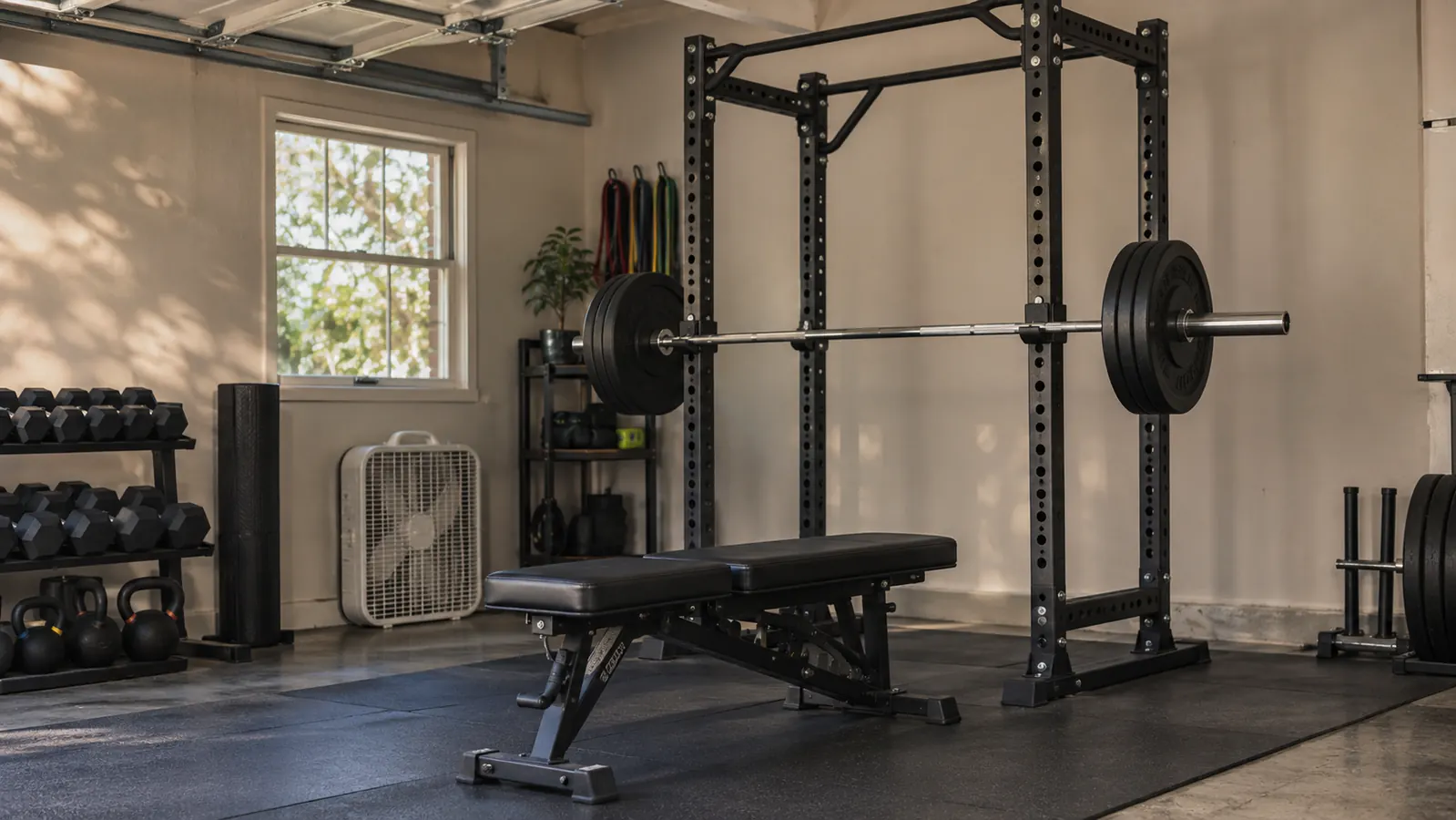
The short answer, because you are probably standing in a garage bay doing math on floor space: for most home lifters, the YOLEO Adjustable Weight Bench earns the concrete. It presses flat, inclines, seats you upright for dumbbell work, and gives you a padded platform to step onto when your knee needs it. I bought mine in April 2024 to replace a hand-me-down flat bench that walked sideways every time I racked the bar. Eighteen months later it is still the piece of gear I touch first, four mornings a week.
A flat bench is not a wrong purchase, though. A good fixed flat bench is one welded piece with nothing to adjust, nothing to rattle and usually a lower cost. If your training is bench press inside a rack and not much else, and you have room to leave a heavy bench sitting where you put it, a flat bench is the honest choice. The real question is narrower than which bench is better in general. It is which one earns the space in an 11 by 20 foot bay that also has to hold a truck in the other half.
| YOLEO Adjustable Weight Bench | Flat Bench | |
|---|---|---|
| Adjustability | 7 back, 4 seat and 3 leg adjustments, 84 positions, flat through incline | One angle, and it is flat |
| Setting it up | 98% pre-assembled, open the box, insert two pins, no tools | Usually ships flat-packed, expect 20 to 45 minutes with a wrench |
| Rated capacity | ASTM-certified to 827 lbs, 330 lbs maximum user weight | Varies by bench, check the sticker before you trust it |
| Rigidity under a heavy bar | Hinges and a 23.2 lb frame, fine, but you feel the joints | One welded piece, nothing to shift under load |
| Cost | More than a plain flat bench | The cheaper buy |
| Footprint | 41 inches deep, 12.6 inches wide | Roughly the same patch of concrete |
| Shoving it out of the way | 23.2 lbs, moves with one hand | Light ones move easily, a heavy steel one is a two-hand drag |
| Best for | One bench, one bay, mixed training | Barbell pressing only, inside a rack |
Where YOLEO Wins
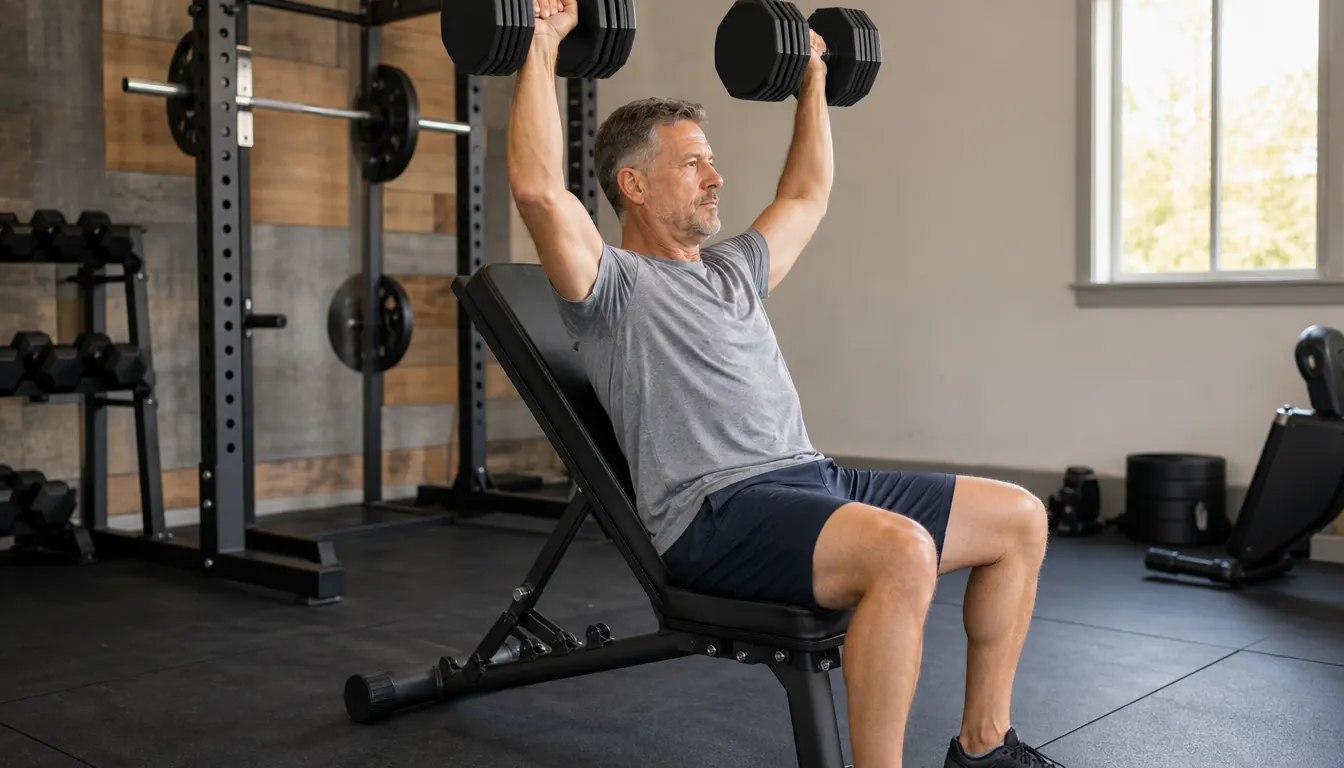
Adjustability is the whole argument. The YOLEO lists 84 positions built from 7 back adjustments, 4 seat adjustments and 3 leg adjustments. In practice that means flat for barbell pressing inside the rack, two or three incline settings for dumbbell press, and a steeper seat angle for one-arm rows and seated curls. My old flat bench did exactly one of those jobs. For two years the dumbbell work happened on the floor with a folded mat under my shoulder blade, which is a poor substitute and hard on the lower back after twenty years of crawling through attics. The first Saturday I owned it, in April 2024, I set the back pad to the second incline notch, pulled the seat pin to the position that keeps my feet flat, and pressed the 25 lb dumbbells for three sets of ten. Sounds like nothing. It was the first incline work I had done at home that did not leave my lower back talking to me the next morning. The seat adjustment matters more than the back pad and nobody tells you that. Set the seat too low and an incline turns into a slide, so the four seat positions are doing real work, not just filling a spec line.
Setup is the second win, and it surprised me more than the adjustability did. YOLEO ships the bench 98% pre-assembled. You open the box, insert two pins, and you are lifting, no tools, no bag of bolts and no instruction sheet in three languages. I had it out of the carton and inside the rack faster than it takes to make coffee. The capacity holds up too: ASTM-certified to 827 lbs with a 330 lb maximum user weight. That is more bench than a lifter at my level will ever ask of it, and it is on a spec sheet rather than guessed at.
Where the Flat Bench Wins
Rigidity, and I will not pretend otherwise. Every hinge is a place where a bench can move a little under load. A welded flat bench has none of those joints. My hand-me-down cost me nothing and behaved like it: a steel tube frame with bolts that would not stay tight, and a habit of walking two or three inches to the right every time I racked the bar. I tightened those bolts four times over two years with a socket wrench before I quit trying. The wobble was never dangerous at the weights I press, but it was a small distraction on every single rep, and a small distraction on every rep is how form goes. A heavy steel flat bench built as one piece will feel deader under a loaded bar than anything that adjusts. At 23.2 lbs the YOLEO is light, and light is convenient right up until you are close to your limit and want the bench to feel like it grew out of the floor. I can feel a bit of give at the hinge when I set up on it. Not much. But I know it is there, and on flat barbell days I notice.
Simplicity and cost are the other two. Nothing on a flat bench needs to be checked, seated or re-tightened. You set it down and it is ready, and it is the cheaper buy when the bench is the last item on a long list of gear. A flat bench is also easier to buy secondhand without regret, because there is almost nothing on it to wear out. If you find a solid one at a yard sale, take it and put the money you saved into plates.
If one bench has to do all of it, this is the one that does
The YOLEO Adjustable Weight Bench arrives 98% assembled, is ASTM-certified to 827 lbs and covers flat through incline with three pins. Check today's price on Amazon.
Amazon Check Today's Price on Amazon →How I've Used Both Since April 2024
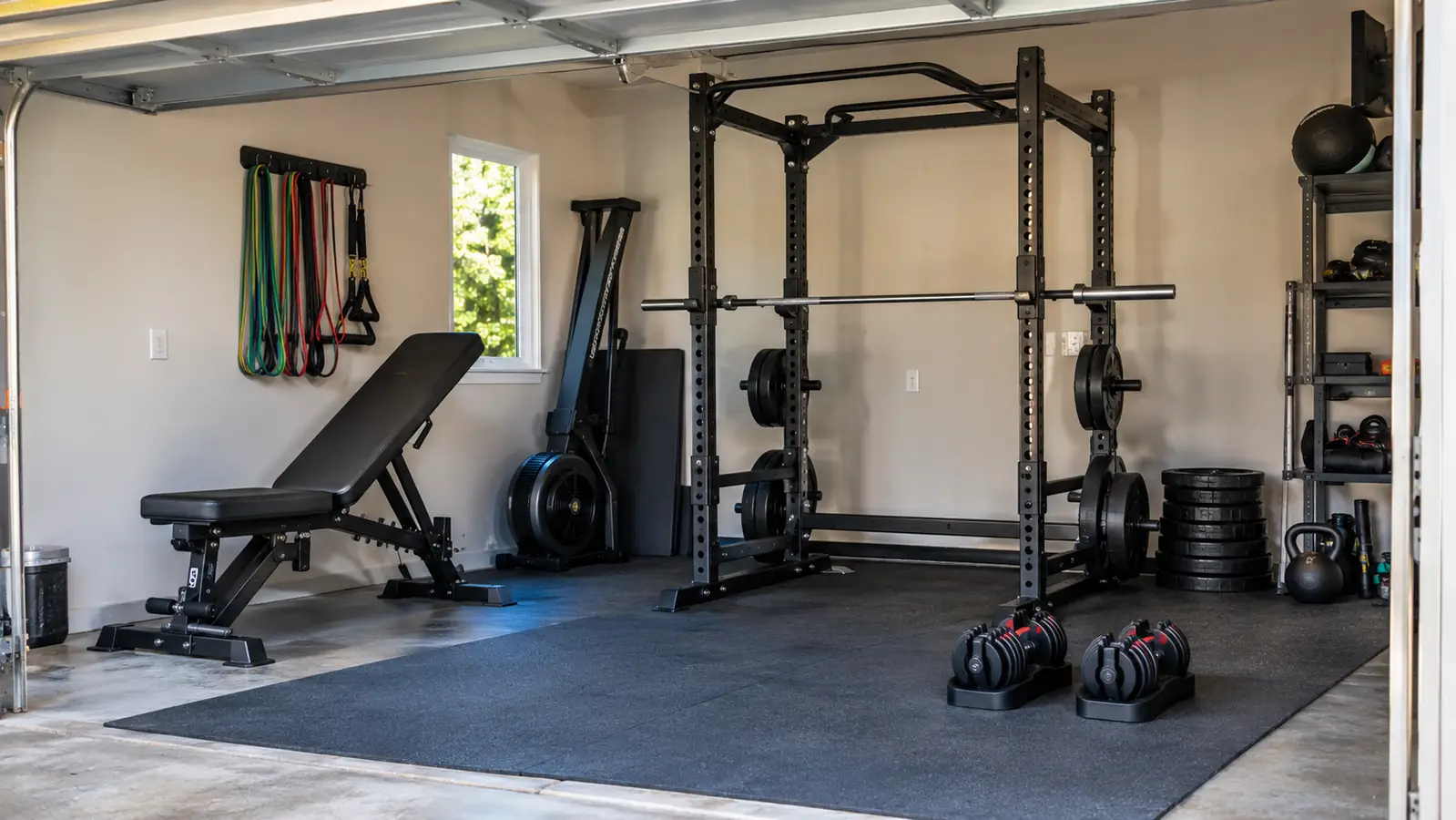
The routine here is four mornings a week, 5:30 to 6:20, before the truck leaves the driveway. Monday and Thursday are barbell days: the YOLEO sits inside the CAP power rack, flat, with the used 7-foot Olympic bar and about 230 lbs of iron I bought off Marketplace in the fall of 2023. Tuesday and one weekend morning are dumbbell and row days, when the bench comes out of the rack and gets its back pad raised. One-arm rows get the flat setting with my free hand braced on the pad. Seated curls get the steepest seat angle, which is thirty seconds of pin work and beats standing in the kitchen doing them. The step-ups are the part a flat bench cannot give me. My left knee has been cranky since the attic seasons, and stepping onto a padded surface at roughly knee height, ten reps each side for three sets, is what keeps it quiet enough to climb ladders all week. A flat bench pad is too narrow and too low to trust for that, and a step stool is a step stool.
Noise is worth mentioning because of the hour. A hinged bench can rattle at the pins if the back and seat are not seated properly, and mine did for about a week. The first time was the second rep of my first set on a Tuesday, still dark out, and it carried straight into the kitchen where Dana was making coffee. The problem was me, not the bench: I had pushed the back pad pin in until it looked seated, which is not seated. Now I push each pin until the click, thumb behind it, and check the seat pin the same way. Two seconds of habit and it has been quiet since. The bench sits on the rubber rolls I laid in October 2023, so what little sound there is dies in the mat instead of ringing off bare concrete.
Condition after eighteen months of daily use: the pads have not split, the hinge points have not developed side-to-side slop, and the pins still seat with a click instead of a rattle. Cole, who is fifteen and thinks every piece of equipment is a climbing frame, has used it for dumbbell work twice a week since last spring and has not managed to break anything. I wipe it down maybe once a month, which is more attention than it needs. The one thing I check now and then is the hardware, because a bench that ships mostly assembled still ships with fasteners, and fasteners work loose. Thirty seconds with a wrench twice a year is the whole maintenance bill.
Eighteen months, four mornings a week, 5:30 to 6:20. The pins still seat with a click instead of a rattle, and I still have not needed a second piece of equipment for the incline work.
The Specs, Read Out Loud
The bench is alloy steel, 41 inches deep, 12.6 inches wide and 42.5 inches tall, at 23.2 lbs. I put a tape on it the week it arrived, mostly because I do not trust any listing until I have measured it myself. Depth came out at 41 inches front to back, which is the same strip of mat the old flat bench used, so the footprint in this bay did not change by an inch. Width at the pad came to 12.6 inches, wide enough that my shoulder blade lands on the pad instead of hanging off the edge, which is the difference between pressing and bracing. Height at full incline came to 42.5 inches, and this bay has an 8 foot ceiling with a pull-up bar hung a bit under it, so there is room to raise the pad without knocking anything. When the truck needs the bay, I shove the bench against the left wall and it takes about four seconds and one hand.
The 827 lb ASTM certification and the 330 lb maximum user weight are the two numbers to keep in mind. Certification means an outside lab tested it rather than the company testing it in-house and printing a big figure. For someone pressing a used Olympic bar and a couple hundred pounds of plates, that is headroom you will never spend. The 84 positions come from 7 back, 4 seat and 3 leg adjustments, and the honest note is that most people will live in three or four of them. That is fine. The rest are there for the day your shoulder or your program changes.
What I Liked
- Arrives 98% pre-assembled, two pins and no tools
- ASTM-certified to 827 lbs with a 330 lb maximum user weight
- 84 positions cover flat, incline, seated work and step-ups
- 23.2 lbs, so it moves out of the way with one hand
Where It Falls Short
- Hinged construction means more to check than a welded flat bench
- You can feel the joints under a heavy bar compared to a heavy steel flat bench
- The pins rattle until you learn to seat them properly
What I Would Do Differently
I would have bought an adjustable bench before I spent two years working around a free one. The hand-me-down flat bench cost nothing and took up the same 41 inches of mat while doing a fraction of the work. Cheap gear is not free if it quietly removes half your training options. That is the trap for anyone setting up a home gym on a budget: the bench looks like the boring purchase next to the rack and the plates, so it gets the leftover money, and then every session is shaped around what the bench cannot do.
The other thing I would do sooner is put something under it. The concrete in this garage was chipping and carrying sound into the kitchen long before I laid the rubber rolls, and a bench on bare concrete is louder than the bench itself deserves. Mats first, then the rack, then the bench. If you buy the bench before the flooring, at least learn where the pins seat so you are not clicking and clacking at 5:30 in the morning with the rest of the house asleep.
Who Should Buy Which
Buy the YOLEO if you have one bench slot and more than one job for it. That is the situation in most garage gyms, basement corners and spare bedrooms: a rack, a barbell, a pair of adjustable dumbbells, and one padded surface that has to press, incline, row and step. It suits anyone who does not want to hand a Saturday to an Allen key, since it arrives nearly built. And the 827 lb rating means you are not going to outgrow it in a year and start shopping again.
Buy a flat bench instead if your training is genuinely one lift. If you press inside a rack, never incline, never row, and you have room to leave a heavy welded bench in place, a flat bench gives you more rigidity and less to check on for less money. That is not a downgrade. It is a narrower tool for a narrower job. The wrong move in either direction is real, though: buying a cheap hinged bench and expecting flat-bench rigidity, or buying a flat bench and then doing dumbbell inclines with a folded towel behind your back for two years, which is exactly what I did.
One bench, one bay, four mornings a week
The YOLEO Adjustable Weight Bench ships 98% assembled, is ASTM-certified to 827 lbs and moves from flat to incline with three pins. Check today's price on Amazon before your next session.
Amazon See Today's Price on Amazon →