
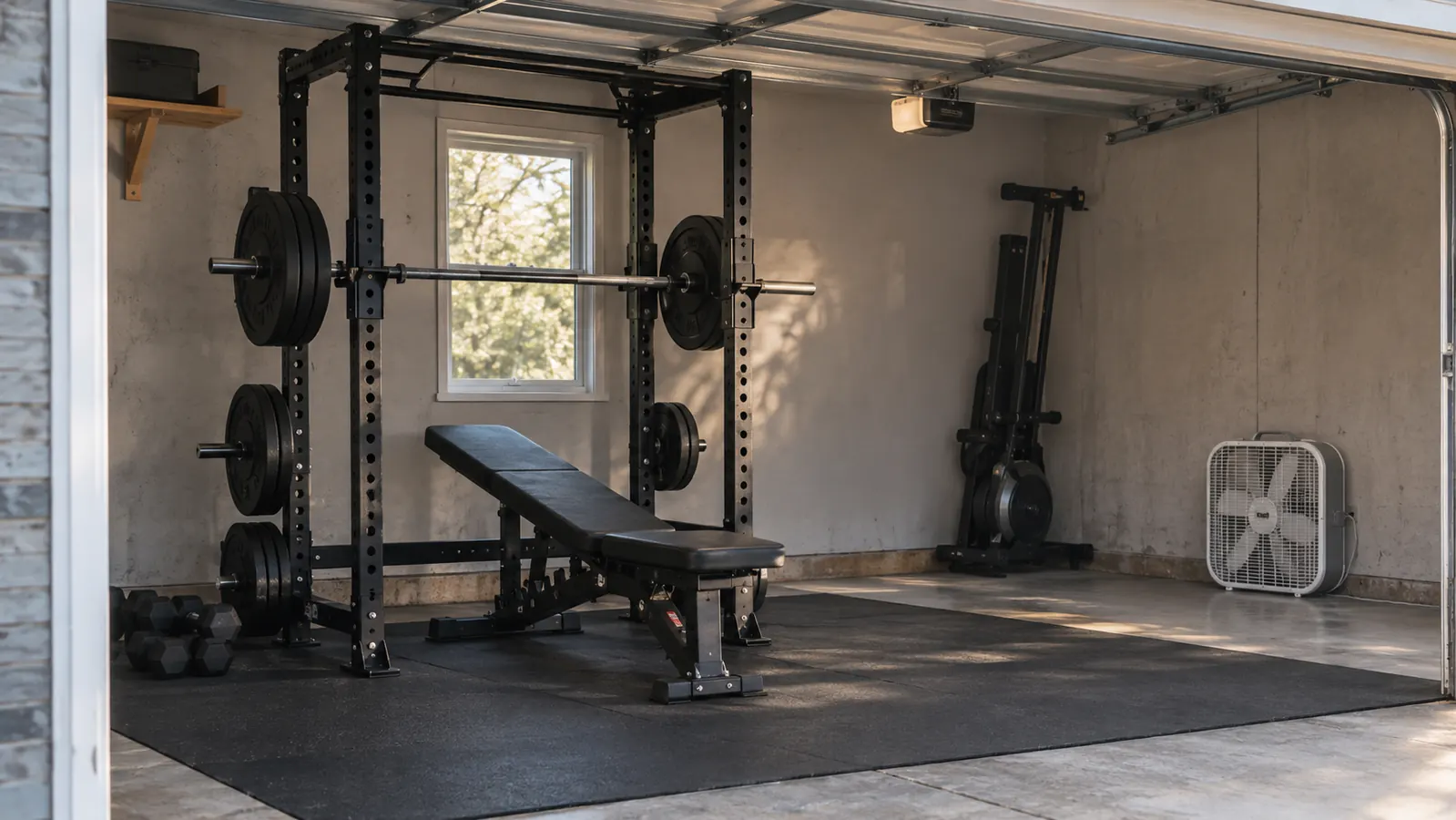
Bare concrete is a good floor right up until the first time you drop a loaded barbell on it. Then it chips at the edge, throws a puff of grey dust across the bay, and makes a noise you can hear from the kitchen. I found that out in October 2023, about a month after I dragged a used 7 foot Olympic bar and 230 lbs of Marketplace iron into the left bay of my garage.
The fix was the IncStores Tough Rubber Roll, 3/8 inch thick, two 4 by 10 foot rolls laid side by side under the rack and the bench. That was two years ago. The floor has been down through four mornings a week of lifting, two winters, one dropped 45 lb plate I would rather not talk about, and a left knee that stopped enjoying jumps somewhere around 44. What follows is the order I would do it in again, including the two steps I nearly skipped and should not have.
The 3/8 inch roll that sat under two years of dropped plates
The IncStores Tough Rubber Roll comes 4 feet wide and 10 feet long, 3/8 inch thick, 40 sq ft per roll. Two rolls covered my 8 by 10 foot lifting area with a single seam down the middle. Solid rubber, shock absorbing, five year warranty, wipe clean with a damp cloth.
Amazon Check Today's Price on Amazon →The Five Steps, in Order
Step 1: Measure the Bay, Not the Whole Garage
My bay is roughly 11 by 20 feet with an 8 foot ceiling. The truck lives in the right bay, so the left bay is mine. My first instinct was to cover every square foot of it, which would have meant five rolls and a floor I still had to sweep around tires twice a week.
What I actually needed was coverage where weight lands. The rack and the bench sit in an 8 by 10 foot footprint in the middle of the bay. Two 4 by 10 foot rolls side by side give exactly that, 80 sq ft total, with one seam running down the middle. The rower sits on bare concrete next to the mats, and that is on purpose. It is light, it does not get dropped, and I wanted some exposed slab so I could tell what the floor was doing in humid weather.
I measured that bay four times over two evenings because the first two numbers did not agree. Eleven feet two inches at the door, ten feet nine at the back wall, twenty feet one inch deep. None of it mattered once I decided the floor only had to cover the middle. What mattered was that a 4 foot wide roll fits inside a 10 foot 9 inch width with room left over, and two of them side by side gave me the 8 by 10 footprint under the rack without a single cut. If your bay is narrower than about 10 feet 4 inches, plan on trimming, and trim the wall side where nobody looks.
Measure twice with a tape, mark the corners with chalk, and leave a couple of inches of bare slab along the walls. Rubber does not need to be tucked under baseboard. A tight fit against three walls will hump up in the middle the first time the garage gets hot in July.
Step 2: Match the Thickness to What You Drop
IncStores makes this roll in a few thicknesses. 1/4 inch for lighter setups. 1/2 inch and 3/4 inch for horse stalls, commercial gyms and heavy loads. I went 3/8 inch, because the heaviest thing in my bay is a barbell with 230 lbs on it and the loudest thing is that same barbell coming down from waist height.
The 3/8 inch roll measures 0.38 inches thick, 48 inches wide and 120 inches long. It is solid rubber and it is shock absorbing, which is the entire point of the exercise. It kills the ring of a dropped plate and it stops the plate from taking a bite out of the slab. What it does not do is turn a garage into a quiet room. My wife could still hear plates land from the kitchen. She just stopped hearing them in the living room.
If your garage setup is a bench and a pair of adjustable dumbbells, 1/4 inch would probably be plenty and cheaper. If you are rolling a loaded implement across it daily, you want 1/2 inch or better. The common mistake is buying the thinnest thing that looks like a gym floor and then wondering why the ends curl and the seam never quite sits down.
The 45 lb plate is the real test. Dropped flat from waist height onto bare concrete, it chips the slab and rings through the house. Dropped onto 3/8 inch rubber, it lands with a thud and stays where it lands. That is the whole difference, and it is worth understanding before you buy. The mat does not stop the weight. It spreads the hit over a wider area and takes the abrasion so the concrete does not have to. Two winters in, the rubber under my rack has a couple of shallow dents where plates land most often. The slab underneath is untouched.
Step 3: Fix the Slab Before the Rubber Goes Down
This is the step people skip and it is the one that decides whether the floor lasts two years or ten. Rubber is a vapor barrier whether you want it to be or not. Whatever moisture is in the slab stays under the mat and goes to work on the concrete.
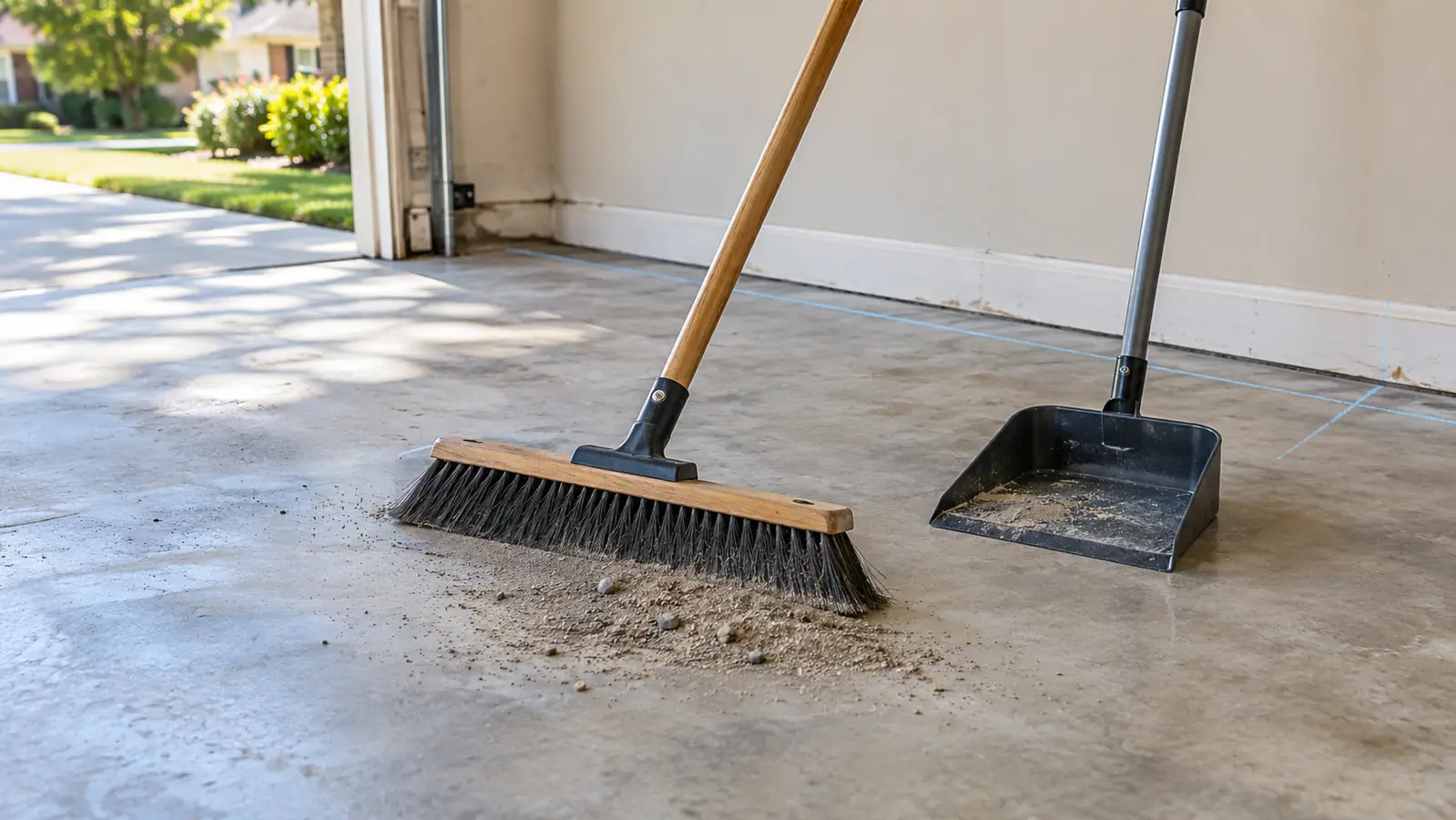
Sweep the bay out completely, twice, and get the concrete dust out of the corners. Then knock off any high spots and fill the spalled edges where old plates have already taken bites. A cheap trowel patch from the hardware store handles that. Let it cure per the bucket before you cover it, and do not rush this because you are excited about the mats.
Then test for moisture the dumb way. Tape a 2 foot square of clear plastic to the slab, leave it overnight, and look at the underside in the morning. Beads of water mean the slab is still passing moisture and you have a drainage question to answer before any roll goes down. A slightly cloudy patch is normal. Standing water is not. I did this test on a Tuesday and it cost me one sheet of plastic and one day of waiting.
Two years of dropped plates later, the concrete under the rack still has the same surface it had the day the slab was poured. The mats took the damage instead.
Step 4: Unroll It, Let It Relax, Then Cut
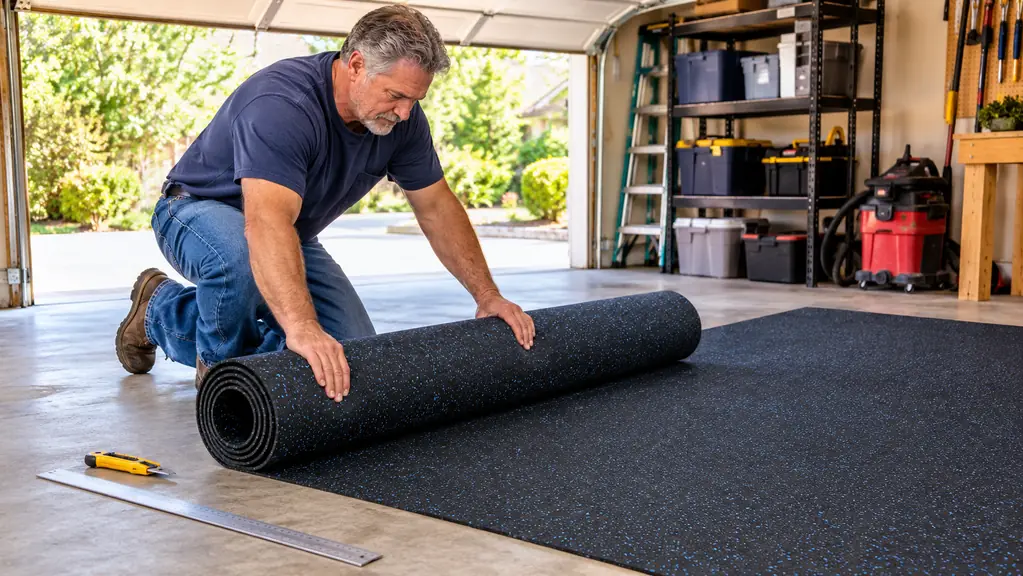
Both rolls came banded and heavy, and I dragged them one at a time through the garage door on a hand truck rather than trying to carry them. The first went down across the bay, the second butted against it. That first afternoon the rubber was still remembering the roll and the ends lifted a couple of inches. I put a spare plate on each corner and left it. By the next morning it was flat. If you lay this in cold weather, give it two days instead of one, because cold rubber takes longer to relax and cutting it early is how you end up with a floor that never sits right.
A roll comes tight from the warehouse. If you cut it the afternoon it lands on your driveway, you will spend the next month fighting a floor that wants to roll back up at both ends. I unrolled both rolls in the bay, roughly where they were going to live, and left them alone for a day with the garage door open.
The smell is real for the first few weeks. It is rubber, it off gasses, and the answer is air. I ran a box fan in the doorway for about a week and the garage smelled like a tire store for maybe three weeks. Then it faded and never came back. If you lay this in a closed garage in August with no ventilation and then complain about the smell, that is a ventilation problem, not a product problem.
Cut with a straight edge and a fresh utility knife blade. Score it and snap it rather than trying to saw through in one pass. Butt the long seam tight against the second roll. Two years on, my seam has not opened. I never taped it, though a strip of double sided carpet tape under the seam will keep it from wandering while you get weight on the floor.
Step 5: Load It Up and Check Back in a Month
I set the rack on top of the mats and bolted nothing to the floor. The rack is heavy, it sits flat on rubber, and it has not walked an inch in two years. The bench sits inside the rack. The dumbbells live on their trays on the floor beside it. Nothing has shifted enough to notice.
A month in, walk the seams with your hand. Check the edges along the walls for curling and vacuum out the grit that collects around the rack feet. Grit trapped under a rubber mat is what wears the mat, not the weights. That was the one thing nobody told me.
At the one month check I found two things. The seam had not moved, but grit had collected along it, fine grey dust that worked up through the joint. A vacuum with a crevice tool took care of it. The other thing was at the rack feet, where four small piles of concrete dust had appeared. That worried me until I worked out it was dust from the slab that had been under the rack before the mats went down and had nowhere to go. I swept it out, set the rack back, and it never came back. Check yours the same way, and do not assume the worst.
Cleaning is a damp cloth, per IncStores. I use a shop vac and a mild soap and water mop twice a year and nothing stronger. Solvents will break rubber down over time and there is no reason to find out how quickly.
What Else Helps
Ventilation comes first. A garage with the door shut and a space heater running gets damp, and damp is the enemy of anything you put on a slab. I keep a box fan by the window and crack the door when I am not out there. In winter the small heater runs twenty minutes before I lift and gets shut off after, and the fan moves the air back out.
A rubber lip or a threshold at the garage door keeps winter grit and blown rain from running under the mats. A cheap shop vac in the corner pays for itself in a year. And if your slab already has a crack with a real lip to it, address that first. No roll of rubber will make a heaving floor flat.
One more thing that helped me: leave yourself a strip of bare concrete as a tell. When the exposed slab by the wall starts sweating in the spring, you know the humidity is up and it is a good day to open the door and run the fan. You cannot read that from a floor that is covered wall to wall.
What This Won't Fix
It will not warm the garage, it will not soundproof it, and it will not turn a bare slab into a competition platform. If you are dropping heavy barbells from overhead on a regular basis, 3/8 inch is a good floor but a proper lifting platform is a better one. The rubber is there to protect the concrete, not to let you be careless with it.
It also will not fix a slab that is actively passing water. That is a drainage question and a rubber floor will quietly hide it while it gets worse. Test with the plastic sheet first, then buy.
If you are going to do this once, do it with a roll that stays flat
The IncStores Tough Rubber Roll in 3/8 inch, 4 by 10 foot, covers 40 sq ft per roll and carries a five year warranty. Two rolls handled my rack, my bench and every plate I have dropped on them, and the concrete underneath still looks like concrete.
Amazon Check Today's Price on Amazon →