
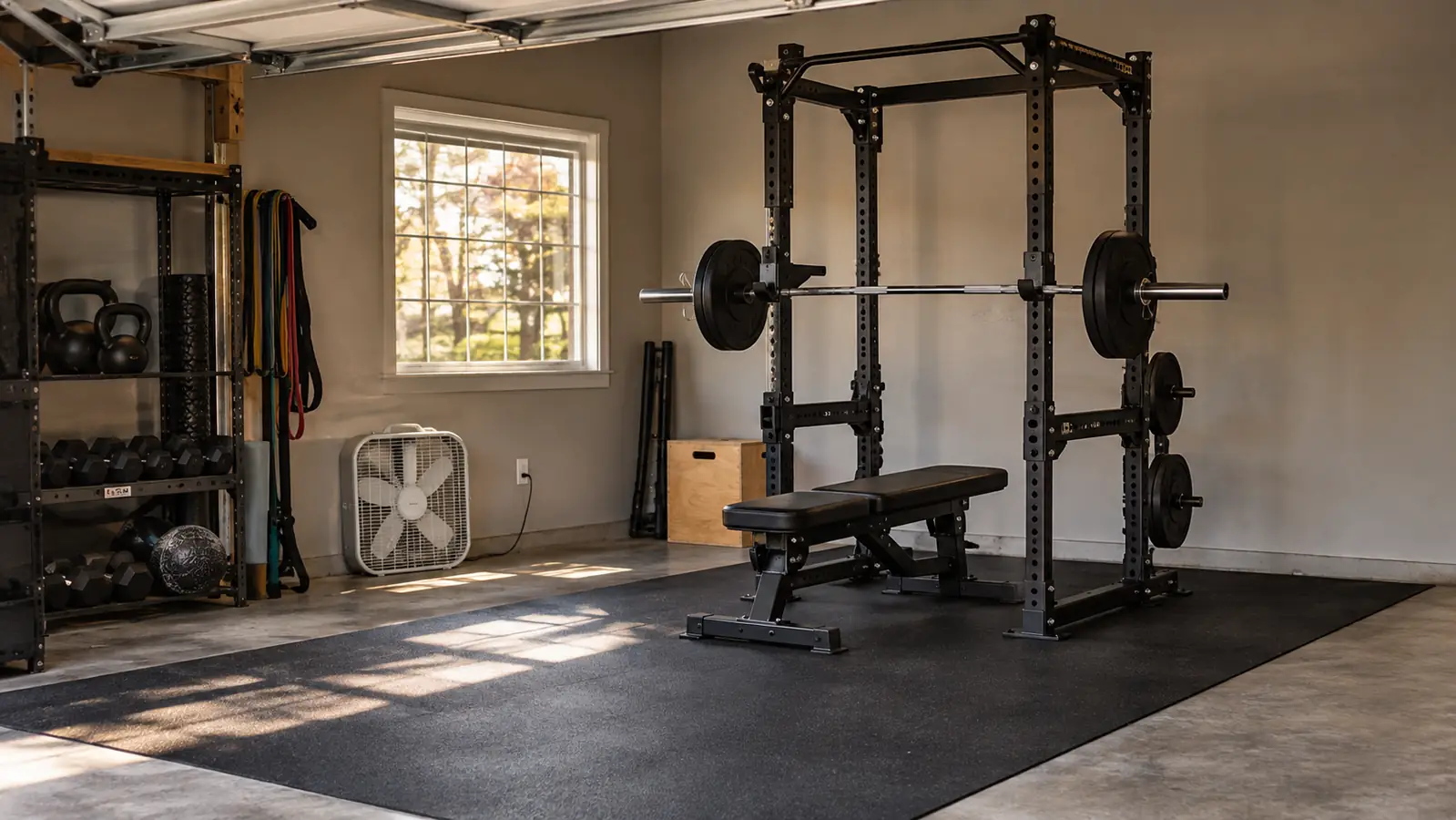
I bought the IncStores Tough Rubber Roll in October 2023. Two rolls, each 4 feet by 10 feet and 3/8 inch thick, laid side by side under my rack to make an 8 by 10 foot lifting area in the left bay of my garage. Two years of dropped plates later, they are still there, still flat, still doing the job. This is the version of the review I wanted to read before I ordered, which means it covers the smell, the weight, the seam down the middle and the parts of the listing that are technically true but easy to misread.
Here is the short version. The rolls do the two jobs I bought them for. They keep the concrete from chipping when a missed rep lands, and they take the hard edge off the noise that used to carry into the kitchen at 6 in the morning. What they do not do is turn a garage into a quiet room, and no rubber at this thickness will. If you are expecting silence, you will be disappointed by this product and by every product like it, IncStores included.
The Quick Verdict
Honest flooring for a home gym. Do the square footage math before you order, plan for two people to move it, and give it a few weeks to air out. Firm enough for barbells, not a cushioned mat.
Amazon Check Today's Price →Why I ordered two rolls instead of one big mat
A single 4 by 10 foot roll covers 40 square feet. I needed 80, so I ordered two and lived with the seam. Check the current sizes and thicknesses before you measure your bay.
Amazon Check Today's Price on Amazon →How I've Used It
The bay is roughly 11 by 20 feet with a bare concrete floor. My bar and plates sit on the mats, the rack sits on the mats, and the bench goes inside the rack. The rower stays on the bare concrete to the side, because that is where it fits when the truck is parked. So this is not a review written from a commercial gym with thousands of square feet of flooring. It is one guy with 80 square feet of rubber and a habit of missing reps.
Laying it was a two person job and I did it with my son Cole on a Saturday morning. Each roll is 120 inches long and 48 inches wide, and rubber at this thickness does not want to lie flat the minute you unroll it. We rolled them out, let them sit in the sun for a few hours, then walked the edges down. The corners stayed a little proud for about a week before they settled.
We laid them on a Saturday, the 21st of October. The first night I put the rack back on top of them and did a light session just to see how they felt underfoot, and the answer was basically like concrete with a little give. What I did not expect was how much quieter the rack sounded when I racked a squat, because the vibration that used to run through the slab was going into the rubber instead. That was the first time I thought the purchase might actually work out.
I did not glue anything down and I did not tape the seam. Two years in, nothing has shifted more than a fraction of an inch, and I move the bench and the rower around constantly. That tells you something about the grip on the underside. It also tells you that if you are the type to drag a loaded rack across the floor, you should still check it now and then.

What the Listing Does Not Tell You
The listing says this roll delivers 40 square feet. That is correct, and it is also the number people get wrong when they order. A 4 by 10 foot roll is 40 square feet, so an 8 by 10 foot area takes two rolls. If your space is 10 by 12, you are looking at three rolls for full coverage, because you do not trim a 4 foot roll down to a 2 foot strip without throwing away most of what you bought. Measure twice, sketch it on paper, then order.
Nobody mentions the weight. A roll this size is heavy enough that dragging it across a garage by yourself will scuff the concrete and tweak your back. Plan on a second person, and plan on sliding it rather than lifting it. I moved mine off the truck with Cole and a hand truck and it was still the worst part of the day.
The delivery was its own afternoon. The rolls came on a pallet and the driver would not bring it up the driveway, so Cole and I broke the pallet down where it sat and moved the rolls one at a time, about 60 feet, with a hand truck for most of it and by hand for the last few feet through the garage door. Have yours dropped as close to the door as the driver will allow, because there is no good way to walk a 10 foot roll through a house and around a corner.
Then there is the smell. Mine had a strong rubber odor for the first couple of weeks. I left the garage door open during the day and it faded. By the end of the first month I could not smell it standing on top of it. If your gym is a spare bedroom with the door shut, budget more time, not less.
The last thing a listing cannot describe is how the material behaves under a heavy bar. It has a little give at 3/8 inch, enough that a dropped plate thuds instead of cracking, but not so much that the rack rocks when I rerack a squat. That balance is the whole reason I am still using it.
Noise, Vibration and the Concrete Underneath
The reason I bought flooring at all was noise. My neighbor's bedroom window is maybe 30 feet from my garage door, and my family sleeps on the other side of a wall. Before the mats, a dropped deadlift at 6 AM sounded like a car door slamming inside the house. After the mats, it sounds like a heavy book landing on a table. That is a real improvement and I would buy them again for that alone.
In the first week I tested it, mostly because I did not believe the mats would be enough on their own. I set an empty bar down from waist height, then a bar loaded to 135 lbs, and had Dana stand in the kitchen with the door shut while I did it. Her report was that the empty bar disappeared and the loaded bar sounded like something being set down hard in the next room rather than something being dropped. That is a small distinction and it is the whole reason the mats stayed.
But be honest about the ceiling of what rubber does. It absorbs impact and it kills the sharp crack. It does not stop low frequency thud from traveling through a slab. If your bar comes down hard and your garage shares a foundation with the house, you will still hear it in the next room. The mats change the character of the noise. They do not remove it, and anyone who tells you otherwise is selling something.
Same story with the equipment itself. The rack sits on the mats and does not walk, and the bench does not slide when I set up for a press. That is what shock absorbing means in practice at this thickness. It is not a floating floor and it was never advertised as one.
Before the mats, a dropped deadlift at 6 AM sounded like a car door slamming inside the house. After the mats, it sounds like a heavy book landing on a table.
The Seam, the Edges and Cutting the Stuff
Two rolls side by side means one seam runs the length of the lifting area, right about where I stand for deadlifts. It has not been a problem. The edges butt up close enough that a plate does not catch and I have never caught a toe in it. But it is there, and if you are the sort of person who will stare at a narrow gap every session, order a single wider roll or accept that the seam is part of the deal.
I trimmed the second roll on the wall side, maybe two inches, because the bay is not square and the wall bows about that much near the garage door. That is the one cut worth measuring three times, and I did it off a chalk line so I only had one shot at getting it straight. The edge came out clean enough that I never bothered to cover it with trim. The first roll I did not cut at all, since 10 feet fit the depth of the bay once I pulled the rack forward a little.
Cutting this material is not hard but it is not fun either. A sharp utility blade and a straight edge work, and you want to score it and go back over the cut two or three times rather than trying to push through in one pass. Warm rubber cuts cleaner than cold rubber, so if you are working in a January garage, bring the roll inside the night before.
The edges along the walls in my bay are not fastened down and they have not curled up. That surprised me. The only spots that have lifted at all are two corners where the rolls meet the wall, and we are talking about an eighth of an inch after two winters with a space heater running in that corner.
Thickness Choices and What 3/8 Inch Actually Means
This is the part of the IncStores lineup that trips people up. The same product family comes in 1/4 inch for lighter setups, 3/8 inch for general fitness flooring, and 1/2 inch or 3/4 inch for commercial gyms, horse stalls and heavy loads. The 3/8 inch roll I bought is the middle of that range, which is exactly why I picked it and exactly why it is not the right answer for everybody.
If all you do is bodyweight work, bands and a pair of adjustable dumbbells, 1/4 inch will cover you, weigh less and be easier to handle. If you drop loaded barbells from overhead on a regular basis, 3/8 inch is the floor of what I would personally trust, and I would think hard about stepping up to 1/2 inch over a wood subfloor or a second story room. Anything thicker than that belongs in a stable or a commercial gym, not a one car bay.
One more thing about thickness. It changes how the floor feels underfoot. At 3/8 inch you can still feel the concrete through it when you stand on one leg, and that is fine for lifting. Some people want more cushion for kettlebell work or stretching on the floor. Those people should look at interlocking tiles instead of a roll, because a roll this size is a commitment and you are not going to reconfigure it every season.
Alternatives I Considered
The other serious option was horse stall mats from the farm supply store. They are heavy, they are cheap relative to a roll, and plenty of people build whole gyms out of them. What talked me out of it was the seams. You end up with a grid of edges and a few of them never sit perfectly flush, and I did not want to be chasing a corner that lifted while I was setting up for a squat. The roll gives you one continuous surface per piece, which is the thing I was actually paying for.
Foam tiles were never on the table. They are fine for floor work and useless under a barbell. I also looked at the thinner IncStores roll first and went up one step, mostly because I knew I would be dropping weight on it and I did not want to redo the purchase in a year. Two years later that call looks right.
What I Liked
- One continuous piece per roll, no jigsaw tiles that shift out of line
- 3/8 inch takes the crack out of dropped plates without feeling spongy underfoot
- Stayed flat through two years of daily use, edges have not curled
- Wipes clean with a damp cloth, chalk dust and road salt come right off
- Five year manufacturer warranty listed, longer than I expected at this level
Where It Falls Short
- Strong rubber odor for the first couple of weeks
- Heavy and awkward, a two person job to move and lay
- Two rolls means a seam running down the middle of the platform
- Does not stop low frequency thud from reaching the rest of the house
- You have to plan square footage carefully, roll sizes rarely match a room exactly
Two Years In: Wear, Cleaning and the Smell
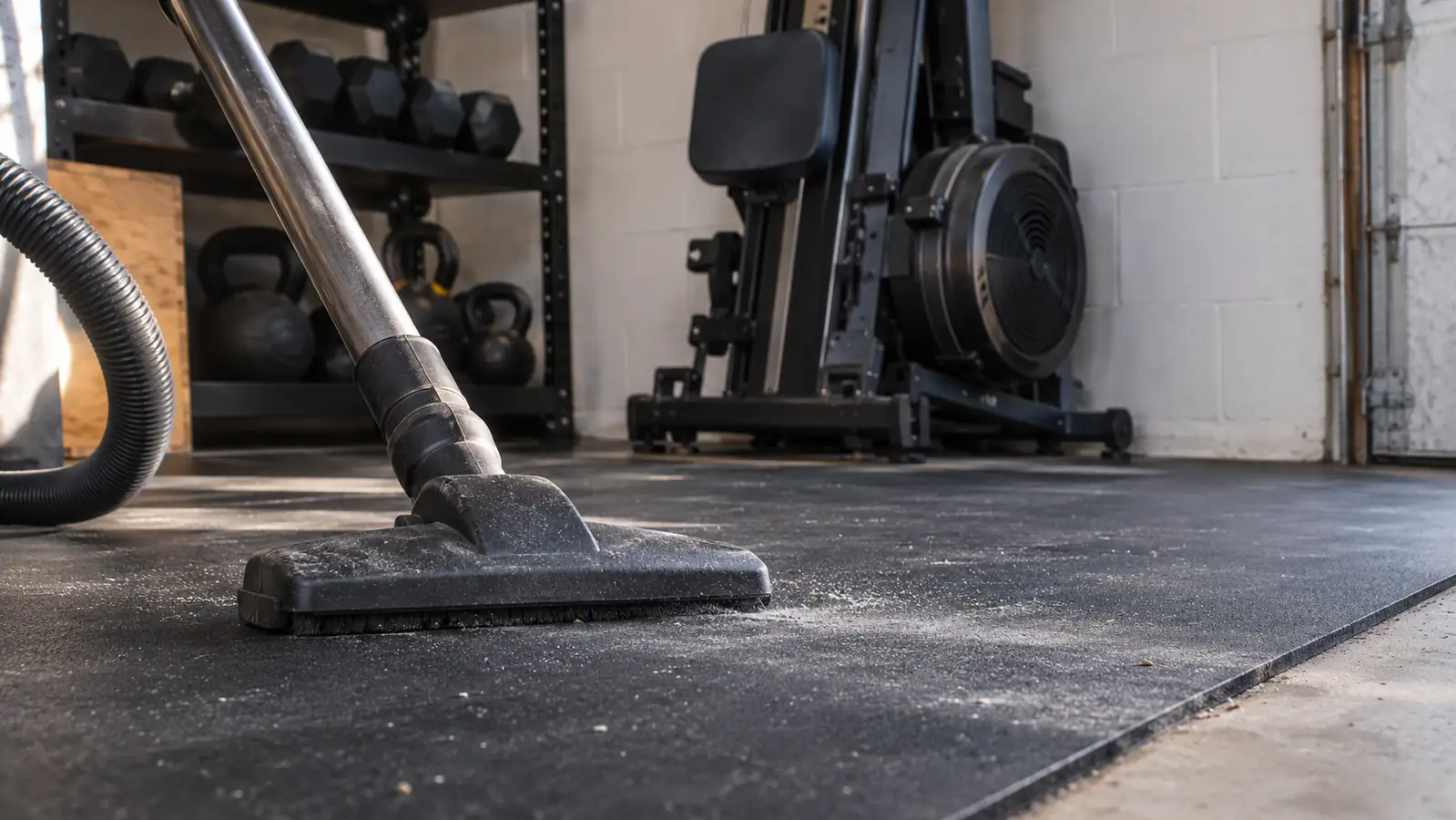
After two years the surface shows use but not damage. There is a scuffed patch where my feet go for deadlifts and a couple of small indentations where the rack feet sit. No tears, no chunks missing, no separation at the seam. I wipe it down with a damp cloth every few weeks and vacuum it more often than that, because chalk dust and road salt off my boots both end up on it.
The smell was the one thing that made me doubt the purchase in week one. It faded completely and I would not factor it into a decision now, but I would factor it into a schedule. Do not lay this on a Sunday night and expect to train in a closed garage on Monday morning.
The listing carries a five year manufacturer warranty. I have not had to use it, so I cannot tell you how a claim goes. Two years is not long enough to prove a floor, but nothing I have seen in that time makes me think it will fail before the warranty runs out.
Who This Is For
This is for the person with a concrete garage bay, a basement slab or a spare room with a hard floor, who is tired of chipped concrete and noise, and who wants one flat surface they never have to reassemble. It suits a barbell setup, a rack, a bench and a rower. It suits someone who measures the space first and orders rolls to match. If that is you, IncStores makes a straightforward product that has held up under my bar for two years without any attention from me.
Who Should Skip It
Skip it if your space is small and awkward, because cutting a 40 square foot roll down to a 5 by 6 foot corner wastes most of what you paid for. Skip it if you want cushion for stretching and floor work, since a roll this firm is not a mat you sit on. Skip it if you are renting and cannot leave anything behind, or if your gym is a carpeted upstairs bedroom. Skip it too if you want quiet rather than quieter, because nothing at this thickness delivers that and I would rather tell you now than have you find out in week one.
Measure the bay, then order the roll
Two 4 by 10 foot rolls covered my 8 by 10 foot platform and left me with one seam to live with. Check the current sizes, thicknesses and warranty terms before you commit.
Amazon Check Today's Price on Amazon →