
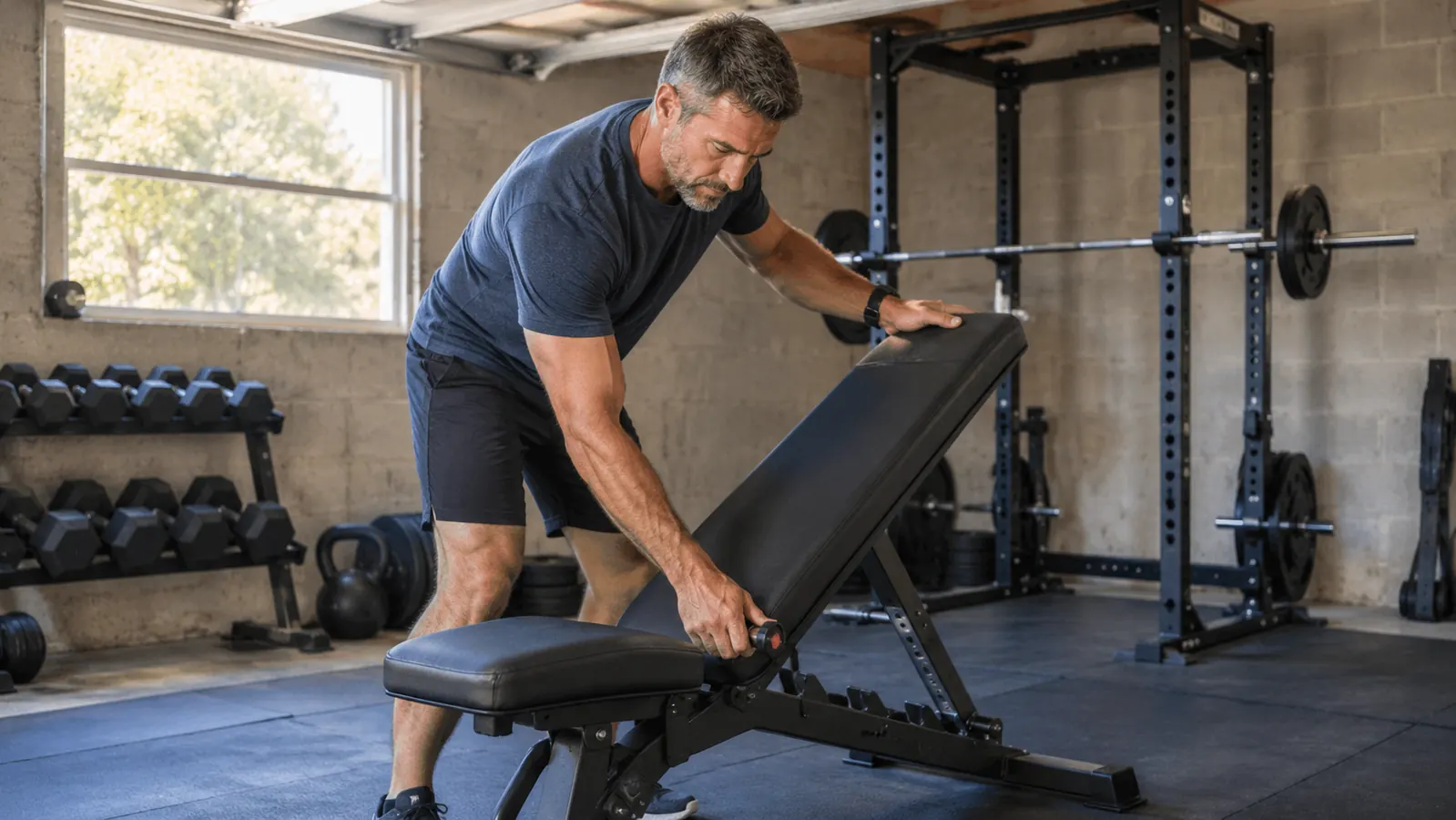
The useful part of a bench review starts around month four, and almost nobody writes it. I put the YOLEO adjustable weight bench in the left bay of my garage in April 2024. It replaced a hand-me-down flat bench that had a rock in one foot, and once you notice a rock you cannot un-notice it, especially with a loaded bar over your chest. A year and a half later, four mornings a week, here is the version of this review I would want if I were the one shopping.
The short answer up front: the YOLEO bench does the job it is sold to do, and it does it with less fuss than most benches in its class. The longer answer is that a few of the complaints you will read online are real, a few are not, and the ones that are real do not show up in the first week. That gap between week one and month eighteen is what this piece is about.
The Quick Verdict
A stable, near-fully-assembled adjustable bench that has handled daily garage use without loosening. Buy it for the frame and the position count. Think twice if you change angles constantly mid-session.
Amazon Check Today's Price →The frame is why you buy this bench. The pin is why you think twice.
Independently certified to 827 pounds, 23.2 pounds of steel you can carry with one hand, and out of the box in about five seconds. Everything else is detail.
Amazon Check Today's Price on Amazon →What Nobody Tells You Before You Buy
The listing says 98 percent pre-assembled and that you will be lifting in five seconds. That is close to true, and it is also the first place a buyer can get surprised. The YOLEO arrives in one box, you open it, you insert two pins, and it is done. No tools. What the listing does not say is that nearly assembled means you do not get to look at how the joints went together. On a bench I built myself I know where every bolt is and how tight it was. Here I took the frame out of the box, looked it over once from arm's length, and trusted the factory. That turned out to be the right call, because nothing has loosened in eighteen months, but you should know you are buying someone else's assembly rather than doing your own.
The box itself is not the problem. At 23.2 pounds it is a one-person carry from the driveway to the garage, which is a sentence I could not honestly write about the power rack. What surprised me was how little there was to do once it was open. I had set aside a Saturday morning out of habit. I used about four minutes of it. If you have ever spent an afternoon with an Allen key and a bag of bolts that came up one short, you will understand why that matters more than it sounds like it should.
Eighty four adjustable positions sounds like something you will use. It is a multiplication, not a menu. The bench has seven back positions, four seat positions and three leg positions, and the marketing department did the arithmetic. In a year and a half I have used three of them: flat for bench press, one notch up for incline dumbbell work, and a steeper setting for the seated rows I do on the mornings my knee is complaining. That is not a knock on the bench. It is a knock on how benches get sold. If you are picturing yourself cycling through dozens of angles, you are picturing something nobody does. If you want a bench that will hit the three or four angles your program actually calls for, this one covers them and then some.
How I've Actually Used It, Week to Week
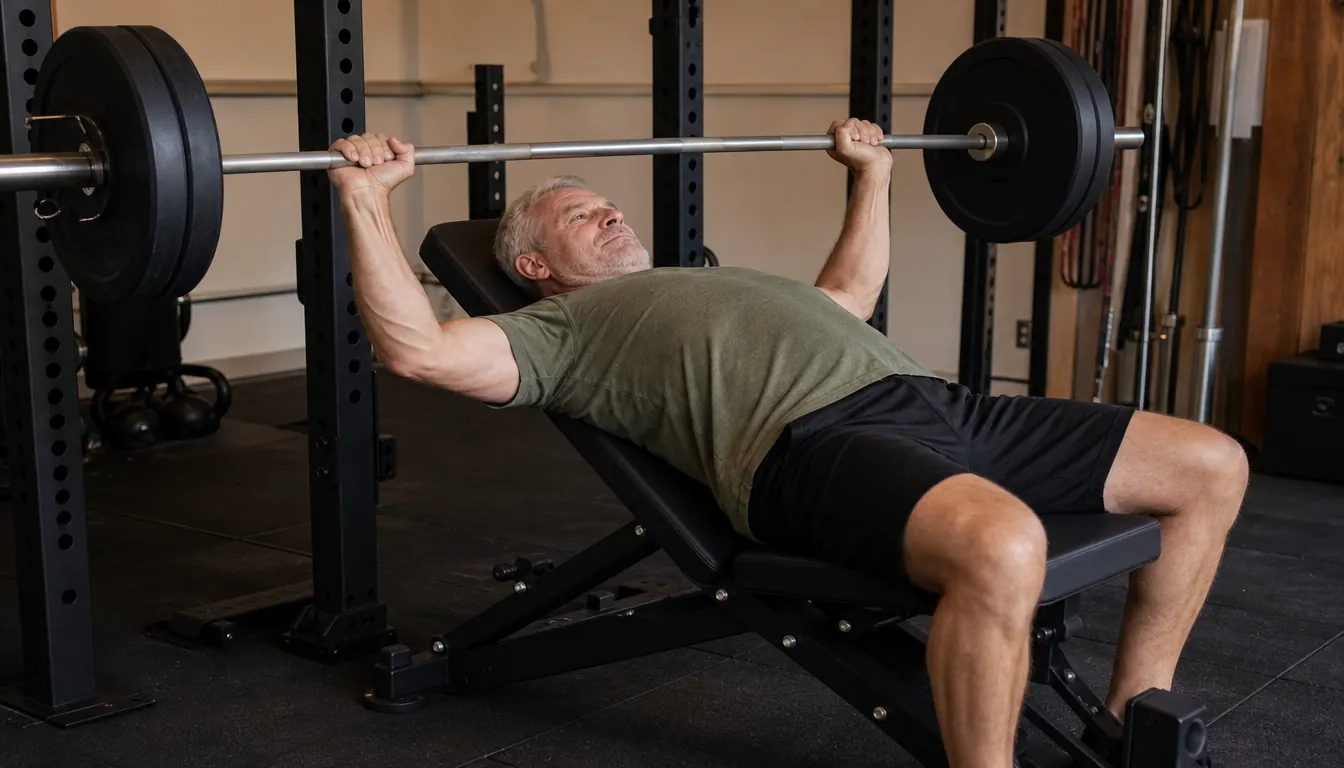
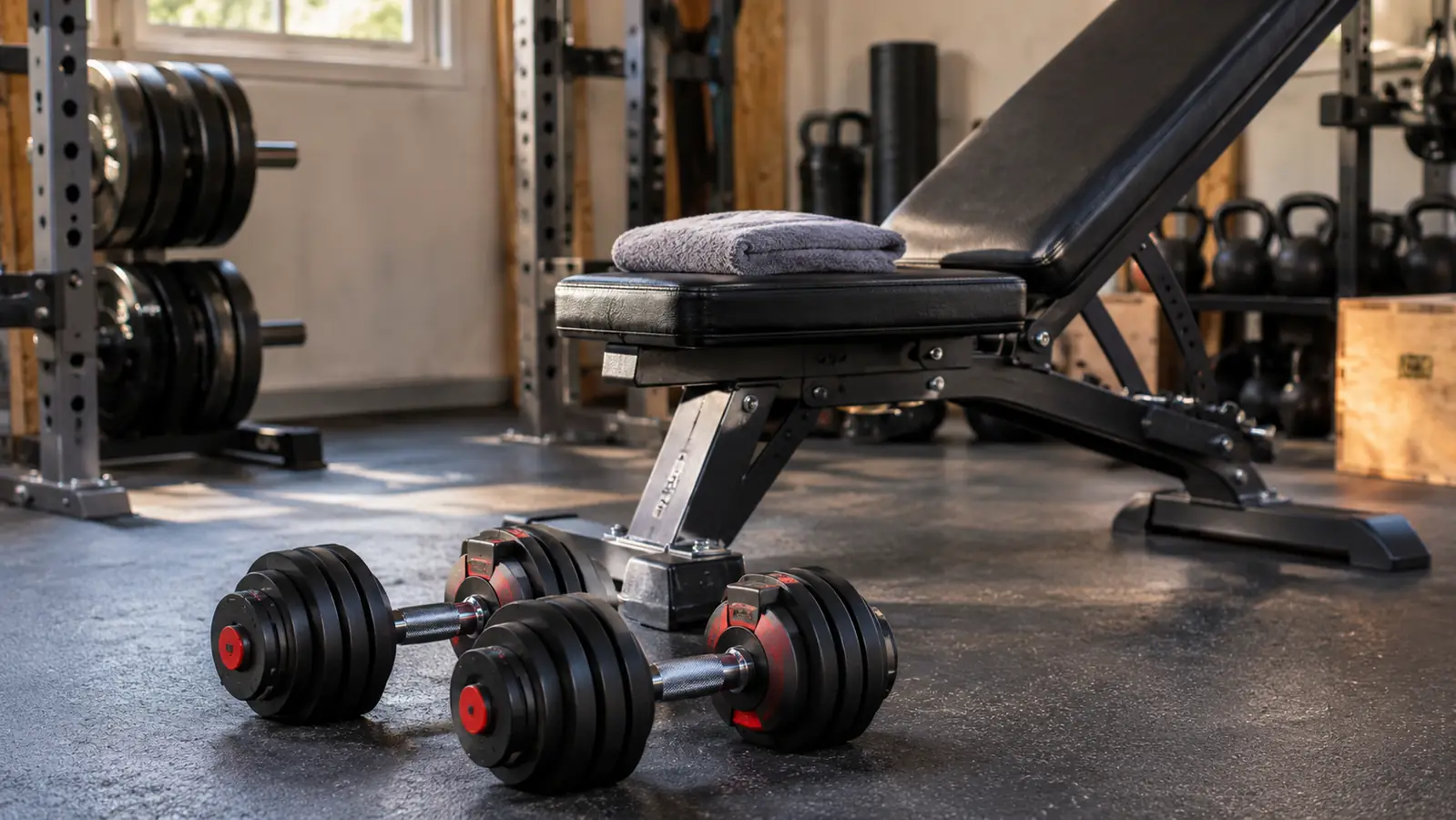
I lift four mornings a week, 5:30 to 6:20, before I leave for work. The bench gets used on three of those mornings. Bench press happens inside the rack, with the bench pulled into the uprights and my feet planted on the rubber mat. The other sessions are dumbbell work: incline press with the pair of adjustable dumbbells I keep on the floor beside it, and one-arm rows with a hand on the pad for support. I also use it for step-ups, which is the one thing my left knee tolerates well after twenty years of crawling through attics. My son Cole, fifteen, uses it more than I expected, mostly for incline work between the rowing he does on the other side of the garage.
Changing the back angle is a two-step job. You pull a pin, lift the back pad to the notch you want, and set the pin again. It takes a few seconds once you know the bench. It takes more than a few when you are doing it between sets with your heart rate up and chalk on your hands. That is the honest tradeoff of a pin-adjusted bench at this size, and it is why I set the angle before I start a block rather than switching mid-session. The seat adjusts the same way. The leg attachment has three positions, and I found mine in the first week and have not moved it since.
Before I bought this one I tried to save the old bench twice. The first attempt was a folded towel under the short foot. It worked for about a week, then compressed down to nothing. The second was a shim cut from a scrap of the rubber flooring, which lasted longer, until it slid out one morning mid-set and dumped me sideways with 135 pounds over my chest. That was the end of that experiment. The difference between this bench and that one is not the angle count or the rating. It is that I stopped thinking about the bench at all.
After eighteen months of that routine, here is how it has held up. The pads have not split, cracked or gone shiny in the spots where I sit and where my shoulders land. The frame has not developed a rock or a wobble in the joints. The pin holes have not wallowed out, which is the failure I expected first, because a loose pin in a worn hole is what turns a bench into a bench you do not trust. Nothing has needed tightening. I wipe the pads down every couple of weeks with a damp rag, and that is the entire maintenance history.
The Weight Ratings, Untangled
There are two numbers on this bench and they are not the same number. The frame is rated to 827 pounds, independently tested and certified. The maximum user weight is 330 pounds. Those two figures get used interchangeably in listings and in reviews, and they should not be. The 827 is what the bench will hold. The 330 is the ceiling on the person using it, and if you are anywhere near that line you should be doing heavy pressing in a rack with safeties rather than on any adjustable bench. At about 210 pounds with a working weight well south of the frame rating, I am not close to either edge. If you are a very heavy lifter, the 330 figure is the one that decides whether this bench is even a candidate, and no amount of marketing about the frame number changes that.
I ran those numbers on my own setup once, out of curiosity. Bodyweight around 210, working weight in the low 200s on bench press, which puts somewhere near 420 pounds on the frame during a heavy single. That is half the frame rating, and half is the margin I want on a piece of steel holding me off the floor. The 330 is a separate gate entirely. Weigh 300 pounds and you are comfortably inside the frame rating while sitting outside the user limit, which is exactly the sort of thing having two published numbers is supposed to tell you.
What I Liked
- Out of the box and ready to use with no tools and no assembly session
- Frame has stayed tight and level through eighteen months of four-day weeks
- 827 pound frame rating and 330 pound user limit are published, checkable numbers
- Seven back positions cover flat, low incline and the steeper angles most home programs use
- At 23.2 pounds it is light enough to carry between the rack and the wall
- Padding has held up to daily dumbbell work without splitting or going shiny
Where It Falls Short
- Changing the back or seat angle means pulling and re-seating a pin
- The 84 position figure is arithmetic, not a set of settings you will use
- The pad is firm, and high rep sets will let you know about it
- The leg attachment has three positions and will not suit every shin length
- Moving it is a lift, not a roll, which matters in a tight bay
- At 41 inches front to back it claims real floor space in a small room
The frame is rated to 827 pounds. The number that actually governs your training is 330, the maximum user weight, and the two get blurred together in every listing I have read.
Where It Falls Short
The pin adjustment on the YOLEO is the main thing I would change. On mornings when I superset flat press with incline dumbbell work, I am either changing the angle twice or working around it. A bench with a quicker mechanism would suit that style better. If your program is one angle per session, which mine mostly is, this is a non-issue and you can stop worrying about it.
Wednesday is the morning it bothers me. That is the session where I go from flat press straight into incline dumbbell work, and the change costs more time than the set does. I tried leaving the back flat and doing the incline work standing, which my left shoulder did not care for. I tried flipping the order, which just moved the problem to the other end of the session. What I settled on is flat work first, one pin pull, then stay at the incline for the rest of the morning.
The leg attachment is the second. Three positions is a real limitation if your shins are much shorter or much longer than mine. Cole is a good bit shorter than I am and ends up with the roller in a spot that is not quite right for him in either direction. The pad firmness is a preference rather than a flaw, but this is a firm bench, and if you are doing sets of fifteen or twenty rather than sets of five you will feel it in your tailbone. A folded towel fixes it. That is not something you should have to do on any bench, but it is a small thing and it is honest.
There are two complaints in the reviews that I looked for and did not find on my own bench. The first is a wobble, which I have not had on level concrete with the bench sitting on mats. The second is the pads going soft, which has not happened after eighteen months of four-day weeks. I am not saying those reviews are wrong. A bench is a mechanical object and a bad unit leaves the factory now and then, and the pattern in the complaints reads more like that than like a design flaw.
One practical note on space. Moving it is a lift, not a roll. At 23.2 pounds it is easy for me to pick up and set against the wall when the truck needs the bay, but I am carrying the whole bench, and in a tight space that happens more often than you would think. The footprint is 41 inches front to back and 42.5 inches tall at the highest back setting, so it clears an eight foot garage ceiling with room to spare and sits between the rack and the wall without crowding. If you are working in a spare bedroom instead of a garage, measure that 41 inches against the wall you plan to use before you order.
The Noise Question
A bench that squeaks is a bench your household learns to hate. Mine gets used at 5:30 in the morning in a garage under a bedroom where a fifteen year old is still asleep, so noise is not a small consideration. In eighteen months I have not had a squeak, a creak or a pop out of the joints. What noise there is comes from the plates and the rack, not the bench. If you are on a second floor, that will be a different story, because a bench on carpet over a joist transmits more than one on rubber over concrete, and no bench design fixes that.
One more thing on noise that has nothing to do with the bench. The floor matters more than the equipment. I put down rubber rolls across the whole lifting area the fall before I bought this bench, mostly because dropped plates were chipping the concrete and the sound was carrying into the kitchen. A bench on bare concrete in a closed garage will ring. If you are chasing a quiet setup, budget for the floor before you budget for the bench.
Who This Is For
This bench suits the person I described at the top: someone training three or four mornings a week in a garage, a basement or a spare room, doing barbell work in a rack and dumbbell work on the bench. It suits lifters who set an angle and leave it there. It suits anyone who wants to open a box and train that day rather than spend a Saturday with an Allen key. And it suits a household where two people of different sizes share the equipment, which is exactly what happens here now that Cole trains with me.
Sharing a bench between two people of different sizes is easier than sharing a barbell, it turns out. Cole and I swap the seat height and the leg roller between sets without much fuss, and the pins hold where you put them. The one thing we have not solved is the roller, which fits me and does not quite fit him, so he does his incline work with his feet flat on the floor instead. That is a workaround, not a fix.
It also suits someone who has been putting off buying a bench because the last one they owned was a folding thing that shifted under them. The difference between a bench you trust and a bench you do not is most of the difference between training and not training, in my experience. This one I trust, and I have trusted it with a loaded bar over my face at 5:40 in the morning, which is the only test that counts.
Who Should Skip It
Skip it if you change angles constantly within a session and want that to be a one-hand motion. Skip it if you are near or above the 330 pound maximum user weight, because that number is a limit and not a suggestion. Skip it if you want a leg attachment that genuinely adjusts to your body rather than the other way around. And skip any adjustable bench, this one included, if your main pressing is heavy and you do not have a rack with safeties to do it in. None of that is a knock on the YOLEO. It is a description of the job it was built for, and if your job is different, buy the tool that fits it.
Two pins, a few seconds, eighteen months, and nothing has loosened
827 pound frame rating, 330 pound maximum user weight, seven back positions, 98 percent assembled out of the box. If that matches how you train, it is worth a look at today's price.
Amazon Check Today's Price on Amazon →